
the-diner-secret-inside-the-photo
A Terrified 6-Year-Old Girl Ran Into A Diner And Begged Me To Pretend I Was Her Father… But The Crumpled Photo She Dropped Revealed A Secret I Wasn’t Ready For
CHAPTER 1
The rain in rural Pennsylvania doesn’t just fall; it assaults the earth. It was coming down in thick, freezing sheets that night, rattling against the large plate-glass windows of Hank’s Route 6 Diner. It was the kind of storm that made you want to pull over, grab a mug of terrible black coffee, and wait for the world to stop feeling like it was washing away.
I was sitting on a red vinyl stool at the far end of the counter, keeping to myself. My name is Elias. I’m forty-eight years old, pushing two hundred and fifty pounds, and I look exactly like what I am: a guy who has spent the last twenty years riding a Harley across the country, building engines, and avoiding complicated people. My leather cut was heavy and wet, my beard was tangled from the wind, and my arms are covered in thick, faded ink. I’m used to the way people look at me. It’s always a mixture of caution and mild disapproval. That’s fine by me. I prefer the quiet space it creates.
The diner was packed. There were long-haul truckers trying to stay awake, a few miserable-looking families trapped on road trips, and locals escaping the chill. The air was thick with the smell of frying bacon, wet wool, and burnt coffee. It was loud, too—a steady hum of conversation, the clattering of silverware, and the jukebox in the corner playing some old country song.
Then, the heavy front door chimed and flew open, banging hard against the wall.
A gust of freezing wind swept through the diner, carrying a spray of rain that made the closest patrons hiss and pull their coats tighter.
Standing in the doorway was a little girl.
She couldn’t have been more than six years old. She was painfully thin, shaking violently, and completely soaked to the bone. Her blonde hair was a matted, tangled mess plastered to her cheeks. But it was her clothes that made my chest tighten. She was wearing a dirty, olive-green men’s jacket that was absurdly huge on her. The sleeves hung far past her hands, and the hem dragged on the muddy floorboards. Underneath, she had on a thin summer dress and no shoes. Just mismatched, soaking wet socks.
The chatter in the diner died down. A few people turned their heads. I took a sip of my coffee, assuming a parent was right behind her, probably running back to the car for an umbrella.
But no one came through the door.
The girl stood there, her chest heaving as she scanned the room. Her eyes were wide, frantic, and filled with a kind of raw, animal terror that you never want to see in a child. She wasn’t just lost. She was hunted.
She looked past the families eating pancakes. She ignored the older couple by the jukebox. Her eyes swept over the truckers. And then, her gaze locked onto me.
Before I could even set my mug down, she sprinted across the diner.
She didn’t just run to me; she crashed into me. Her tiny, freezing arms wrapped around my heavy, denim-clad leg like a vice. She buried her wet face into my knee, trembling so hard I could feel the vibrations through my thick boots.
I froze. My hands hovered awkwardly in the air. I didn’t know whether to push her away or pat her back. “Hey, kid,” I muttered, my voice coming out gravelly and deep. “Where are your folks?”
She looked up at me. Her lips were blue, her face pale and streaked with dirt and rain.
“Dad,” she sobbed, her voice cracking loudly in the now-quiet diner. “Dad, please don’t let them take me. Don’t let him take me back.”
The silence in Hank’s Route 6 Diner became absolute. It was heavy, suffocating, and immediate. The jukebox seemed to fade into the background. The clatter of silverware stopped completely. Every single eye in the room pivoted to me.
I felt the blood drain from my face. “Whoa, whoa, sweetheart,” I said, trying to gently pry her fingers off my jeans. Her grip was impossibly strong. “I’m not your dad. You’ve got the wrong guy.”
“No!” she screamed, a sound of pure panic. She squeezed her eyes shut and clamped onto me tighter. “Please, Daddy! He’s right outside! Please!”
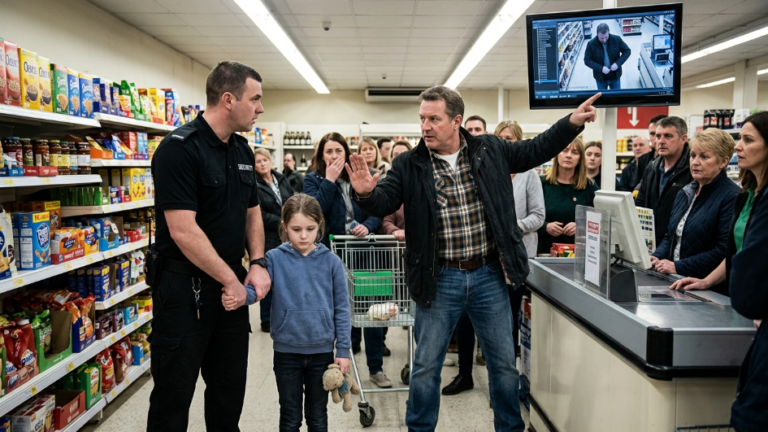
A man in a flannel shirt sitting two booths down stood up. He was a big guy, probably a local, and he had a deep scowl on his face. He crossed his arms and stared at me like I was something vile he’d just scraped off his boot.
“Hey, buddy,” the man said, his voice carrying over the sound of the rain. “Why the hell is your little girl running around outside in the freezing rain with no shoes on?”
“She’s not my kid,” I said, looking up at him, my heart starting to hammer against my ribs. “I’ve never seen her before in my life.”
“She just called you Dad,” an older woman sitting at the counter chimed in, her tone dripping with disgust. “You really going to sit there and deny your own flesh and blood? What kind of monster makes a child terrified of him like that?”
“I am telling you,” I said, my voice rising defensively as I looked around the room, “I don’t know who this is.”
But the optics were terrible. I looked like a rough, dangerous drifter. The girl was clinging to me like I was her only lifeline, yet she was terrified. The narrative forming in the room was clear: I was an abusive, deadbeat father, or maybe something much worse. I could see two truckers at the front standing up, their shoulders squared. They were getting ready to step in. They were getting ready to take her from me, or take me outside and beat me half to death in the parking lot.
“Dad, please,” the little girl whispered into my leg, her voice barely a squeak now. “The black car. He’s in the black car.”
I looked up toward the front of the diner.
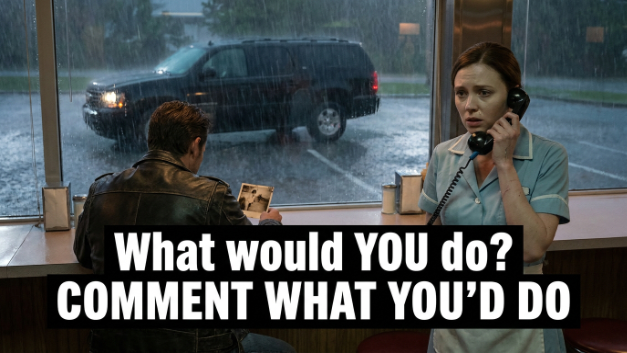
Maggie, the middle-aged waitress who had poured my coffee ten minutes ago, was standing completely still behind the pie case. She hadn’t said a word to condemn me. Instead, her eyes were locked on the large window at the front of the diner.
I followed her gaze.
Out in the muddy, pothole-riddled parking lot, sitting just beyond the glow of the neon “OPEN” sign, was a massive black SUV. Its headlights were off, but the engine was clearly running—I could see the thick white exhaust fumes curling up into the freezing rain. The windows were tinted pitch-black, making it impossible to see inside. But the vehicle was angled perfectly toward the diner doors. Toward us.
Someone was in there. Watching.
“Leave him be, Earl,” Maggie suddenly snapped, her voice sharp and authoritative. She didn’t look at the angry local man; she kept her eyes on the SUV. “Sit down.”
“Maggie, you can’t be serious,” Earl argued, taking a step toward me. “Look at the kid. She’s freezing. He’s probably been keeping her out in a truck bed or—”
“I said sit down, Earl!” Maggie barked. She reached under the counter, and I saw the curly cord of the diner’s landline phone stretch out. She pulled the receiver to her ear and started dialing without ever taking her eyes off the black vehicle outside. “Something ain’t right.”
The tension in the room thickened. I looked down at the tiny girl. She was still shivering, her face buried in my jeans. I realized then that she wasn’t hiding from me. She was hiding behind me. She had picked the biggest, meanest-looking guy in the room and used me as a human shield.
“Hey,” I whispered softly, leaning down. I didn’t care who was watching anymore. “It’s okay. You’re inside now. It’s warm.”
I carefully placed my large, calloused hand on her trembling back, over the heavy, wet fabric of the oversized coat. The moment my hand touched her, she flinched, but then she leaned into the weight of it.
As she shifted her body, the huge pocket of the men’s jacket gaped open.
Something slipped out.
It fluttered silently down to the checkerboard linoleum floor. It was a piece of stiff, glossy paper.
I stared at it. It was an old Polaroid photograph. The edges were badly water-damaged, warped and peeling from the rain, but the image in the center was still perfectly clear.
My breath caught in my throat. The diner around me seemed to fade out. The angry muttering of the patrons, the sound of the storm, Maggie talking quietly to the 911 dispatcher—it all vanished into a dull ringing in my ears.
Slowly, I reached down and picked it up. My fingers were shaking.
I stared at the glossy surface.
It was a picture of me.
I looked a lot younger. My beard was shorter, my face less lined. I was wearing my old club vest, leaning against a beat-up pickup truck in the sunshine. And standing right next to me, with her arms wrapped tight around my waist and a bright, blinding smile on her face, was a woman.
A woman I hadn’t seen in nearly eight years. A woman I had loved more than anything in this world, who had vanished from my life without a trace.
I looked from the photo to the top of the little blonde girl’s head.
My lungs felt empty. The walls of the diner felt like they were closing in. This wasn’t a random child seeking a random shield.
Outside, the heavy engine of the black SUV suddenly revved loudly over the sound of the rain, and its bright headlights snapped on, blindingly white, shining straight through the diner windows directly at us.
CHAPTER 2
The blinding white light from the SUV pierced the diner windows, casting long, sharp shadows across the checkerboard floor. The heavy rumble of the engine vibrated against the glass. Whoever was inside had stopped hiding in the dark.
I barely had time to process the water-damaged Polaroid in my hand. My brain was misfiring, caught between the terrified child clinging to my leg and the impossible image of Sarah—my Sarah—smiling back at me from a decade ago.
Before I could piece it together, the diner door swung open.
The man who stepped out of the freezing rain was a jarring contrast to everyone else in Hank’s Route 6 Diner. He wasn’t a trucker. He wasn’t a weary traveler. He was tall, perfectly groomed, and wearing a dark, expensive-looking trench coat that repelled the water. His silver hair was neatly slicked back, and despite the downpour outside, he looked entirely composed. He had the kind of polished, commanding presence that immediately demanded authority.
He stopped just inside the doorway, his eyes sweeping the room before locking onto the little girl huddled behind me.
His face instantly twisted into a mask of overwhelming relief and panic.
“Lily!” he cried out, his voice echoing with the perfect pitch of a desperate father. “Oh, dear God. Lily, sweetheart!”
He lunged forward, taking long, urgent strides toward us.
The moment she heard his voice, the little girl—Lily—let out a muffled shriek. She scrambled backward, putting my massive frame entirely between her and the man. Her tiny hands grabbed fistfuls of my leather vest, and she pressed her face so hard into my spine I could feel her teeth chattering. She was trembling like a cornered animal.
“Hold it right there,” I barked, putting one heavy, boot-clad foot forward and raising a hand to stop him.
The man halted a few feet away. He put his hands up, breathing heavily, playing to the crowd. He looked around the diner, making eye contact with the patrons, projecting the image of an exhausted, heartbroken guardian.
“I am so sorry,” the man said, addressing the room, his voice shaking with feigned emotion. “I am so incredibly sorry for the disturbance. She slipped out of the car when I was getting gas down the road. I’ve been driving around for twenty minutes trying to find her in the dark. I was terrified.”
He looked back at me, giving me a tight, grateful smile. “Thank you, sir. Thank you for keeping her safe. Come here, Lily. It’s time to go home. You’re freezing.”
He took another step forward, reaching out a manicured hand.
I didn’t move. I stood like a brick wall.
“She doesn’t want to go with you,” I said, my voice low and dangerous.
The man sighed, letting his hand drop. He gave me a look of patient exhaustion, the kind a professional gives to someone acting foolishly. “Sir, I appreciate your concern, I really do. But my niece has been through a profound trauma. Her mother passed away recently, and she hasn’t been right since. She has… episodes. She gets confused. She runs.”
He looked at Earl and the other truckers, shaking his head sadly. “The doctors said she might attach herself to strangers, looking for a father figure she never had. It’s a tragic coping mechanism.”
The lie was so smooth, so perfectly delivered, that I felt the entire room instantly shift.
The tension that had been directed at me moments ago vanished, replaced by a wave of collective sympathy for the well-dressed man. The diner patrons murmured in understanding.
“See? I told you, buddy,” Earl called out from his booth, glaring at me. “She’s sick. Hand the man his kid and mind your own business.”
“Yeah, man, back off,” one of the truckers added, standing up. “He’s her uncle. You’re scaring the poor girl.”
The gaslighting was instantaneous and suffocating. Suddenly, I was the villain again. I was the towering, tattooed biker holding a traumatized child away from her loving, grieving family. The walls were closing in, the social pressure turning into a physical weight.
“Please, sir,” the man said, stepping closer, his voice dropping into a gentle, commanding tone. “Just let her go. You’re making this harder on her.”
But I could feel her. I could feel Lily shaking against my back. This wasn’t the trembling of a confused, grieving child having an episode. This was pure, unadulterated terror. And then there was the photo.
While keeping myself between Lily and the man, I subtly shifted the wet Polaroid in my left hand. I ran my thumb over the water-damaged edge and flipped it over.
There, written in smeared but unmistakable blue ink on the back of the photograph, was a single line of text. I recognized the cursive immediately. It was Sarah’s handwriting. The loops and sharp angles were exactly how she used to write grocery lists on the back of my work receipts.
The note read: If you ever see him, call him Dad.
My heart slammed against my ribs like a sledgehammer.
If you ever see him…
Sarah had given this to her. Sarah had known I was out there. She had prepped this little girl—her daughter, maybe our daughter—to find me. This wasn’t an accident. This wasn’t a child wandering in the dark looking for a random shield. Lily had recognized my face, or my cut, or the very diner I always stopped at on this route. She had executed a desperate plan her mother had given her.
I looked up from the photo, my blood turning to ice.
The polished man in the trench coat was staring at my left hand. For a fraction of a second, the mask of the grieving uncle slipped. His eyes went dead and flat, locking onto the edge of the Polaroid. His jaw tightened, a flash of pure, violent panic crossing his features before he instantly smoothed it away.
He knew about the photo. That was why he was chasing her.
“I’m not going to ask you again, pal,” Earl growled, taking two steps toward me, rolling up his flannel sleeves. “Let the girl go to her family.”
“He’s not her family,” I said, my voice cutting through the diner like a whip. I stared dead into the man’s eyes. “If you were driving around looking for her for twenty minutes, why was your SUV parked outside with the lights off, watching the door?”
The diner went quiet again. Earl hesitated.
“I was on the phone with the police,” the man lied smoothly, not missing a beat. “I didn’t want to turn the lights on and spook her. When she’s having an episode, if she feels cornered, she runs into traffic. I was trying to de-escalate.”
“That’s a lie,” Maggie’s voice rang out from behind the counter. She stood tall, still holding the diner’s landline phone. “I’ve been watching that car for ten minutes. You weren’t on the phone. You were just sitting there. Waiting.”
The man shot Maggie a look of sheer venom, but his voice remained calm. “Ma’am, with all due respect, you don’t understand the medical situation here—”
“I don’t care about the medical situation,” I interrupted, stepping forward, forcing the man to take a step back. “She’s not leaving with you.”
The man’s charismatic facade finally cracked. He lunged, trying to reach around my waist to grab Lily’s coat.
I didn’t think. Instinct took over. I dropped my heavy right hand onto his shoulder and shoved him backward with a fraction of my strength. He stumbled hard, his polished shoes slipping on the wet floor, and he crashed into the edge of a booth.
The diner erupted.
“Hey!” Earl shouted, charging at me.
“Someone call the cops!” a woman screamed from the back.
“I already did!” Maggie yelled over the chaos.
The man in the trench coat straightened up, brushing off his jacket. He wasn’t playing the victim anymore. He stepped right up into my personal space, ignoring the angry shouts of the patrons around us. He leaned in close, his voice dropping to a terrifying, deadly whisper meant only for me.
“You’re making a massive mistake, you piece of white-trash garbage,” he hissed, his eyes burning into mine. “You have no idea what you’re interfering in. Give me the girl, give me what’s in your pocket, and walk out of here, or I swear to God I will ruin your life just like I ruined her mother’s.”
A cold shock waved through my system. Just like I ruined her mother’s.
Before I could grab him by his expensive collar and throw him through the plate-glass window, the wail of a siren cut through the storm. Blue and red lights flashed across the rain-streaked glass, illuminating the parking lot.
The man instantly took three steps back, throwing his hands up in the air, transforming back into the helpless victim. “Help! He assaulted me! He’s trying to take my niece!”
The front door burst open, and a local county deputy stepped in, his uniform soaked, one hand resting instinctively on his duty belt. “Alright, everyone calm down! What the hell is going on here?”
“Officer!” the man cried out, pointing a trembling finger at me. “Thank God you’re here. This man assaulted me. He’s holding my niece hostage. She’s severely mentally disturbed, and he refuses to let her go!”
The deputy looked at me. He looked at my leather cut, my tattoos, my size, and then at the little girl cowering behind my legs.
“Sir,” the deputy said, his voice hard and uncompromising as he unclipped his radio. “Step away from the child. Now.”
“Officer, you need to listen to me,” I started, keeping my body planted. “He’s lying. The girl ran in here begging for help—”
“I have the custody papers right here in my coat,” the man interrupted loudly, reaching into his inner pocket and pulling out a folded legal document. He handed it to the deputy. “I am her legal guardian. Her mother is dead. This biker is trying to abduct her.”
The deputy scanned the paper, his expression hardening. He looked back up at me, unsnapping the retention strap on his holster.
“Last warning, buddy,” the deputy said, the whole room watching me with hostility. “Step away from the girl, put your hands on the counter, and do not make me ask you again.”
I stood there, completely isolated. The law, the crowd, the entire world was against me.
And then, I felt a tiny, freezing hand slip into mine, squeezing my fingers with a desperate, heartbreaking grip.
CHAPTER 3
The freezing grip of Lily’s tiny fingers wrapping around my calloused hand anchored me to the floor. The deputy was glaring at me, his hand resting dangerously close to his sidearm, waiting for me to step away. The entire diner held its breath.
I didn’t raise my voice. I didn’t make any sudden movements. I’ve dealt with nervous cops before, and I knew that anger was the fastest way to lose this fight.
“Officer,” I said, my voice low, steady, and calm. I slowly raised my right hand in the air, showing my empty palm, but I kept my left hand firmly wrapped around Lily’s. “I’m not trying to cause trouble. But I need you to look at this little girl. Look at her face. Does she look like a child having a medical episode, or does she look like she’s fighting for her life?”
The deputy hesitated. His eyes flicked from my leather cut down to the six-year-old girl cowering behind my heavy work boots. Lily was shaking so violently her teeth were audibly clicking together.
“She’s sick, officer,” the man in the trench coat interjected, his voice dripping with exhausted sorrow. He stepped closer to the deputy, gesturing helplessly. “She has severe attachment trauma. Her mother—my sister—passed away two days ago. She’s confused. She just needs to be in a warm car and taken back home to her family. This man is agitating her.”
“I have the paperwork right here,” the man continued, tapping the folded document the deputy was now holding. “Emergency custody, granted by a judge. Please, just give me my niece before this gets any worse.”
The deputy unfolded the paper. He scanned it, his jaw tightening. “This says Richard Vance. That you?”
“Yes, sir,” the man said smoothly.
“Says here you were granted guardianship of Lily Harper following the death of Sarah Harper,” the deputy read aloud.
When I heard her full name, a cold shockwave rolled through my chest. Sarah Harper. It had been Sarah Hayes when I knew her. She had gotten married. Or changed her name to hide. But it was her.
“That’s right,” Richard Vance said, nodding solemnly. “It’s been a nightmare of a week. Now, if you’ll please just order this man to let her go—”
“I’ll let her go,” I interrupted, my voice cutting through the diner like a heavy blade. “The second you explain why a child you supposedly have custody of is running around the side of a highway in the freezing rain with no shoes on.”
Richard shot me a look of pure, unadulterated hatred, but quickly masked it for the deputy. “I told you, she slipped out when I stopped for gas—”
“And I told you that’s a lie,” Maggie barked from behind the counter. She stepped out from the pie case, carrying her order pad, her face flushed with maternal fury. “Deputy, I’ve been watching the front window for ten minutes. That black SUV has been parked right outside, engine running, lights off. He wasn’t looking for her. He was sitting in the dark, watching her.”
The deputy frowned. He looked at Maggie, a respected local, and then back at Richard. The narrative Richard had so carefully constructed was beginning to fray at the edges.
“People do strange things when they panic,” Richard said, his voice tightening slightly. He was losing control of the room, and he knew it. “I was on the phone with my lawyer trying to figure out how to handle this without traumatizing her further. This is a private family matter. Give me the girl.”
He took a step toward me, reaching out.
“Touch her,” I growled, “and we’ll see how fast the deputies in this county can pull me off you.”
“Hey!” the deputy shouted, pointing a stern finger at me. “Enough. Both of you back up.”
The deputy looked at me, his expression still hardened with suspicion. “Sir, I appreciate your concern, but this man has legal paperwork. If he is her legal guardian, I have to release her to him. Let go of the child.”
The men in the diner muttered in agreement. The law was the law. Richard stood a few feet away, a smug, victorious gleam returning to his eyes. He had won.
But he had forgotten about what was in my pocket.
“Deputy,” I said quietly. “Before you hand this child over to a man she is terrified of… I need you to look at something.”
I slowly reached into the pocket of my leather vest. The deputy’s hand twitched toward his belt, but I pulled my hand out slowly, holding the water-damaged Polaroid between two fingers. I placed it face-up on the nearest diner table.
“Take a look at that,” I said.
The deputy stepped forward and looked down at the glossy surface. He studied the image of the younger me, standing next to Sarah, her arms wrapped happily around my waist. He looked at the photo, then looked up at my face, tracing the lines, the beard, the eyes. It was undeniable.
“That’s me,” I said, my voice thick with emotion I was fighting to keep down. “And the woman next to me is Sarah. Lily’s mother.”
A ripple of shock went through the diner. Earl, the big local who had been ready to fight me five minutes ago, leaned out of his booth to get a better look, his brow furrowed in confusion.
“Where did you get this?” the deputy asked, his tone shifting. The hostility was gone, replaced by genuine investigative curiosity.
“She brought it to me,” I said, looking down at Lily. “It fell out of her pocket.”
I reached down and flipped the photograph over. The blue ink was smeared from the rain, but the sharp cursive was still clearly visible against the white backing.
If you ever see him, call him Dad.
The deputy read the words silently. His face went completely pale. He looked at the frantic little girl, then at the massive, tattooed biker holding her hand, and finally at the well-dressed man in the trench coat. The puzzle pieces were suddenly rearranging themselves into a very different, very dark picture.
“That… that is stolen property!” Richard stammered. His smooth charisma vanished in an instant. His face flushed red with panic. “That belongs to her mother’s estate! He stole it from my car! He’s a drifter, he’s making this up—”
“Why would he steal a photo of himself?” Maggie asked loudly, her voice dripping with common sense.
Richard ignored her, stepping toward the table to grab the photo. “Give that to me! This is absurd. You have my paperwork, deputy! Give me my niece!”
“Back up, Mr. Vance,” the deputy ordered, his voice suddenly sharp and authoritative. He held up a hand, physically stopping Richard from reaching the table.
“I know the county sheriff!” Richard threatened, his voice rising in desperation. “If you don’t enforce this custody order right now, I will have your badge by tomorrow morning!”
“You can call the governor for all I care,” the deputy shot back, stepping between Richard and me. He pulled his radio from his shoulder. “Dispatch, I need a rush on a background check and a document verification. Name is Richard Vance. I also need you to run the plates on a black SUV parked outside Hank’s Route 6 Diner.”
“You have no right to search my vehicle!” Richard snapped, his eyes darting frantically toward the front door. The panic in his voice was raw now. It wasn’t the panic of a worried uncle. It was the panic of a trapped animal.
While Richard argued with the deputy, I knelt down on one knee. I was entirely focused on Lily.
I looked closely at the absurdly large, olive-green men’s jacket she was drowning in. In the chaos, I hadn’t truly looked at it. But now, kneeling at her eye level, I noticed the heavy brass zipper. I noticed the specific fraying on the right cuff. And then, I saw the faded, circular patch stitched onto the left breast pocket.
It was a rusted motorcycle gear with wings.
My breath stopped.
It was my jacket. It was the old canvas work coat I used to wear when I ran a mechanic shop down in Texas, a decade ago. I had draped it over Sarah’s shoulders the night she told me she had to leave, the night she told me she was in trouble and couldn’t explain why. I had told her to keep it so she’d remember me.
She had kept it for eight years. And tonight, she had wrapped her terrified daughter in it to keep her safe.
“Lily,” I whispered, my voice breaking.
She looked up at me. Her blue eyes were wide, filled with tears, but the absolute panic was beginning to recede, replaced by a desperate, exhausted hope.
“Lily, where is your mom?” I asked gently. “Where is Sarah?”
“Hey!” Richard yelled, trying to push past the deputy. “Stop talking to her! Don’t let him interrogate my niece!”
“Stand down, Vance!” the deputy roared, physically pushing the man back.
I kept my eyes locked on Lily. “It’s okay, sweetheart,” I whispered. “He can’t hurt you anymore. I promise you, nobody is going to take you out of this diner. But I need you to tell me what happened. The paper the policeman has says your mommy went to heaven two days ago.”
Lily shook her head frantically. The oversized sleeves of my old jacket flapped against her sides.
“No,” Lily cried, her voice echoing in the dead-silent diner. Every single patron was hanging on her next word. “Mommy didn’t go to heaven two days ago.”
She pointed a trembling, tiny finger straight at Richard Vance.
“She gave me the picture tonight,” Lily sobbed, tears finally spilling over her dirt-streaked cheeks. “She gave it to me in the back of his car. She told me to put the coat on, wait for the car to stop, and run inside the diner to find the man in the picture.”
My blood ran cold. The deputy froze, his hand slowly dropping from his radio.
“Lily,” I asked, my heart pounding so hard I could hear it in my ears. “Where is your mommy right now?”
Lily looked toward the front window of the diner, pointing out into the freezing, pouring rain.
“She’s still in the trunk of his car.”
CHAPTER 4
The six words hung in the air of the diner like a physical weight. She’s still in the trunk of his car.
For one agonizing second, time completely stopped inside Hank’s Route 6 Diner. The only sound was the relentless pounding of the freezing rain against the front windows and the low, mechanical rumble of the black SUV idling out in the parking lot.
Then, the deputy moved.
His hand, which had been hovering near his radio, dropped instantly to his duty belt. In one fluid motion, he drew his sidearm and pointed it directly at Richard Vance’s chest.
“Hands on your head!” the deputy roared, his voice cracking like a whip. “Get down on your knees and put your hands behind your head right now!”
Richard’s polished, charismatic facade didn’t just crack; it shattered into a million pieces. The color drained completely from his face, leaving him a sickening shade of gray. Panic, raw and ugly, twisted his features.
“She’s lying!” Richard screamed, taking a frantic step backward toward the front door. “She’s a disturbed child! You cannot listen to her, this is insane!”
He spun around to run.
He didn’t make it two steps.
Earl, the big local in the flannel shirt who had been ready to fight me five minutes earlier, stepped squarely into the aisle. He didn’t say a word. He just planted his heavy boots, crossed his thick arms, and lowered his shoulder. Richard slammed into him like a bird hitting a pane of glass and bounced off, stumbling backward.
Before Richard could regain his balance, two of the long-haul truckers were out of their booths. They grabbed him by the shoulders of his expensive trench coat and slammed him hard against the counter.
“You ain’t going anywhere, suit,” one of the truckers growled, pressing his forearm against Richard’s back, pinning him to the laminated wood.
The diner, which had been so quick to judge me, had instantly transformed into a fortress protecting Lily. The patrons formed a human wall between Richard and the front door.
“Don’t move! Nobody move!” the deputy shouted, advancing on Richard. He holstered his weapon, pulled a pair of steel handcuffs from his belt, and violently wrenched Richard’s arms behind his back. The sharp click of the ratcheting metal echoed through the room.
I didn’t care about Richard. I didn’t care about the cops. I dropped down onto both knees on the wet linoleum, wrapping my large arms entirely around Lily. She buried her face into my neck, sobbing uncontrollably now that the secret was out. She felt so tiny, so fragile inside my old canvas jacket.
“I’ve got you,” I whispered fiercely into her wet hair, my own tears finally spilling over and getting lost in my thick beard. “I’ve got you, Lily. You’re safe.”
“Deputy,” Maggie called out, her voice shaking but resolute. “The keys.”
The deputy dug roughly into Richard’s coat pocket and pulled out a heavy black key fob. He grabbed Richard by the collar of his coat.
“Walk,” the deputy commanded, shoving the struggling man toward the door. “We’re going outside.”
I stood up, lifting Lily effortlessly into my arms. She clung to me like a monkey, her legs wrapped around my waist, her face buried in my shoulder. I followed the deputy out into the freezing storm, and half the diner came with us. Earl, the truckers, even Maggie—they all poured out into the rain, forming a tight semicircle around the rear of the massive black SUV.
The rain was blinding, the wind biting straight through my leather cut, but I barely felt it. The red and blue lights from the cruiser washed over the asphalt, reflecting off the puddles.
The deputy dragged Richard to the back bumper and forced him to his knees in the mud. He pointed the key fob at the vehicle.
Beep-beep.
The heavy hydraulic liftgate unlatched. Slowly, agonizingly, the rear door of the SUV began to rise.
The trunk area was pitch black. But as the interior dome light flickered on, illuminating the dark carpet, a collective gasp ripped through the crowd of bystanders. Maggie covered her mouth with her hands, letting out a stifled sob.
Curled up on the floor of the trunk, bound at the wrists and ankles with thick plastic zip ties, was a woman.
She was shivering violently, her lips blue from the cold. Her face was bruised, her clothes torn, and a piece of silver duct tape was secured loosely around her neck, as if she had managed to partially rip it off her mouth.
I stepped forward, the rain stinging my eyes.
“Sarah,” I choked out.
She weakly turned her head toward the sound of my voice. Her eyes, the same vibrant blue as Lily’s, fluttered open. Despite the dirt, the bruises, and the eight long years that had passed, it was her. The woman from the water-damaged Polaroid. The woman I had never stopped looking for.
When her eyes finally focused on my face, and then on the tiny girl wrapped in my old jacket holding onto my neck, a sound escaped her throat. It was a guttural, earth-shattering sob of absolute relief.
“Elias,” she whispered, her voice barely audible over the storm. “You were there. You were actually there.”
I handed Lily gently to Maggie, who wrapped her own cardigan around the girl to shield her from the rain. Then, I reached into the trunk. I pulled my heavy pocket knife from my jeans, flicked the blade open, and carefully snapped the thick plastic ties binding her wrists and ankles.
The moment her hands were free, she threw her arms around my neck. I pulled her out of that dark, freezing trunk, lifting her into my arms just like I had lifted Lily. She buried her face against my chest, crying so hard her whole body shook.
“I told her to find you,” Sarah sobbed into my wet shirt. “I prayed you were still driving this route. I prayed.”
“I’m here,” I said, holding her tighter than I had ever held anything in my life. “I’m right here. I’m not letting you go again.”
Behind us, the deputy was aggressively reading Richard Vance his rights, hauling him to his feet by the handcuffs. Richard was ranting, his dignity completely stripped away.
“I am the executor of the estate!” Richard screamed, water pouring down his perfectly styled hair, ruining his expensive clothes. “She is mentally unfit! I have the legal right to protect my family’s assets!”
I turned around, still holding Sarah. I looked at the pathetic, wealthy man who had tried to play God with our lives.
“You don’t have a family,” I said quietly, my voice carrying a heavy, terrifying finality. “You have a prison cell.”
By the time the ambulance and two more county cruisers arrived, the storm had finally begun to break. The heavy rain slowed to a steady drizzle. The paramedics wrapped Sarah and Lily in thick foil thermal blankets and brought them inside the diner, sitting them down in my booth at the end of the counter.
Maggie brought over three mugs of hot chocolate and a plate of warm food, refusing to let me pay a dime.
As the paramedics checked their vitals, Sarah held my hand across the Formica table. Her grip was weak, but she refused to let go. In a quiet, exhausted voice, she finally explained the eight-year mystery that had haunted me.
Richard wasn’t just her brother; he was the sole financial controller of their late father’s massive estate. When Sarah had fallen in love with me—a rough, wandering mechanic with grease under his fingernails and no pedigree—Richard had been enraged. He demanded she leave me, threatening to use his money and influence to frame me for crimes that would put me away for life.
To protect me, Sarah had packed her bags in the middle of the night and vanished. She had taken only one thing to remember me by: my old olive-green work jacket.
She didn’t know she was pregnant with Lily until two months later.
She had spent six years hiding off the grid, living a quiet, impoverished life just to keep her daughter away from Richard’s toxic control. But two days ago, Richard’s private investigators finally found her. He realized that with Sarah out of the picture, and with custody of her daughter, he could permanently secure the rest of the family trust.
He had forged the death certificate. He had forged the emergency custody papers. He ambushed her, threw her in the trunk, and forced Lily into the car, intending to disappear them both into an institution—or worse.
But Richard didn’t know Sarah. And he certainly didn’t know me.
When Richard pulled off the highway for gas, confident he had won, Sarah had managed to kick down the plastic divider of the back seat just enough to pass Lily the old Polaroid and my jacket. She knew Hank’s Route 6 Diner was my regular stop when I rode through Pennsylvania. It was a desperate, impossible gamble.
She told her terrified six-year-old daughter to put on the jacket, run inside, find the giant biker from the photo, and call him Dad.
“It was the only way I knew a stranger wouldn’t just hand her back to him,” Sarah whispered, tears pooling in her eyes again. “I knew if people thought you were her father, you’d have to protect her. And I knew… I knew if you saw her face, you’d know she was yours.”
I looked down at Lily. She was sitting pressed against my side, a thermal blanket draped over her shoulders, quietly drinking her hot chocolate. She had my dark, heavy eyebrows, but her mother’s bright blue eyes.
I felt a sudden, overwhelming tightness in my chest. A twenty-year-old wall I had built around my heart crumbled into dust on the diner floor.
I reached out and gently brushed the tangled blonde hair out of Lily’s eyes. She looked up at me, offering a small, exhausted smile.
Outside, the tow truck hooked up Richard’s expensive black SUV, dragging it away into the dark. The flashing police lights faded down the highway, taking the monster from Sarah’s past away for good. The diner slowly returned to its quiet hum, the patrons whispering respectfully, giving us our space.
“Are we going home now?” Lily asked quietly, her tiny hand reaching out to grab onto my thick, leather-clad arm.
I looked at Sarah, who was watching me with a look of pure, unconditional love. Then, I looked back down at the brave little girl who had marched into a room full of strangers to save her mother’s life.
“Yeah, kid,” I said softly, resting my hand on top of hers. “We’re going home.”