
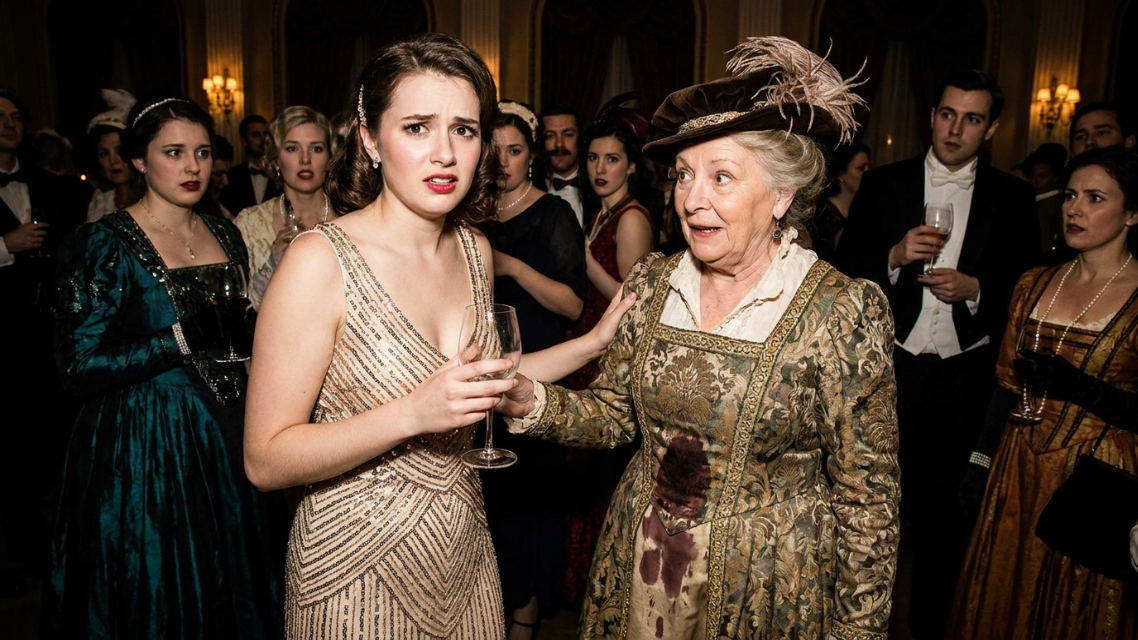
The Starlet Spilled Wine On The Elderly Costume Lady And Called Her Trash. The Old Woman Didn’t Cry—She Just Opened A Black Folder. By Midnight, Hollywood Knew Who The Real Fraud Was…
CHAPTER 1
Soundstage 4 was a cavernous, poorly ventilated warehouse sitting on the backlot of one of Los Angeles’s most historic studios. It smelled perpetually of ozone, burning dust from the thousand-watt tungsten lights, and the stale sweat of people who worked fourteen-hour days just to make rent in a city that despised the poor.
There is a distinct, unspoken caste system on an American film set, as rigid and unforgiving as anything found in the history books. Above the line sat the directors, the producers, and the talent—the ones whose names were etched into gleaming brass chairs and who were ferried to and from their air-conditioned trailers in golf carts. Below the line was everyone else. The grips with their bruised knuckles, the gaffers constantly inhaling electrical smoke, and the wardrobe department, hovering at the very bottom of the social ladder, kneeling on the floor with mouths full of pins, tending to the hems of the elite.
Adelaide Sinclair belonged to the bottom. At least, that was what everyone on Soundstage 4 believed.
At seventy-two years old, Adelaide was an invisible fixture. She wore practical, orthopedically sound shoes, a faded grey cardigan that smelled faintly of lavender and mothballs, and wire-rimmed glasses perched on the edge of a nose that had seen decades of changing Hollywood tides. She was known simply as “Addie,” a quiet woman who worked union scale, clocking in at four in the morning to steam wrinkles out of period costumes. She never complained. She never asked for autographs. She just did her job with a meticulous, practiced grace.
To the crew, she was a kindly grandmother trying to supplement her Social Security checks. To Vivienne Monroe, she was merely a prop. Worse, she was a servant.
Vivienne Monroe was twenty-two, breathtakingly beautiful, and toxic to the core. The media had recently crowned her the “Vanderbilt of the West Coast.” According to her meticulously crafted public relations narrative, Vivienne was the sole heir to a massive New England shipping fortune. She was supposedly a renegade debutante who had rejected high society to pursue the arts, bringing millions of dollars of her family’s capital to help fund the very picture they were currently shooting.
Because she was the financial lifeblood of the production, the studio executives permitted her to behave atrociously. Wealth in America operates as a universal hall pass, excusing everything from rudeness to outright abuse. Vivienne wielded her supposed bank account like a medieval broadsword. She fired assistants for making eye contact. She demanded bottled water imported from a specific glacier in Iceland. And she harbored a deep, vicious contempt for the working class.
“Ow! Watch what you’re doing, you idiot!” Vivienne shrieked.
Her voice, sharp and nasal, shattered the low murmur of the set. The makeup artists flinched. A grip carrying a heavy C-stand froze in his tracks.
Adelaide remained kneeling on the dusty concrete floor, her measuring tape draped over her shoulders. She was adjusting the complicated hem of a hand-beaded, three-hundred-thousand-dollar silk gown that Vivienne was wearing for the film’s climax.
“I apologize, Miss Monroe,” Adelaide said quietly, her tone perfectly even. “The silk organza is quite stiff at the seams. I am merely trying to ensure it doesn’t bunch at your waist.”
“You pricked me!” Vivienne snapped, glaring down at the top of Adelaide’s grey head.
“The pin did not break the skin, Miss Monroe. It caught the outer layer of the tulle,” Adelaide replied gently. It was the truth. Adelaide had been sewing since before Vivienne’s parents were born; her hands were as steady as a surgeon’s.
But truth did not matter to Vivienne. Power did. She felt a sudden, inexplicable need to assert her dominance, perhaps driven by the deep, clawing insecurity that always seemed to bubble up behind her perfectly manicured facade.
Declan Mercer, the film’s director, stood ten feet away, staring intently at the script in his hands. Declan was a man in his late forties who had traded his artistic integrity for studio paychecks a long time ago. He saw the confrontation brewing. He saw the cruelty in Vivienne’s eyes. But Declan was a coward. He knew that Vivienne’s “family money” was keeping the production afloat. To speak up for an elderly wardrobe woman meant risking his mortgage in Calabasas and the private school tuition for his three kids. So, Declan did what middle-management always does when the elite misbehave: he looked the other way.
Vivienne reached over to the vanity table. Sitting beside her cell phone was a large crystal glass filled to the brim with expensive French Merlot. Drinking alcohol on set was strictly forbidden by union rules, but rules, as Vivienne often reminded the producers, were for poor people.
She picked up the glass. The heavy red liquid swirled against the crystal.
“You know what your problem is, Addie?” Vivienne sneered, using the nickname with deliberate disrespect. “You people have no attention to detail. You’re careless. That’s why you’re seventy years old and crawling around on the floor like a dog for minimum wage.”
The silence on the soundstage grew thick and suffocating. Fifty people held their breath.
Adelaide looked up, her blue eyes calm and piercing behind her wire-rimmed glasses. She didn’t look at the floor. She looked directly into Vivienne’s eyes.
“I assure you, my attention to detail is quite sharp,” Adelaide said softly.
Something about the old woman’s lack of fear infuriated Vivienne. She wanted tears. She wanted apologies. She wanted the old woman to grovel, to acknowledge the vast, unbridgeable chasm of status between them. When Adelaide refused to break eye contact, Vivienne’s fragile ego snapped.
“Let’s see how sharp you are at cleaning, then.”
With a flick of her wrist, Vivienne tilted the crystal glass.
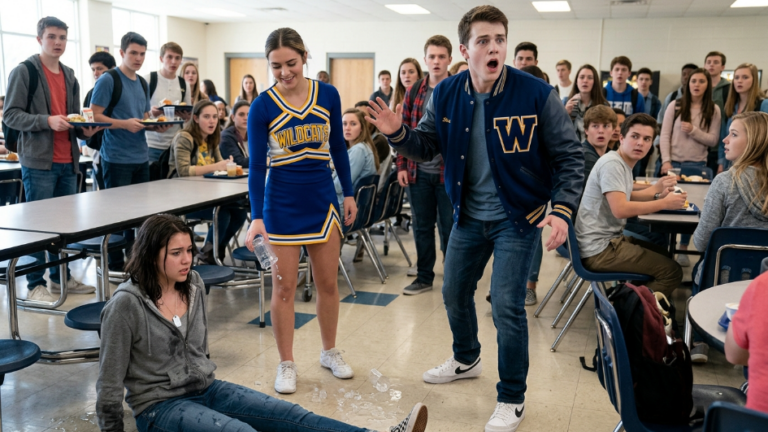
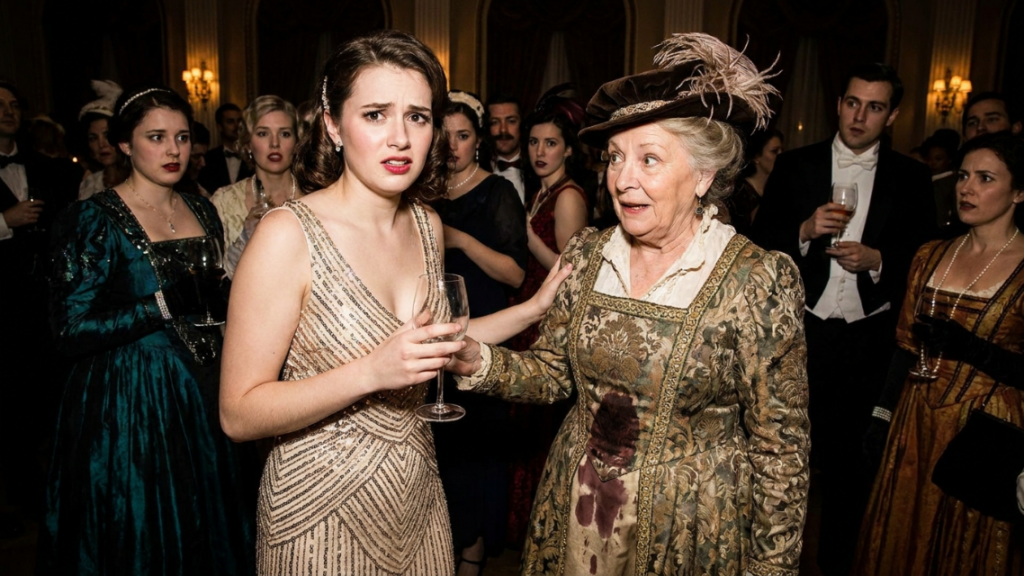
The dark red Merlot poured out in a heavy, violent splash. It hit the top of Adelaide’s head, soaking her grey hair, splashing across her glasses, and dripping heavily onto the shoulders of her faded cardigan.
A collective, audible gasp echoed across the soundstage. A young script supervisor near the monitors covered her mouth with her hands. Declan Mercer finally looked up, his face draining of color.
“Christ, Vivienne,” Declan muttered under his breath, but he didn’t move an inch to help.
The wine dripped from Adelaide’s chin onto the dusty concrete. The metallic smell of the alcohol mixed with the heat of the studio lights. The sheer cruelty of the act hung in the air, a visceral display of class warfare. A young, wealthy aristocrat publicly degrading a vulnerable, elderly worker just because she could.
Vivienne stood tall, a cruel, triumphant smirk stretching across her face. “You’re fired, trash,” she whispered venomously. “Get your cheap sewing kit and get off my set.”
Adelaide did not move immediately.
For a long, agonizing moment, the old woman just stayed on her knees. The crew watched in a state of paralyzed horror. They expected her to break down. They expected the crushing weight of the humiliation to shatter her. They expected her to scramble to her feet, weeping, and run toward the exit, a broken casualty of Hollywood’s brutal caste system.
But Adelaide Sinclair did not cry.
Inside her mind, Adelaide felt a profound, almost clinical sense of pity for the girl standing above her. Vivienne thought she understood power. She thought power was a tantrum. She thought power was throwing wine and shouting insults. Vivienne was a child playing dress-up, entirely unaware of how the real world operated.
Real power was silent. Real power didn’t need to scream.
Adelaide slowly stood up. Her knees popped slightly—a reminder of her age—but her posture was entirely erect. She reached into the pocket of her cardigan, pulled out a clean white cotton handkerchief, and calmly wiped the dripping wine from her glasses. She placed the glasses back on her face. Her eyes were completely devoid of intimidation.
“You really shouldn’t have done that, Tammy,” Adelaide said. Her voice was low, carrying effortlessly across the dead-silent room.
Vivienne’s triumphant smirk flickered. The glass in her hand trembled just a fraction of an inch.
“What did you call me?” Vivienne snapped, though her voice had lost its confident edge. It sounded thin, suddenly laced with a creeping panic.
Adelaide ignored her. The elderly woman turned her back on the starlet and walked over to her designated workstation—a cheap folding table covered in thread spools and a faded canvas tote bag.
Declan Mercer finally stepped forward, his hands raised in a placating gesture. “Okay, let’s all just calm down. Addie, why don’t you go to the washroom and clean up? Vivienne, let’s get you into makeup—”
“Quiet, Declan,” Adelaide commanded.
The director stopped dead in his tracks. He had never heard the sweet, invisible wardrobe lady speak with such a razor-sharp tone of absolute command. It wasn’t the voice of a subordinate. It was the voice of a CEO addressing a mailroom clerk.
Adelaide unzipped the heavy canvas tote bag. She bypassed the fabric shears and the extra measuring tapes. She reached deep into the bottom of the bag and retrieved a thick, heavily reinforced black leather folder.
It looked entirely out of place in her wrinkled, wine-stained hands. It looked like something a high-powered corporate litigator would carry into a federal boardroom.
Adelaide carried the folder over to the brightly lit makeup vanity. She set it down on the glass surface. The heavy thud echoed loudly.
“What is that?” Vivienne demanded, her arms crossed defensively over her chest. “Are you deaf? I said you’re fired! Security! Get this crazy old woman out of here!”
Nobody moved. The crew was too mesmerized by the strange shift in the room’s gravity. The power dynamic had just violently reversed, and nobody understood why.
Adelaide reached out and unhooked the metal clasp of the black folder.
“The problem with constructing a false identity, Tammy,” Adelaide said, opening the cover, “is that you inevitably leave a paper trail. You see, true wealth—the kind of wealth you’ve been pretending to have—doesn’t make you loud. It makes you careful.”
Vivienne stared at the folder. Her breath caught in her throat.
Adelaide turned the first page around so Vivienne, and Declan, who had cautiously walked over, could see it.
It was a birth certificate. Stamped by the state of Nevada.
“Tammy Lynn Hodges,” Adelaide read aloud, her voice ringing clearly through the soundstage. “Born in Henderson, Nevada. Not the Hamptons. Your mother was a cocktail waitress, not a shipping heiress. Your father is currently serving a six-year sentence for wire fraud in a federal penitentiary.”
“Shut up!” Vivienne shrieked. The panic in her voice was total and absolute. The carefully cultivated accent of a New England aristocrat vanished, replaced by the raw, unpolished tone of desperate panic. “Where did you get that? It’s a fake! She’s lying!”
Declan Mercer stared at the document. He looked from the paper to Vivienne, his eyes widening.
Adelaide turned to the next page. It was a dense financial ledger, covered in red ink.
“You didn’t invest a single dime of family money into this production,” Adelaide continued ruthlessly, laying the documents out one by one under the vanity lights. “Because you don’t have a family. You convinced a syndicate of private lenders that you were an heiress. You took out high-interest loans against a trust fund that does not exist. You are currently twelve million dollars in debt, Tammy. And the FBI has been looking for the source of the fraudulent collateral for three months.”
“Declan, do something!” Vivienne screamed, tears of genuine terror finally spilling down her cheeks, ruining her expensive makeup. She grabbed the edge of the vanity, her knuckles turning white. “She’s insane! Have her arrested!”
Declan couldn’t speak. He was staring at a photograph clipped to the third page. It was a mugshot of Vivienne from five years ago, looking haggard, with a cheap dye job, holding a placard that read: HODGES, TAMMY L. – GRAND THEFT.
“Who… who are you?” Declan finally choked out, staring at the soaking wet, elderly costume lady in absolute bewilderment.
Adelaide Sinclair buttoned the top button of her ruined cardigan. She looked at the terrified starlet, then at the spineless director.
“My name is Adelaide Sinclair,” she said smoothly. “My late husband founded this studio forty years ago. I am the majority shareholder of the parent company that employs every single person in this room.” She paused, letting the devastating reality sink into the suffocating silence. “And I don’t tolerate thieves in my house.”
CHAPTER 2
The revelation hit the cavernous space of Soundstage 4 with the concussive force of a physical blow. For a span of ten agonizing seconds, the only sound was the high-pitched, metallic hum of the overhead tungsten lights and the rhythmic, hollow dripping of the spilled Merlot hitting the dust-covered concrete.
To understand the sheer magnitude of what had just occurred, one had to understand the invisible architecture of American power. In Los Angeles, power is not measured by the pedigree of one’s ancestors, nor by political office. It is measured exclusively by capital and the leverage it buys. For the past two months, Vivienne Monroe—or rather, Tammy Lynn Hodges—had terrorized this film set because everyone believed she held the checkbook. She was the golden goose, the untouchable elite.
But true, generational American wealth does not scream at people. It does not need to throw wine or demand imported water to prove its existence. True wealth is an invisible, suffocating atmosphere. It is the ability to end a career, bankrupt a family, or dismantle a life with a single, softly spoken sentence.
Adelaide Sinclair was the embodiment of that atmosphere. Her late husband, Easton Sinclair, had built the very walls they were standing inside. The ground beneath their feet, the cameras they were operating, the catering trucks parked outside—it all belonged to a corporate trust of which this quiet, seventy-two-year-old woman in a wine-stained cardigan was the absolute master.
Declan Mercer, the director, looked as though all the blood had been surgically siphoned from his body. His hands, still clutching the heavily annotated shooting script, began to tremble uncontrollably. He looked from the soaked, elderly woman to the damning police mugshot lying under the vanity lights, his mind desperately trying to reconcile the cognitive dissonance.
“Mrs… Mrs. Sinclair?” Declan choked out, his voice cracking like a terrified adolescent. He had met Easton Sinclair only once, decades ago, but the legend of the Sinclair family’s reclusive widow was a known Hollywood ghost story. She was said to be a phantom board member who lived quietly in a heavily guarded estate in Montecito, communicating only through high-powered proxy lawyers.
“You may continue to call me Addie, Mr. Mercer,” Adelaide replied smoothly, her voice a masterclass in restrained authority. She reached into her pocket again, retrieved a second clean handkerchief, and dabbed at the dark red stain blooming across her collar. “Though I suspect my days of hemming costumes are officially over.”
“This is a lie!” Vivienne shrieked, shattering the silence.
The twenty-two-year-old actress lunged toward the vanity, her perfectly manicured hands clawing frantically at the black leather folder. She managed to grab the Nevada birth certificate and the heavily redacted financial ledger, her breath coming in ragged, hysterical gasps.
“She’s a crazy old bitch!” Vivienne screamed, turning to the crew, waving the papers wildly. The carefully cultivated, breathy Mid-Atlantic accent she had spent three years perfecting was gone, instantly replaced by the flat, harsh vowels of a desperate desert town. “She forged this! She’s trying to ruin me because she’s a jealous, minimum-wage nobody! Declan, call security! Have her arrested for trespassing!”
Nobody moved.
The fifty crew members—the grips, the gaffers, the makeup artists who had endured weeks of Vivienne’s verbal abuse—stood perfectly still. The social dynamic of the room had inverted with violent speed. The working-class professionals, deeply attuned to the shifting winds of authority, recognized the absolute truth radiating from Adelaide. They looked at the young woman screaming in the three-hundred-thousand-dollar silk gown, and for the first time, they did not see a billionaire heiress. They saw a cornered rat.
“Declan!” Vivienne shrieked, her voice echoing shrilly off the soundproofed walls. “I am paying your salary! I am funding this movie! Throw her out!”
“Actually, Miss Hodges, you aren’t paying for anything,” a new voice echoed from the shadows near the heavy acoustic doors of the soundstage.
Out of the gloom stepped Preston Aldridge.
He was a man who looked like he had been born wearing a bespoke charcoal suit. At fifty-five, Preston was the Chief Legal Counsel for Sinclair Entertainment, a corporate assassin armed with Ivy League degrees and an utter lack of human empathy for the opposition. He walked onto the set with the casual, terrifying confidence of an apex predator entering a cage full of frightened birds. Trailing two steps behind him was a massive, broad-shouldered man in a tactical polo shirt—Maddox Crawford, the head of studio security.
Preston approached the brightly lit vanity area, his polished oxfords clicking sharply against the concrete. He did not look at Vivienne. He walked directly to Adelaide, paused, and offered a deep, respectful nod.
“I apologize for my delay, Mrs. Sinclair,” Preston said, his tone deferential but brisk. “The traffic on the 405 was uniquely awful this afternoon. Are you injured?”
“Merely damp, Preston,” Adelaide replied, calmly folding her ruined handkerchief. “And thoroughly exhausted by the lack of professionalism on this set.”
Preston finally turned his gaze upon Vivienne. The young woman had backed herself against the mirror, clutching the forged documents to her chest as if they could act as a bulletproof vest. Her chest heaved. The glamorous illusion was rapidly melting away, leaving behind a terrified twenty-two-year-old grifter who realized she had walked into a meticulously laid trap.
“What is this?” Vivienne hissed, though her voice shook violently. “Who are you?”
“My name is Preston Aldridge. I represent the Sinclair Trust. And to clarify your earlier statement to Mr. Mercer,” Preston said, slipping a sleek tablet from his leather briefcase, “you are not funding this movie. You have been running a highly sophisticated, multi-million-dollar wire fraud operation across three states.”
Preston tapped the screen of his tablet, his eyes scanning the data with practiced detachment. “You rented private jets by putting down fraudulent deposits. You hired a public relations firm to plant stories in the trades about your fictional New England shipping magnate family. You leveraged that fake social capital to secure meetings with independent film financiers. And then, using forged collateral documents from a shell corporation in Delaware, you secured a twelve-million-dollar bridge loan to buy your way into the starring role of this production.”
The words hung in the air, heavy and lethal. The crew listened in absolute awe. It was a stark commentary on modern American culture—an entire society so blinded by the performance of wealth that no one had bothered to verify the reality of it. Vivienne had simply acted rich, demanded to be treated as rich, and the gates of Hollywood had swung wide open for her. It was the ultimate indictment of a social structure built on appearances rather than substance.
“You’re insane,” Vivienne whispered, shaking her head in denial. “You have no proof.”
“Miss Hodges, I have spent the last three weeks quietly conducting a forensic audit of this production at the behest of Mrs. Sinclair,” Preston countered, his voice dripping with condescension. “We have the IP addresses you used to forge the Delaware registry documents. We have the sworn testimony of the graphic designer you paid to Photoshop your face into pictures of the Vanderbilt estate. But more importantly, we have the attention of the Federal Bureau of Investigation, who are highly interested in the twelve million dollars you stole.”
Declan Mercer finally found his voice. He stepped forward, his face pale, pointing a shaking finger at Vivienne. “You… the money isn’t real? The production budget?”
“The money the studio received from her shell company is currently frozen in an escrow account, pending federal seizure,” Preston explained flatly. “This production is officially suspended. Every contract signed under the pretense of Miss Hodges’s fraudulent financing is null and void.”
“My movie,” Declan whispered, the realization crushing him. He looked at Adelaide, his eyes pleading. “Mrs. Sinclair… Addie… I didn’t know. I swear to God, I thought she was legitimate.”
Adelaide turned her cold, piercing blue eyes upon the director.
“You didn’t care if she was legitimate, Declan,” Adelaide said, her voice dropping an octave, slicing through his pathetic defense. “You only cared that she had a checkbook. You watched her verbally abuse your crew. You watched her demand twelve-hour turnarounds that exhausted the camera department. You watched her humiliate me, a woman you believed to be a seventy-two-year-old working for union scale, and you said absolutely nothing. You surrendered your moral compass to a mirage.”
Declan shrank back as if he had been slapped. The working-class crew members—the ones who had suffered the most under Vivienne’s tyrannical reign and Declan’s cowardly complicity—stood a little taller. The raw, unfiltered justice of the moment was intoxicating.
Vivienne realized that the legal arguments were lost. The financial facade had evaporated. She had no money, no power, and no leverage. The only thing she had left was pure, venomous spite.
She threw the crumpled papers onto the floor and pointed a trembling finger at Adelaide.
“You think you’ve won?” Vivienne snarled, her face twisting into an ugly, hateful sneer. The mascara was running down her cheeks in thick, dark tracks. “You think you’re some kind of hero, coming down from your mansion to play dress-up with the poor people? You’re just a bored old widow. You can freeze the money. You can shut down the movie. I don’t care! I’ll file for bankruptcy. I’ll walk away. You can’t get blood from a stone!”
Preston Aldridge did not look angry. He looked profoundly, genuinely amused. He snapped his tablet shut and slipped it back into his briefcase.
“Miss Hodges, you seem to labor under a very dangerous misconception,” Preston said softly. “You believe your primary problem is the Sinclair Trust or the FBI.”
Vivienne blinked, her sneer faltering. “What are you talking about?”
Preston adjusted his tie. “When you sought out that twelve-million-dollar bridge loan, you didn’t go to Chase Manhattan or Bank of America. Standard financial institutions require actual proof of assets, not just a forged Wikipedia page and a rented Rolex. You went to private, unlicensed lenders. You went to the shadow market.”
A sickening, suffocating dread suddenly bloomed in Vivienne’s chest. The color completely drained from her face, leaving her looking like a wax corpse in a three-hundred-thousand-dollar dress.
“You took twelve million dollars from a holding company registered under the name ‘Ironwood Logistics,'” Preston continued, his tone devoid of any mercy. “Did you ever bother to look up who actually owns Ironwood Logistics?”
Vivienne couldn’t speak. Her throat had closed up entirely. She shook her head in a tiny, jerky motion.
“It is managed by a gentleman named Jett Ramsey,” Preston said, the name dropping like a lead weight in the silent room.
Even a few of the crew members—specifically a burly grip who spent his weekends at dive bars in the valley—gasped audibly.
Jett Ramsey was not a banker. He was not a venture capitalist. He was a notorious figure in the Southern California underworld, a man with deep, violent ties to the most ruthless outlaw motorcycle syndicates on the West Coast. He used shell companies to wash dirty money through high-risk loans. He didn’t care if borrowers defaulted; he preferred it. It gave him leverage. It gave him bodies.
“You borrowed twelve million dollars of cartel-adjacent money, Tammy,” Adelaide said, stepping forward. The old woman’s voice was no longer commanding; it was filled with a chilling, clinical grimness. “You used my studio as the collateral. When my lawyers froze that escrow account an hour ago to protect my assets, Mr. Ramsey’s accountants were automatically notified that the funds were inaccessible.”
“No,” Vivienne whimpered, a sound so pathetic it barely resembled human speech. She backed up until her spine hit the vanity mirror hard enough to rattle the lightbulbs. “No, no, no… you can’t freeze that money. You have to give it back to them! If I don’t pay them back…”
“I have no legal obligation to return stolen funds to an organized crime syndicate,” Adelaide said coldly. “And I certainly have no obligation to protect you from the consequences of your own catastrophic arrogance.”
“They’ll kill me!” Vivienne screamed, raw, unadulterated terror ripping through her throat. She dropped to her knees on the dusty concrete—right in the puddle of the very wine she had poured on Adelaide’s head. The silk dress soaked up the red stain like blood. She scrambled forward, reaching out to grab the hem of Adelaide’s skirt. “Please! Mrs. Sinclair, please! You have the money! Pay them off! I’ll work for you forever! I’ll do anything! They will literally kill me!”
Maddox Crawford, the massive head of security, stepped forward instantly, his hand hovering over the radio on his belt. But Adelaide held up a single, wrinkled hand, stopping him in his tracks.
Adelaide looked down at the weeping, pathetic girl groveling at her orthopedically sensible shoes. The sheer, towering entitlement of the American grifter—demanding salvation from the very person they had abused mere minutes prior.
“You told me to clean up my mess, Tammy,” Adelaide whispered. “Now it is time to clean up yours.”
Before Vivienne could beg again, the massive, red steel doors at the far end of Soundstage 4 suddenly groaned loudly.
Everyone turned. The heavy doors were being forced open from the outside, breaking the airtight seal. The blazing Los Angeles sunlight poured into the dim warehouse, casting long, menacing shadows across the floor.
Silhouetted in the harsh sunlight were four men.
They were not studio executives. They were not FBI agents. They wore heavy leather boots, denim cuts, and carried themselves with the predatory, heavy-footed swagger of men who broke bones for a living.
At the center of the group stood a man with a heavily tattooed neck and a jagged scar running through his eyebrow. He held a crumpled piece of paper in one hand and a heavy steel wrench in the other.
Jett Ramsey had come to collect.
CHAPTER 3
Hollywood is a town built entirely on the commodification of danger. It packages violence, rehearses it with highly paid stunt coordinators, films it with expensive anamorphic lenses, and sells it to the masses. The crew working on Soundstage 4 was intimately familiar with the choreography of a shootout or a bar brawl. They knew exactly how breakaway glass shattered without cutting the skin. They knew the distinct, hollow pop of blanks being fired from prop guns. They understood the rigid safety protocols that kept the illusion of peril safely confined to the screen.
But as the heavy, red steel doors of the soundstage groaned shut, sealing the Los Angeles sunlight outside once more, the fifty people inside were suddenly introduced to the suffocating, unchoreographed reality of true menace.
Jett Ramsey did not walk like an actor hitting his mark. He moved with the heavy, predatory lethargy of a man who had survived a lifetime of brutal, unforgiving consequences. He was flanked by three massive men wearing worn leather cuts—their names, known to the local gang units, were Harlan, Burke, and Cross. They did not look around with the awe typical of tourists visiting a movie set. Their eyes, hard and deadened, scanned the cavernous room, cataloging the exits, the sightlines, and the immediate threats.
In the deeply entrenched social hierarchy of America, there are those who govern through wealth, like Adelaide Sinclair. There are those who govern through the law, like Preston Aldridge. And then, existing entirely outside the social contract, are the men who govern through raw, unfiltered brutality. The arrival of Jett Ramsey was a violent collision of these worlds. The artificial bubble of Hollywood elite privilege had just been pierced by the sharp, rusty blade of the criminal underclass.
The metallic click of the soundstage doors locking echoed like a gunshot. The hum of the massive air conditioners suddenly felt deafening.
Vivienne Monroe—Tammy Hodges—was still kneeling in the puddle of spilled Merlot. Her three-hundred-thousand-dollar silk organza gown, once a symbol of her fabricated aristocratic dominance, was heavily stained, clinging to her trembling frame like a wet shroud. She stared at the men approaching the vanity area, her chest heaving with shallow, panicked breaths. The bravado that had fueled her tyrannical reign over the wardrobe department was completely eradicated. She was no longer the “Billion-Dollar Baby.” She was a desperate grifter from Nevada who had finally run out of runway.
“Well, well,” Jett Ramsey rasped, his voice sounding like coarse sandpaper dragging across rusted iron. He slapped the heavy steel wrench rhythmically against his thigh. “Look at the setup you got here, Tammy. They really rolled out the red carpet for you. Got your own little makeup station. Got a whole army of people fetching your coffee. You must feel real important.”
Declan Mercer, still operating under the delusion that he held some semblance of authority as the director, took a hesitant step forward. His hands were raised in a placating, desperate gesture.
“Listen, gentlemen,” Declan stammered, his voice betraying a pathetic, wavering pitch. “This is a closed set. You are trespassing on Sinclair Entertainment property. We are in the middle of a highly sensitive production, and I’m going to have to ask you to leave before I call studio security to have you escorted to the gate.”
It was the language of the shielded upper-middle class—a man accustomed to having his disputes settled by human resources departments and sternly worded emails.
Jett didn’t even break his stride. He didn’t look at Declan. He simply flicked his wrist.
The biker named Burke, a mountain of a man with a scarred jaw and heavily tattooed forearms, stepped forward in a blur of motion. He backhanded Declan across the face with terrifying force. The sickening crack of knuckles connecting with bone echoed through the soundstage. Declan was violently lifted off his feet, crashing backward into a heavy grip cart. Equipment cascaded down around him with a deafening clatter. The director crumpled to the dusty concrete floor, clutching his bleeding face, whimpering in sudden, agonizing shock.
A collective scream rippled through the crew. The makeup artists backed away, terrified. The burly grips, men who prided themselves on their blue-collar toughness, remained frozen, recognizing that their union-mandated strength meant nothing against organized, homicidal intent.
“The next person who speaks to me like I’m a meter maid gets their jaw wired shut,” Jett stated, his tone conversational, devoid of elevated emotion. He finally stopped a few feet from the illuminated vanity table, looking down at Vivienne.
Preston Aldridge, standing beside Adelaide, did not flinch at the violence. The corporate lawyer simply adjusted his grip on his leather briefcase. In the boardroom, Preston was the apex predator, but he was calculating enough to know that his usual weapons—subpoenas, injunctions, and cease-and-desist orders—were utterly useless here. Still, he possessed the arrogant confidence of a man shielded by billions of dollars.
“Mr. Ramsey, I presume,” Preston said smoothly, cutting through the terrified silence.
Jett slowly turned his head, his cold, reptilian eyes assessing the man in the bespoke charcoal suit. “And who the hell are you? The accountant?”
“I am Preston Aldridge, Chief Legal Counsel for the Sinclair Trust,” Preston replied, his voice a steady, icy baritone. “And you have made a severe miscalculation by crossing the threshold of this property. The twelve million dollars you are looking for has been frozen by federal mandate. Miss Hodges committed systemic wire fraud. You cannot extort a corpse, Mr. Ramsey. She has nothing. The money is locked in an escrow account that you cannot touch without triggering a federal racketeering indictment.”
Jett stared at Preston for a long, uncomfortable moment. Then, a low, rumbling chuckle escaped his throat. It was a terrifying sound.
“You corporate guys always think you’re the smartest guys in the room,” Jett said, shaking his head. He tossed the heavy wrench onto the vanity table, right next to the damning black folder Adelaide had brought. The glass tabletop cracked under the impact. “You think because you wear a five-thousand-dollar suit and read the Wall Street Journal, you understand how the world actually spins. You think I care about a federal indictment? You think I care about frozen escrow accounts?”
Jett crouched down, bringing his face inches from Vivienne, who was openly weeping, her makeup running in grotesque black streaks.
“I don’t loan out twelve million dollars of my bosses’ money without collateral,” Jett whispered to the trembling girl. “And I don’t loan it to a nobody from Henderson unless she gives me a key to a very, very big vault.”
He stood up and pulled a crumpled piece of paper from his pocket, smoothing it out with his scarred hands. He held it up for Preston and Adelaide to see.
“Tammy here didn’t just forge a Wikipedia page to get our money,” Jett explained, a cruel smile stretching his lips. “She told us she had a silent partner. Someone on the inside of Sinclair Entertainment who could guarantee the loan against the physical assets of this very studio. A guarantor with the legal authority to bypass the board of directors.”
Preston’s eyes narrowed. “That is impossible. No one on this production has the administrative clearance to leverage studio real estate. Any document you hold is a complete forgery.”
“Is it?” Jett asked, amused. “Because our guys at the bank checked the routing numbers. They checked the digital signatures. They checked the encrypted corporate IP addresses. It all cleared. Tammy didn’t hack your system, Mr. Aldridge. She was handed the keys.”
Adelaide Sinclair, who had remained silent and perfectly still amidst the chaos, finally stepped forward. She bypassed Maddox Crawford, her towering head of security, who was practically vibrating with tension, his hand resting firmly on the grip of his concealed firearm.
Adelaide looked at Jett Ramsey. The seventy-two-year-old billionaire and the hardened criminal locked eyes. It was a fascinating study in power dynamics. Neither of them was intimidated by the other. Jett respected the sheer, unyielding stone of Adelaide’s composure. Adelaide recognized that Jett was merely a violent symptom of a much larger disease—the insatiable American greed that drove people like Vivienne to commit desperate acts.
“Who signed the guarantee, Mr. Ramsey?” Adelaide asked, her voice calm, projecting the quiet authority that had built an empire.
Jett looked at the paper. “The signature belongs to a Mr. Declan Mercer. Executed via a secure executive proxy.”
The silence that followed was suffocating.
All eyes turned to the floor. Declan Mercer was sitting up, clutching his shattered nose, blood pouring down his chin and staining the collar of his expensive linen shirt. He froze as the words echoed through the cavernous room.
Vivienne let out a hysterical, ugly sob. “He knew!” she screamed, pointing a trembling, wine-stained finger at the bleeding director. “He knew everything! I didn’t forge the proxy, he did! He told me how to bypass the legal department!”
Preston Aldridge looked at the director, his face contorting with a mixture of absolute disgust and dawning realization. The puzzle pieces rapidly snapped into place. Declan Mercer wasn’t just a cowardly bystander who had looked the other way while a rich girl abused his crew. He was an active conspirator.
“You leveraged the studio,” Preston said, his voice dropping to a lethal whisper. “You were heavily in debt, weren’t you, Declan? The two back-to-back box office flops. The divorce. The gambling rumors we swept under the rug last year. You needed this movie to be funded, no matter where the money came from. So when Tammy Hodges walked into your office with a fake accent and a cartel connection, you didn’t throw her out. You helped her steal from us.”
“I… I was going to pay it back!” Declan pleaded, spitting blood onto the dusty concrete. He scrambled backward like a crab, trying to put distance between himself and the terrifying reality of his actions. “The movie was going to be a hit! We would have cleared the escrow, paid off the principal, and no one would have ever known! Addie, Mrs. Sinclair, you have to believe me, I was protecting the production!”
“You were protecting your own pathetic ego,” Adelaide said coldly. The betrayal stung, but she refused to let it show. She had survived forty years in the most cutthroat industry on the planet; she was immune to the apologies of desperate men. “You mortgaged the livelihood of every single crew member in this room to save your own sinking ship. You are a parasite, Declan.”
Jett Ramsey clapped his hands together, a sharp, abrasive sound that made several people flinch.
“Alright, family therapy is over,” Jett announced. He signaled to the biker named Cross, who moved to the heavy electrical breaker box on the wall and ripped the metal cover off with a violent jerk. “Here is how this is going to work. My bosses are currently out twelve million dollars. That money is sitting in an escrow account that your lawyers froze. Since Mr. Mercer here legally bound Sinclair Entertainment to the debt, you owe me the money.”
“I will not be extorted by a street gang,” Adelaide stated flatly. “And I certainly will not unfreeze those funds. You can take Mr. Mercer and Miss Hodges. Their fates are of no concern to me.”
“No! Please!” Vivienne shrieked, crawling toward Adelaide again, but Maddox Crawford stepped in, planting a massive boot firmly in front of the starlet, blocking her path.
Jett laughed, genuinely entertained. “You’re a cold piece of work, Mrs. Sinclair. I respect that. Truly. But you’re misunderstanding the situation. I’m not taking these two idiots. They’re worthless to me. I’m taking the money.”
“The funds are locked under federal jurisdiction,” Preston reiterated, stepping in front of Adelaide. “It requires a judge’s order to release them. It is physically impossible for us to transfer the money to you.”
“Then I suggest you get a judge on the phone, counselor,” Jett said softly.
He gave a subtle nod. In terrifying unison, Harlan, Burke, and Cross reached under their leather cuts. The sharp, metallic sound of heavy-caliber handguns being chambered echoed through Soundstage 4. The weapons were drawn and pointed directly at the crowd of crew members.
Total pandemonium erupted. People screamed, dropping to the floor, hiding behind lighting stands and heavy canvas backdrops. The makeup artists huddled together, weeping hysterically. The illusion of the Hollywood set was completely shattered, replaced by the grim, terrifying reality of a hostage situation.
Maddox Crawford instantly drew his own weapon, his body shielding Adelaide and Preston. He aimed squarely at Jett’s chest. “Drop them! Drop the weapons now!” Maddox roared, his voice booming with military authority.
Jett didn’t even blink. He looked at Maddox’s gun, then back to Adelaide.
“Your boy here might get one of us,” Jett said calmly, ignoring the firearm pointed at his heart. “But my boys will empty their clips into this crowd before they hit the ground. How many minimum-wage workers are you willing to watch bleed out on your floor today, Mrs. Sinclair?”
The heavy, stifling heat of the soundstage seemed to press down on them, suffocating and inescapable. The class divide had evaporated. The billions of dollars in the Sinclair Trust could not stop the bullets currently aimed at the terrified grips and gaffers cowering in the dust.
“You have precisely sixty minutes to make those funds liquid and transfer them to the offshore routing number I provide,” Jett Ramsey declared, looking at his heavy steel diver’s watch. He picked up the wrench from the shattered vanity mirror. “Or I start breaking legs. And I’ll start with the director.”
Declan Mercer let out a pathetic, whimpering cry, pressing his back against the wall, trapped like an animal. Vivienne Monroe curled into a fetal position, sobbing uncontrollably into her ruined silk dress.
Adelaide Sinclair stared at the cartel enforcer, her mind calculating a thousand different variables. She was trapped in a cage of her own making, surrounded by the very people she had come to protect, and the clock had just started ticking.
CHAPTER 4
Time seemed to fracture and suspend itself inside the cavernous, stifling space of Soundstage 4. The heavy, thousand-watt tungsten lights beat down on the dusty concrete, casting long, grotesque shadows of the men holding drawn handguns. The air, already thick with the smell of ozone and spilled Merlot, now carried the sharp, metallic tang of raw adrenaline and absolute terror.
Sixty minutes. Jett Ramsey had given them exactly one hour to transfer twelve million dollars of liquid capital to an offshore routing number, or he was going to start executing the working-class crew members of Sinclair Entertainment.
Maddox Crawford stood like a granite statue, his service weapon leveled perfectly at the center of Jett’s chest. Maddox was a former Marine Raider; his heart rate had barely elevated. He knew he could put two hollow-point rounds through Jett’s sternum before the biker could even blink. But Maddox also knew the cruel geometry of a firefight. Harlan, Burke, and Cross had their heavy-caliber pistols trained indiscriminately on the huddled masses of grips, gaffers, and makeup artists. If Maddox fired, Jett would die, but the dying muscle spasms of his enforcers would undoubtedly send a spray of bullets into the terrified, innocent crowd.
It was a Mexican standoff, orchestrated by a man who had nothing to lose, against a woman who had built an empire.
Jett Ramsey smiled, revealing a row of nicotine-stained teeth. He looked at the heavy steel diver’s watch strapped to his heavily tattooed wrist. “Fifty-nine minutes, Mrs. Sinclair. I highly suggest you tell your corporate attack dog here to open his laptop and start moving some decimal points.”
Adelaide Sinclair did not tremble. She did not reach for her phone. She stood amidst the wreckage of Vivienne Monroe’s vanity table, her grey cardigan still damp with wine, projecting an aura of absolute, terrifying calm.
“You suffer from a very common, very fatal flaw, Mr. Ramsey,” Adelaide said, her voice echoing smoothly across the dead-silent soundstage. “You mistake a willingness to commit violence for actual leverage. You believe that because you hold a gun, you control the board.”
Jett’s smirk faltered slightly. He was used to victims weeping, begging, or furiously attempting to negotiate. He was not used to a seventy-two-year-old woman offering him a philosophical critique of his extortion tactics.
“I don’t need to control the board, lady,” Jett rasped, gesturing with the heavy steel wrench to the terrified crew huddled behind the grip carts. “I just need to control whether or not these people get to go home to their families tonight. Now, transfer the money.”
“I cannot do that,” Adelaide replied calmly. “And even if I could, I wouldn’t. Giving in to terrorists is a bad precedent for a studio executive. It tends to ruin the quarterly earnings reports.”
Declan Mercer, still bleeding profusely from his shattered nose, let out a pathetic, high-pitched wail from the floor. “Addie, please! For the love of God, just pay them! It’s twelve million dollars! You make that in a week on streaming rights alone! Please, they’re going to kill us because of me!”
“They are going to go to federal prison because of you, Declan,” Preston Aldridge corrected smoothly.
The corporate lawyer hadn’t moved an inch. He stood beside Adelaide, holding his leather briefcase as if he were waiting for a commuter train rather than staring down the barrel of a cartel-backed enforcer.
“What did you just say to me, suit?” Jett snarled, his eyes locking onto Preston.
“I said, you are going to federal prison,” Preston repeated, adjusting his wire-rimmed glasses. “You see, Mr. Ramsey, you came onto this lot operating under the assumption that you possessed the element of surprise. You believed that you were ambushing a Hollywood production to reclaim stolen funds. But as I mentioned to Miss Hodges mere minutes ago, we have been conducting a forensic audit of this film for three weeks.”
Jett narrowed his eyes. The gun in his hand remained steady, but the arrogant swagger in his posture suddenly stiffened.
“When we discovered that Declan Mercer had fraudulently leveraged studio assets through a digital executive proxy, we didn’t just freeze the escrow account,” Preston explained, his tone utterly devoid of empathy. “We traced the origin of the bridge loan. We tracked the shell corporation, Ironwood Logistics. We tracked the routing numbers directly to your organization. And then, we handed all of that pristine, meticulously documented evidence over to the Federal Bureau of Investigation.”
“You’re bluffing,” Jett spat, though a bead of sweat suddenly materialized on his temple. “If the Feds knew about this, they would have raided my clubhouse a week ago.”
“The FBI doesn’t care about a clubhouse, Mr. Ramsey. They care about securing an airtight RICO case,” Adelaide interjected. “They needed to catch you actively attempting to extort a legitimate corporation across state lines. They needed you to walk through those doors and threaten us on camera.”
Adelaide slowly raised her hand and pointed a wrinkled finger up toward the dark, cavernous rafters of the soundstage.
Jett’s eyes darted upward. High above the lighting grids, tucked discreetly into the catwalks, were the small, unblinking red lights of four high-definition studio security cameras. They were not the prop cameras used for filming; they were the closed-circuit system that monitored the lot twenty-four hours a day.
“Every word you have spoken, every threat you have made, and every firearm your men have brandished has been live-streamed directly to a mobile command center parked precisely two blocks away from this studio,” Preston said, finally allowing a cold, razor-thin smile to grace his lips.
Vivienne Monroe, shivering in her puddle of spilled wine, let out a choked, hysterical gasp. The reality of her situation was finally collapsing upon her like a concrete ceiling. She hadn’t just defrauded a movie studio; she had unwittingly acted as the bait in a massive federal sting operation.
“You set us up,” Jett whispered, the realization hitting him with the force of a physical blow. The money was never the objective. He had walked his men directly into a steel trap.
“I protect my house,” Adelaide stated simply. “And I do not tolerate parasites.”
“Then I guess we’re all dying today!” Jett roared, his composure shattering entirely. He raised his handgun, pointing it directly at Adelaide’s face, his finger tightening on the trigger. “Kill them! Kill them all!”
Before Harlan, Burke, or Cross could even pivot their weapons, the entire soundstage plunged into pitch-black darkness.
Someone on the outside had violently severed the main electrical breaker to the building. The sudden, absolute deprivation of light caused a momentary, deafening panic. The crew screamed. Jett fired a single, blind shot into the dark, the muzzle flash illuminating his panicked, heavily tattooed face for a fraction of a second. The bullet shattered the glass of the vanity mirror, raining down over the terrified Vivienne Monroe.
But the darkness only lasted for two seconds.
It was immediately replaced by the blinding, strobing glare of tactical flashlights attached to the barrels of M4 carbines.
The heavy red steel doors of Soundstage 4 did not just open; they were violently breached by explosive charges. The deafening concussive blast blew the doors off their heavy iron hinges, sending sunlight and white smoke pouring into the warehouse.
“FBI! DROP YOUR WEAPONS! DROP THE WEAPONS NOW!”
The roar of forty heavily armored tactical agents flooded the room. Red laser sights cut through the dusty air like a chaotic spiderweb, instantly painting the chests and foreheads of Jett Ramsey and his three enforcers.
The biker named Cross panicked. He raised his weapon toward the incoming tide of federal agents. He didn’t even get to pull the trigger. Maddox Crawford, moving with terrifying, practiced efficiency in the chaos, lunged forward in the dark. He grabbed Cross by the wrist, twisting it violently until a sickening snap echoed over the shouting. Cross dropped the gun, screaming in agony, before Maddox drove his knee into the man’s sternum, sending him crashing to the floor.
Seeing the overwhelming force, Harlan and Burke immediately dropped their pistols, raising their hands in the air, dropping to their knees on the dusty concrete.
Jett Ramsey, however, stood frozen, blinded by the tactical lights, his gun still loosely gripped in his hand. He was surrounded. Five laser sights were fixed perfectly on his face.
A senior FBI agent, clad in heavy Kevlar, stepped forward, his rifle shouldered and ready. “Do not make a mistake today, Ramsey! Drop the firearm!”
The silence returned, but this time it was not the silence of fear; it was the heavy, inevitable silence of justice. Jett looked at the gun in his hand. He looked at the swarm of federal agents. And then, he looked through the blinding lights to find the silhouette of the seventy-two-year-old woman standing perfectly still in her ruined cardigan.
Jett let out a long, defeated exhale. He opened his fingers. The heavy caliber handgun hit the concrete with a dull, hollow clatter.
Within seconds, the tactical team swarmed the enforcers. Jett was thrown face-first onto the ground, his arms violently wrenched behind his back, the heavy plastic zip-ties biting brutally into his wrists. His men were similarly subdued, their curses muffled by the boots of the agents pinning them to the floor.
The main power grid to the soundstage was suddenly restored. The heavy tungsten lights flickered back to life, illuminating the absolute wreckage of the room.
The illusion of Hollywood was dead, replaced by the grim, undeniable reality of a federal crime scene.
“Clear!” the tactical commander shouted, lowering his weapon as his men secured the perimeter.
Preston Aldridge casually brushed a speck of dust off his charcoal suit jacket. Maddox Crawford holstered his weapon, nodding respectfully to the federal agents.
Adelaide Sinclair took a deep breath. Her legs felt heavy for the first time all day, the sheer adrenaline finally beginning to ebb from her aging veins. She turned her attention away from the arrested cartel members and looked down at the two people who had started this entire catastrophic chain of events.
Two FBI agents were currently pulling Declan Mercer to his feet. The director was a weeping, bloody mess. He offered no resistance as they clamped heavy steel handcuffs around his wrists.
“Mrs. Sinclair, please,” Declan sobbed, his tears mixing with the blood from his shattered nose. “I have kids. Please, I can explain everything. I was desperate. I’m sorry!”
“You aren’t sorry you endangered my crew, Declan,” Adelaide said softly, her voice carrying a profound, weary sadness. “You are simply sorry that you are no longer a director. You traded your integrity for a fake billionaire’s promise. The authorities will handle you now.”
The agents dragged Declan away, his pathetic pleas echoing out into the Los Angeles sunlight.
Finally, Adelaide turned to Vivienne Monroe.
Tammy Lynn Hodges was no longer the “Billion-Dollar Baby.” She was a broken, shivering girl kneeling in a puddle of ruined wine and shattered vanity glass. Her expensive silk dress was torn and stained. Her makeup was a horrific mask of black streaks. Two female FBI agents approached her, pulling her roughly to her feet.
“Tammy Hodges, you are under arrest for conspiracy to commit wire fraud, grand larceny, and federal racketeering,” one of the agents recited, spinning the girl around and locking her hands tightly behind her back.
Vivienne looked over her shoulder, her eyes locking onto Adelaide. There was no defiance left in her. There was only the hollow, devastating realization that she had destroyed her own life.
“I just wanted to be somebody,” Vivienne whispered, her voice cracking, completely devoid of the aristocratic accent she had worn like a shield. “I just wanted to matter.”
“You chose to matter by stepping on the necks of people you believed were beneath you,” Adelaide replied, her blue eyes piercing through the girl’s manufactured soul. “You mistook cruelty for class, Tammy. And in America, there is a very steep price for that particular delusion.”
The agents marched Vivienne Monroe out of Soundstage 4. She was paraded past the very grips, gaffers, and makeup artists she had terrorized for weeks. Not a single person offered her a word of sympathy. They watched in silent, justified vindication as the untouchable starlet was escorted into the back of a federal transport vehicle.
The chaos began to subside. The FBI tactical team established a perimeter, beginning the long, arduous process of collecting evidence and taking statements.
Adelaide stood alone for a moment. She looked down at the black leather folder sitting on the cracked vanity mirror. The physical proof of her power. She slowly reached out, closed the folder, and latched the metal clasp.
“Mrs. Sinclair?”
Adelaide turned. Standing a few feet away was the young script supervisor, her hands still shaking slightly. Behind her, the rest of the crew had slowly emerged from their hiding spots. They looked at Adelaide with a mixture of profound awe and lingering trauma. This was the woman who owned their livelihoods, a billionaire who had spent weeks disguised as their lowest-paid colleague, quietly stitching their hems and enduring their director’s apathy.
Adelaide walked away from the vanity, moving toward the center of the room. She stood before the fifty working-class men and women who formed the true backbone of her empire.
“I owe you all an apology,” Adelaide said, her voice warm, entirely dropping the icy, corporate edge she had used against Jett and Declan. “You were subjected to unacceptable abuse on my property, under my watch. For that, I am deeply sorry.”
A burly grip, still holding a heavy wrench in his calloused hand, shook his head. “You saved our lives, Addie. You stood down a cartel hitman. You don’t owe us an apology.”
Adelaide smiled gently. “Nevertheless, you are my crew. This studio operates because of your sweat, your long hours, and your dedication. Not because of spoiled actors, and certainly not because of cowardly directors.”
She turned to Preston Aldridge, who was already waiting with his tablet ready.
“Preston, ensure that every member of this production receives double their union scale for the duration of this film’s projected schedule,” Adelaide commanded. “Consider it paid administrative leave. We will restructure the production, hire a director who actually respects his crew, and recast the lead with someone who knows how to act without throwing a tantrum.”
A wave of profound relief and genuine gratitude washed over the soundstage. A few of the makeup artists began to cry again, this time from the sheer release of the crushing pressure they had been under. It was the ultimate, rare victory for the working class—a moment where the system actually protected the vulnerable and punished the corrupt.
“It will be handled immediately, Mrs. Sinclair,” Preston affirmed, making a note on his screen.
Adelaide Sinclair nodded. She looked down at her faded, wine-stained grey cardigan. She ran a hand over the damp, sticky wool, a quiet smile playing on her lips. She had built a legacy. She had protected her people. And she had reminded Hollywood that true power didn’t need to scream.
“Come along, Preston, Maddox,” Adelaide said softly, picking up her cheap canvas tote bag and slipping the black folder inside. “I believe I am long overdue for a dry-cleaning.”
With a quiet, dignified grace, the seventy-two-year-old titan of industry walked out of the massive red doors of Soundstage 4, stepping out of the shadows and back into the brilliant, blazing light of the California sun.
The End.