
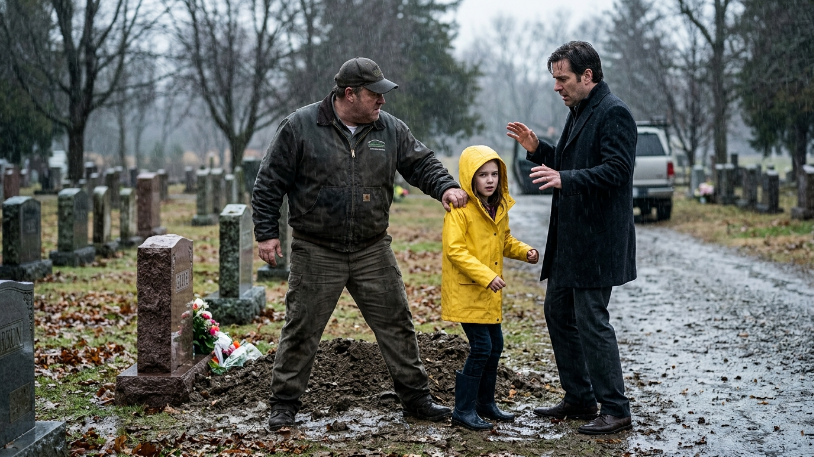
PART 2: The caretaker’s heavy leather work boot caught the girl right in the shoulder, shoving her backward into the sinking mud of my nephew’s grave.
Have you ever discovered a piece of evidence that proved everyone you trusted was lying to you, but you knew taking it to the authorities would only put you in worse danger? Tell me what you would do if you realized the people meant to protect your family were the ones actively covering up the truth.
The heavy steel flashlight came down with a terrifying, blinding speed.
If the mud hadn’t been so slick beneath my boots, Arthur would have crushed my skull right there on the edge of my nephew’s grave.
My left foot slid out from under me in the sinking, rain-soaked earth, dropping my body weight just enough to throw off the caretaker’s violent swing.
The thick metal cylinder whistled through the cold air, missing my temple by less than an inch and violently grazing the heavy fabric of my jacket shoulder.
The sheer force of his missed swing pulled Arthur forward, his massive frame suddenly off balance in the pouring rain.
I didn’t try to stand up or back away.
I let my momentum carry me forward, driving my shoulder as hard as I possibly could directly into Arthur’s stomach.
All the air rushed out of the massive caretaker’s lungs in a violent, wet gasp.
We both slammed hard into the flooding mud between the rows of granite headstones.
The impact rattled my teeth, but pure, blinding adrenaline had completely taken over my nervous system.
Arthur immediately threw a brutal, closed-fist punch that caught me right in the ribs, the blow heavy enough to crack bone.
I ignored the sharp, burning pain.
I didn’t care about hitting him back.
My eyes were locked entirely on the heavy iron ring of keys secured to the leather loop on his thick work belt.
Arthur roared in anger, raising the steel flashlight again to bring it down directly onto the back of my neck.
I grabbed the heavy metal keyring with both hands and twisted upward with absolutely everything I had.
The old leather belt loop snapped with a sharp, satisfying tear.
I ripped the massive iron keys away from his waist, driving my knee hard into his chest to push myself backward, sliding away from him through the freezing mud.
Arthur scrambled wildly, his heavy boots kicking up chunks of wet grass as he tried to grab my ankle, but I was already rolling to my feet.
“Help!” the little girl in the yellow raincoat screamed, her small voice finally cutting clearly through the howling thunderstorm.
She wasn’t screaming for me to help her.
She was screaming for me to help whoever was trapped behind the corrugated steel door.
I turned my back on the stunned caretaker and sprinted as fast as I could through the rain toward the dark green maintenance shed.
The heavy, rhythmic pounding from inside the metal structure had suddenly stopped, replaced by a terrified, suffocating silence.
Whoever was in there knew exactly what was happening outside.
I reached the heavy steel door, my hands trembling violently as I grabbed the massive, rusted iron padlock holding the thick latch closed.
There were at least twenty different keys on Arthur’s heavy iron ring.
I frantically jammed the first large key into the padlock, but it wouldn’t turn.
“You’re dead, Mark!” Arthur bellowed from behind me, his voice raw with panic and rage as he finally managed to drag his heavy frame out of the mud.
I glanced over my shoulder.
He was thirty yards away, clutching his ribs, gripping the heavy steel flashlight, and charging directly toward me like a massive, terrifying wall of violence.
I jammed a second, jagged brass key into the bottom of the rusted lock.
It slid in perfectly.
I twisted it hard to the right.
The heavy internal mechanism clicked loudly, and the heavy iron padlock popped open in my freezing hands.
I ripped the lock off the metal latch, threw it onto the wet grass, and grabbed the cold steel handle of the heavy shed door.
I pulled it open, throwing my entire body weight backward to rip the rusted hinges apart.
The smell hit me the second the door swung wide.
It was an overpowering, suffocating mixture of chemical fertilizer, stale ammonia, and raw, wet earth.
The inside of the windowless shed was pitch black, completely shielded from the afternoon storm.
“Hey!” I yelled into the darkness, stepping quickly inside and pulling the heavy door partially shut behind me to block Arthur’s line of sight. “Who’s in here? I have the keys.”
There was a sudden, terrified scramble of movement from the far back corner of the shed.
It sounded like someone violently crawling backward over plastic bags of soil, desperate to get away from the door.
I pulled my cell phone out of my soaked jacket pocket and quickly turned on the bright LED flashlight feature.
I shined the narrow white beam of light deep into the suffocating darkness of the maintenance shed.
The light swept over stacked bags of landscaping lime, heavy rusted shovels, and a row of old gasoline cans.
Then, the bright beam hit something sitting right in the middle of a wooden workbench.
My breath completely stopped.
My heart felt like it had been violently ripped out of my chest.
It was a small, bright red backpack with a familiar blue spider web pattern printed across the front zipper.
Leo’s school backpack.
The exact same bag the local police explicitly told my devastated sister had been swept away in the fast-moving river current at the rock quarry.
It was sitting right here, perfectly dry, hidden in the dark corner of a cemetery maintenance shed.
“Don’t hurt me,” a terrified, cracking voice begged from the shadows directly beneath the wooden workbench. “Please, man. I swear to God I won’t tell anyone.”
I immediately lowered the bright flashlight beam, aiming it at the dirty concrete floor.
Huddled in the corner, wedged tightly between two massive, torn bags of fertilizer, was a teenage boy.
He couldn’t have been older than sixteen.
He was wearing a filthy, oversized grey hoodie, his knees pulled tightly to his chest, trembling so violently his teeth were actually chattering.
His face was severely bruised, his bottom lip split and bleeding, and his dark eyes were wide with absolute, primal terror.
“I’m not him,” I said quickly, keeping my voice as low and calm as I possibly could over the sound of the rain pounding against the metal roof. “I’m not Arthur. I just fought him outside. I’m the one who unlocked the door.”
The teenager blinked, shrinking further back into the dark corner, clearly not believing a single word I was saying.
“He said he was going to bury me,” the boy sobbed, wiping a mixture of blood and dirt from his pale cheek. “He said if I didn’t tell him where the phone was, he was going to put me in the ground just like the little kid.”
The words hit me like a physical, suffocating weight.
Just like the little kid.
“What little kid?” I asked, taking one slow, careful step forward. “My nephew? Leo?”
The teenager looked up at me, his terrified eyes locking onto mine as he realized why I was actually out here in the storm.
“That was your nephew?” the boy whispered, his voice cracking with absolute horror.
I nodded, feeling a cold, violent wave of sickness wash entirely through my body.
“My name is Toby,” the teenager said, his breath hitching as he struggled to speak. “I’m a runaway. I’ve been sleeping in the old pump station down by the rock quarry for a few weeks.”
I knew the pump station.
It was an abandoned, heavily rusted structure sitting right on the edge of the deep water, just a few hundred yards from where they claimed Leo had slipped and drowned.
“What did you see, Toby?” I asked, kneeling down on the cold concrete floor so I was directly at his eye level. “You have to tell me right now. That man is coming to this door in about ten seconds.”
Toby swallowed hard, his eyes darting frantically toward the heavy metal door.
“They’ve been dumping stuff,” Toby rushed out, the words pouring out of him in a desperate, panicked flood. “Arthur and some other guys in suits. They bring these massive tanker trucks to the edge of the quarry at night. They hook up these huge, thick hoses and just pump hundreds of gallons of this foul, toxic sludge straight into the water.”
My mind raced, trying to process the sheer scale of what he was saying.
The rock quarry fed directly into the town’s main reservoir.
Dumping toxic chemicals there wasn’t just a crime; it was an active, massive environmental disaster that would poison the entire county.
“I stayed hidden,” Toby continued, shivering uncontrollably. “I watched them do it twice. But last Tuesday afternoon, they brought a truck in broad daylight. Arthur was arguing with a guy in a suit. He called him Mayor.”
The Mayor.
The exact same corrupt politician who had rushed over to my sister’s house to personally offer his condolences and ensure the autopsy was pushed through without a single question.
“And then he showed up,” Toby whispered, pointing a shaking finger toward the red Spider-Man backpack on the workbench. “The little boy. He rode his bike right down the dirt trail. He was just looking for frogs near the water.”
I closed my eyes, a single, hot tear cutting through the freezing rain still covering my face.
Leo loved catching frogs in the spring.
“Leo saw the trucks,” Toby said, his voice breaking into a quiet sob. “He saw the sludge pouring into the water. He didn’t run away. He just stood there and pulled out his phone. He started recording them.”
My eyes snapped open.
“Arthur saw the flash on the kid’s camera,” Toby choked out. “He screamed at him. The kid got scared. He dropped his blue rubber ball and started running toward the steep rocks to get away. But Arthur is huge. He caught up to him so fast.”
I gripped the edge of a heavy fertilizer bag, my knuckles turning completely white.
“Arthur didn’t even slow down,” Toby said, burying his face in his dirty hands. “He just shoved him. Hard. The kid went over the edge. He hit the rocks at the bottom. He never even made it to the water.”
A heavy, suffocating silence filled the dark shed, broken only by the relentless pounding of the storm outside.
Leo didn’t slip.
My brave, smart, beautiful seven-year-old nephew saw something terrible happening in his town, and he tried to capture it.
And he was murdered for it.
“Arthur grabbed his backpack,” Toby said, looking up at me with terrified eyes. “But the kid’s phone had fallen into the tall grass. I saw where it landed. When Arthur and the Mayor dragged the kid’s body down toward the water to make it look like drowning, I ran out and grabbed the phone. I knew it was the only proof.”
“Where is it?” I demanded, standing up quickly. “Toby, where is the phone?”
“I ran,” Toby said. “But Arthur saw me moving in the brush. He chased me down. He beat the hell out of me and dragged me here. He’s been keeping me locked in this shed for days, trying to starve me into telling him where I hid the evidence.”
“Where is it?” I asked again, my voice hardening.
Toby reached behind him, plunging his arm deep into a torn, open bag of heavy potting soil.
He dug around for a few seconds before pulling out a small, rectangular object completely encased in a thick, protective blue plastic shell.
It was Leo’s phone.
The screen was severely cracked, the bright blue case smeared with thick, heavy dirt, but it was entirely intact.
“I turned it off to save the battery,” Toby said, pressing the muddy device into my open hand. “The video is still right there on the lock screen. It shows everything. It shows the Mayor giving the order. It shows Arthur doing the dumping.”
I stared down at the small, cracked phone.
It felt heavier than a brick in my hand.
This was it.
This was the absolute destruction of every single man who had a hand in putting my nephew in the ground.
“We have to call the police,” I said, immediately reaching for my own cell phone to dial 911. “I’m getting you out of here right now.”
Toby lunged forward, grabbing my wrist with a desperate, terrifying strength.
“No!” Toby screamed, his eyes wide with absolute panic. “You can’t call them! You can’t!”
“Toby, calm down,” I said, trying to pull my arm away. “The state police will come—”
“The local chief was there!” Toby yelled, his voice echoing loudly in the cramped shed. “The town police chief! He drove the pilot car that guided the tanker trucks into the quarry! He watched Arthur push the kid! He helped them cover it up!”
I froze completely.
The police chief.
The man who had stood in my living room, holding his uniform hat over his heart, swearing to my devastated sister that his officers had searched every inch of that quarry and found nothing suspicious.
He was on the payroll.
He was one of them.
If I dialed 911 right now, the local dispatch would immediately send the chief and his corrupt deputies straight to this cemetery.
They wouldn’t arrest Arthur.
They would just bury Toby and me right next to Leo.
I heard the heavy, aggressive squelch of boots stepping loudly through the mud just outside the metal door.
Arthur had finally reached the shed.
“You’re a dead man, Mark,” Arthur hissed from the other side of the heavy steel. “There’s no way out of there. I’m locking you in.”
My mind moved with a cold, terrifying clarity.
Arthur didn’t know I had the phone.
He didn’t know Toby had just given me the only piece of evidence that could destroy his entire life.
He thought he had me trapped like a rat.
“Toby,” I whispered, pulling the heavy steel padlock off the floor and grabbing the heavy iron keys. “I need you to listen to me very carefully. I am going to step outside and close this door. I am going to put the padlock back on and lock you inside.”
Toby’s eyes widened in absolute horror. “No! Please! He’ll kill me!”
“He doesn’t want you,” I said quickly, slipping Leo’s muddy phone deep into the inside pocket of my jacket. “He wants me now. If I lock this door myself, I control the keys. Arthur won’t be able to get back inside to hurt you. You are safer behind this heavy steel door than you are out there in the rain with him.”
Toby stared at me, trembling, but he slowly nodded his head.
“I am going to end this today,” I promised him, my voice completely devoid of any fear. “I am going to finish what my nephew started.”
I didn’t wait for him to answer.
I slipped through the heavy metal door and pulled it violently shut behind me.
The loud, metallic slam echoed across the entire cemetery.
I immediately snapped the heavy iron padlock back onto the rusted latch and clicked it firmly shut, locking Toby safely inside.
I turned around, slipping the massive iron keyring securely into my pocket.
Arthur was standing ten feet away, panting heavily, his massive chest heaving beneath his soaked canvas jacket.
He was gripping the heavy steel flashlight with both hands, a vicious, triumphant smirk spreading across his scarred, muddy face.
“You should have just walked away and grieved quietly,” Arthur sneered, taking a slow, aggressive step toward me.
Before I could say a single word, the loud, piercing wail of a police siren cut sharply through the heavy storm.
Flashing red and blue lights illuminated the blinding sheet of rain, painting the wet granite headstones in harsh, strobe-like colors.
A heavy, dark SUV with the town police logo printed on the side aggressively hopped the curb and slammed into park directly in front of the main iron gates.
The driver’s side door swung open, and the corrupt police chief stepped out into the pouring rain.
Arthur’s violent smirk grew even wider, his cold eyes gleaming with absolute victory.
“Looks like your ride is here, Mark,” Arthur laughed, lowering the steel flashlight. “Trespassing. Assaulting a town employee. Resisting arrest. You’re going to be locked in a holding cell for a very long time. And while you’re sitting in the dark, I’m going to take my time dealing with our little rat problem in the shed.”
I didn’t look at Arthur.
I didn’t try to run, and I didn’t raise my hands in surrender.
I just stood perfectly still in the freezing rain, feeling the solid, heavy weight of my nephew’s cracked phone resting silently against my chest.
Arthur thought he had just won the game.
He had absolutely no idea the rules had just completely changed.
The heavy blue and red strobe lights of the police cruiser chopped through the dark afternoon downpour, splashing violent, rhythmic colors across the grey granite face of my nephew’s headstone.
The driver’s side door of the SUV swung open with a heavy, wet creak.
Chief Thomas stepped out into the mud, his massive, black leather rain slicker glistening under the flashing lights as he adjusted the wide brim of his official campaign hat.
He didn’t look like a man coming to investigate a disturbance; he looked like a landlord arriving to evict an unwanted tenant from his property.
His heavy boots sank deep into the waterlogged grass as he walked directly toward us, his hand resting casually on the heavy leather holster at his hip.
“Arthur,” Chief Thomas barked, his deep, booming voice instantly cutting through the steady roar of the storm. “What the hell is going on out here? The Mayor’s office said you called in a code-red trespasser.”
Arthur immediately stumbled forward, faking a heavy, dramatic limp as he clutched his ribs with one hand and pointed his heavy steel flashlight at me with the other.
“It’s Mark,” Arthur lied, his voice pitching into a strained, breathless whine that made him sound like the victim of a brutal, unprovoked attack. “The guy has completely lost his mind, Chief. He came onto the property after hours, assaulted me in the mud, and tried to break into the main maintenance shed with a stolen ring of keys.”
Chief Thomas stopped five feet away from me, his small, dark eyes narrowing behind his rain-spattered glasses.
He didn’t ask for my side of the story. He didn’t ask why my clothes were completely covered in dark brown sludge, or why Arthur was holding a weapon that could easily crack a man’s skull wide open.
“Get your hands out of your pockets, Mark,” Chief Thomas ordered, his voice cold, flat, and entirely drained of any human empathy. “You’re under arrest for criminal trespassing, felony assault, and destruction of town property.”
I didn’t move my hands.
I kept my right hand buried deep inside the inner pocket of my soaked canvas jacket, my thumb pressed firmly against the heavy plastic edge of Leo’s cracked, muddy cell phone.
I didn’t say a single word.
The sheer, suffocating weight of their betrayal sat heavy in my chest, but I knew that any words coming out of my mouth right now would just be used to paint me as an unstable, grieving lunatic.
Silence was the only shield I had left until the stage was properly set.
“Did you hear me, boy?” Chief Thomas sneered, stepping closer until the heavy, artificial scent of his cheap cologne mixed with the metallic smell of the rain. “I said take your hands out of your jacket right now, or I will drop you into the mud myself.”
“He’s dangerous, Chief,” Arthur chimed in from behind him, his eyes-darting nervously toward the locked green maintenance shed forty yards away. “He’s got something in his pocket, and he’s been acting completely erratic ever since he got to the lot. You need to cuff him before he tries to run for the woods.”
Before Chief Thomas could reach for the heavy iron handcuffs at his belt, the low, synchronized rumble of multiple car engines echoed from the front entrance of the cemetery.
A long, somber convoy of heavy black sedans and family SUVs began rolling slowly through the open iron gates, their headlights cutting bright, misty yellow lines through the thick sheet of falling rain.
It was the afternoon crowd arriving for the scheduled public memorial service of Mrs. Gable, the matriarch of one of the oldest and most prominent families in the county.
Within minutes, dozens of local townspeople were spilling out of their vehicles, popping open wide black umbrellas, and gathering in a heavy, quiet crowd near the outdoor stone chapel just fifty yards away from where we stood.
Among them was the young church AV technician, pushing a heavy, rolling plastic cart loaded with professional audio equipment and a tall tripod for the official town livestream camera.
Because Mrs. Gable had been a beloved high school principal for nearly forty years, the town council had officially ordered the entire outdoor service to be broadcast live on the public municipal page for the hundreds of elderly residents who couldn’t make it out in the severe storm.
The technician frantically began plugging heavy black cables into the cemetery’s permanent outdoor Bluetooth loudspeaker system, a network of four massive, weatherproof audio horns mounted high on the stone pillars surrounding the burial plots.
Arthur saw the growing crowd of locals and immediately shifted his posture, putting on a grand display of public safety and professional concern.
“Folks, please stay back near the stone chapel!” Arthur shouted across the grass, waving his heavy steel flashlight to guide the mourners away from us. “We have an active, dangerous situation over here by the fresh graves. A trespasser has assaulted cemetery staff. Please maintain your distance for your own safety!”
Several townspeople stopped in their tracks, turning their heads in shock as they recognized me standing there in the mud, surrounded by the flashing lights of the police cruiser.
“Is that Mark?” a woman’s voice whispered from beneath a large golf umbrella. “What is he doing out here? His nephew’s funeral was just days ago.”
“The poor man must have completely snapped,” an older man muttered, shaking his head in pity. “Look at the state of him. He’s completely covered in dirt.”
Chief Thomas took advantage of the public audience, stepping forward with an aggressive, performative authority as he ripped the heavy steel handcuffs from his leather utility belt.
“Arthur’s right, Mark,” Chief Thomas said loudly, making sure his voice carried over to the gathering crowd of townspeople. “You’re distraught. You’re suffering from severe emotional distress, and you’re causing a massive public disturbance during a sacred service. Turn around and give me your hands before this gets ugly in front of your neighbors.”
Arthur let out a quiet, mocking laugh under his breath, his eyes gleaming with absolute, untouchable arrogance as he leaned against a marble headstone.
“He belongs in a psych ward, Chief,” Arthur whispered loud enough for the nearest mourners to hear. “He’s been screaming about conspiracies and ghosts ever since he walked onto the grass. The man has completely lost his grip on reality.”
I still didn’t say a word.
Instead, my thumb quietly navigated the wet, cracked touchscreen of Leo’s phone inside my deep jacket pocket.
I slid my finger across the glass, entering the simple four-digit passcode my nephew had used for years—the date of his mother’s birthday.
The phone vibrated twice against my hip, a subtle, rhythmic pulse that told me the device was fully unlocked.
I opened the wireless settings, my finger blindly tapping the familiar Bluetooth pairing icon that I had set up for Leo months ago so he could listen to music on his small bedroom speaker.
Because the cemetery’s massive outdoor PA system was currently switched on and searching for a guest audio connection for the upcoming funeral service, Leo’s phone detected the signal instantly.
A sharp, digital chime echoed quietly from inside my jacket pocket as the phone successfully paired with the commercial amplifier.
Fifty yards away, the four massive stone-mounted loudspeakers let out a heavy, low electronic hum that caused the AV technician to pause and look up at the stone pillars in confusion.
“Last warning, Mark,” Chief Thomas growled, his thick fingers wrapping violently around my left wrist, pulling my arm out of my pocket to force it behind my back. “Don’t make me use force in front of the whole town.”
I didn’t resist his grip.
I used my free right hand to pull Leo’s muddy, blue-cased phone completely out of my jacket, holding it high in the air for everyone to see.
“What the hell is that?” Chief Thomas muttered, his eyes locking onto the cracked screen as he tried to snatch the device away from my fingers.
Before his heavy hand could close around the plastic case, my thumb slammed hard against the large triangle play button sitting right in the center of the screen.
The entire cemetery went completely, terrifyingly loud.
A massive blast of white static roared out of the four stone-mounted loudspeakers, a sound so sudden and immense that it caused several women in the crowd to scream and drop their umbrellas into the mud.
Then, the static cleared, replaced by the loud, undeniable sound of heavy engines idling, rushing water, and the deep, metallic sloshing of liquid inside a commercial tanker truck.
Arthur’s voice blasted across the gravestones, amplified ten times over by the heavy commercial speakers, filling the valley with a booming, gravelly roar.
“Just open the damn valve, Arthur! The Mayor said we need this entire load of sludge dumped into the quarry before the rain stops! If the EPA testers show up on Monday, we’re all going to federal prison!”
The AV technician froze on his knees, his hands hovering over his mixing board as he realized the audio wasn’t coming from his own equipment.
The crowd of fifty townspeople turned as one solid unit, their eyes ripping away from the stone chapel to stare in absolute, breathless horror at the loudspeakers.
Chief Thomas’s hand completely froze on my wrist. His grip didn’t just loosen; it turned completely limp, his fingers trembling against my skin as his face drained of every ounce of color, turning a sickening, ash-grey under the flashing police lights.
The recording didn’t stop.
Another voice cut through the heavy rain—a smooth, articulate, slightly nasal voice that every single resident in that cemetery recognized instantly.
It was Mayor Higgins.
“Keep your voice down, you idiot,” the Mayor’s recorded voice snapped from the speakers, clear and crisp despite the background noise of the trucks. “We don’t have all day. Chief Thomas already has his deputies blocking the main access trails down by the highway. Just get the hoses connected and dump the waste.”
A collective, sharp gasp rippled through the crowd of townspeople.
“Is that… is that the Mayor?” a woman cried out, her eyes wide with disbelief as she stared directly at Chief Thomas.
“And he just mentioned the Chief,” a man shouted from the back of the crowd, pulling out his own cell phone and aiming the camera directly at the police cruiser. “They’re talking about the quarry!”
Arthur’s arrogant smirk didn’t just vanish; it looked like it had been violently ripped off his face by a physical blow. He stumbled backward away from the marble headstone, his heavy steel flashlight slipping from his hand and clattering loudly against the wet stone walkways.
“Turn it off!” Arthur shrieked, his voice cracking into a high-pitched, desperate panic as he lunged toward me. “Chief, shoot him! Smash the phone! Turn the damn speakers off!”
But Chief Thomas couldn’t move. He stood there paralyzed, his heavy leather handcuffs dangling uselessly from his shaking fingers as the most devastating part of the recording began to play.
A child’s voice.
Small, innocent, and catching slightly in his throat from fear.
“Uncle Mark? Mom? What are you guys doing to the water? Why is it turning green?”
My heart shattered into a thousand pieces all over again hearing Leo’s voice echo across his own fresh grave, but I held the phone perfectly steady, my arm extended high into the pouring rain.
On the loudspeaker, Arthur’s recorded voice let out a terrifying, animalistic scream.
“Hey! Who the hell is that? Look over there by the rocks! It’s the Davis kid! He’s got a camera! Drop that phone, you little brat!”
The audio captured the frantic, horrifying sound of small sneakers scraping wildly against jagged gravel. It was a breathless, terrifying chase, the sound of my seven-year-old nephew gasping for air as he tried to run up the steep dirt trail to save his own life.
The crowd of townspeople was completely silent now, the only sound among them being the quiet, uncontrollable sobbing of several neighbors who had known Leo since he was a baby.
Then came the sound that would haunt this town for the next fifty years.
A heavy, brutal physical impact. A sharp, terrifying scream from a child that cut off completely with a dull, hollow, sickening thud against the rocks.
“He’s not moving, Mayor,” Arthur’s recorded voice returned after a long, agonizing pause, his breathing heavy and ragged. “He went right over the steep ledge. He hit the granite at the bottom. What the hell do we do now? He’s dead.”
The Mayor’s voice came back, cold, calculated, and entirely devoid of any human emotion.
“Listen to me very carefully, Arthur. Pick up his backpack. Throw his blue rubber ball down into the water near the deep end. We clear the trail completely. Then you call Chief Thomas on his personal line. Tell him we had a tragic, clumsy drowning accident at the quarry. Have his river search team place the body in the deep water before the morning shift comes in. Nobody can ever know he was up here.”
The recording clicked shut.
The sudden silence that followed was heavier than the storm itself.
The entire cemetery stood frozen in time, the only sound being the relentless, steady thud of the rain hitting the hundreds of grey headstones stretching across the valley.
Arthur was staring at the speakers on the stone pillars, his eyes wide and hollow, his mouth hanging completely open as he shook his head in a frantic, desperate denial.
“It’s a fake,” Arthur whimpered, his voice barely a whisper as he looked around at the crowd of his neighbors. “It’s a digital lie. Mark altered the audio. I didn’t touch the kid. I swear to God, I didn’t touch him!”
But nobody was looking at Arthur with pity or confusion anymore.
The crowd of mourners began moving forward as one massive, angry wave, their black umbrellas tilting back as they pulled out their personal cell phones, pointing dozens of active camera lenses directly at Arthur and Chief Thomas.
“You murdered him!” a man screamed from the front line of the crowd, his face twisted in absolute fury as he stepped onto the grass. “You pushed a seven-year-old boy off a cliff to cover up your toxic garbage!”
“And the Chief helped him do it!” a woman yelled, her camera tracking Chief Thomas as the massive officer began backing away toward his idling cruiser. “Look at him! He’s trying to run! He’s part of the murder!”
That was the exact moment the young AV technician shouted from his mixing board, his voice trembling with a mixture of fear and triumph.
“Chief! Don’t bother trying to delete it!” the boy yelled, pointing at the tall tripod standing near the chapel. “The main audio feed for the Mrs. Gable service was already live on the town’s public Facebook page! The microphone on the podium picked up every single second of that recording! Over four thousand people are watching the live broadcast right now!”
The final piece of their protective armor shattered into absolute dust.
The political connections, the corrupt mayor’s office, the local police department’s absolute control over the town—all of it was completely obliterated in a single, unedited digital broadcast that could never be taken back.
Chief Thomas looked at the tall tripod, then at the dozens of local residents recording his every movement, and finally at the flashing lights of his own police vehicle.
He knew the rules of the game had just permanently changed. He knew that within thirty minutes, the county sheriff and the state police would be swarming this cemetery, driven by the thousands of outraged citizens demanding immediate justice online.
The corrupt chief made a sudden, cold calculation to save his own skin.
He turned his back on Arthur, completely ignoring the caretaker’s desperate, pleading eyes.
Thomas dropped the heavy metal handcuffs into the mud, reached up to the small microphone clipped to his uniform shoulder rain slicker, and pressed the talk button with a violently shaking hand.
“Dispatch, this is Chief Thomas,” he rasped, his voice cracking into the radio as he continued to back away toward his car. “I need an immediate patch through to the State Police Headquarters in the capital. Requesting maximum backup, state investigators, and a transport unit to the south lot of the town cemetery. We have… we have a major felony situation here. Immediate assistance required.”
Arthur stared at his long-time partner in absolute, paralyzed betrayal as the loud, rhythmic wail of distant sirens began to echo from the highway miles away.
The power dynamic had completely collapsed in the rain, and the first steps of righteous justice were finally moving toward my nephew’s grave.
The sirens were getting louder by the second, cutting through the heavy afternoon storm, and I finally let myself take a deep, steady breath as I looked down at the muddy blue rubber case in my open hand.
The battle for the truth had been won in front of the entire town, but the final consequences for the men who put Leo in the dirt were only just beginning.
The high-pitched, synchronized wail of state police sirens grew deafeningly loud, drowning out the steady rumble of the thunderstorm.
Five stark white utility cruisers tore through the main iron gates of the cemetery, their heavy tires carving deep, aggressive ruts into the pristine green lawn.
They skidded to a violent halt in a wide, sweeping arc, completely boxing in Chief Thomas’s local department SUV and cutting off every single exit from the south lot.
Before the vehicles had even fully stopped moving, a dozen state troopers in crisp, dark blue uniforms slammed their doors open, their heavy service weapons drawn and held perfectly level in the driving rain.
“State Police! Nobody move! Drop your weapons and put your hands on your heads!” a commanding voice boomed through a high-powered vehicle megaphone.
Captain Vance, a tall, stern-faced investigator with cold grey eyes, stepped directly into the mud, his heavy black combat boots splashing water high into the air as he marched toward us.
Chief Thomas immediately raised his hands high above his campaign hat, his heavy leather handcuffs slipping from his trembling fingers and sinking directly into the flooding grass.
“Captain, thank God you’re here,” Thomas stammered, his voice cracking with a desperate, pathetic attempt to regain control of the situation. “I have the scene secure. The suspect, Mark Davis, is completely unstable. He’s been harassing the cemetery staff and—”
“Shut your mouth, Thomas,” Captain Vance snapped, not even looking at the local chief as he walked right past him.
Two heavy state troopers stepped up behind Chief Thomas, roughly grabbing his arms and forcing them behind his back.
The sharp, metallic click of real, state-issued handcuffs echoed clearly across the silent graveyard.
“You’re stripping my badge?” Thomas gasped, his face turning an even deeper, more sickening shade of ash-grey. “On what grounds?”
“Conspiracy to commit murder, tampering with evidence, and felony violation of the public trust,” Captain Vance said coldly, turning his sharp gaze toward the tree line. “The state dispatch received the live municipal audio feed fifteen minutes ago. The governor’s office personally authorized your immediate detention.”
Arthur saw the absolute finality in the captain’s eyes and realized his political protection had completely evaporated.
The massive caretaker turned his heavy frame toward the dark woods, attempting to sprint away through the slick, treacherous mud between the rows of granite headstones.
He didn’t make it five steps.
Two state troopers lunged forward, tackling Arthur entirely from behind and sending his massive body crashing face-first into the exact patch of loose, sinking earth where he had violently thrown the little girl earlier.
Arthur let out a sharp, pathetic squeal as his face was pressed deep into the dark brown sludge.
The arrogant, lethal monster who had stood over my nephew’s grave with a steel flashlight was completely gone.
In his place was a broken, terrified criminal, sobbing loudly into the wet dirt as the heavy metal cuffs were locked tightly around his thick wrists.
“I was just following orders!” Arthur shrieked, his voice muffled by the mud as he kicked his heavy boots wildly. “The Mayor told me what to do! He said he’d fire me if I didn’t get rid of the kid’s things! It wasn’t my idea!”
“Save it for the state prosecutors,” Captain Vance muttered, before turning his attention directly to me.
I was still standing perfectly still in the rain, my arm finally lowering as I securely tucked Leo’s cracked, blue-cased phone into my safest inner jacket pocket.
“Mark Davis?” the captain asked, his tone softening just a fraction into something resembling professional respect.
“Yes,” I said, my voice hoarse, my chest heaving as the pure adrenaline finally began to drain from my system.
“Where is the teenage witness mentioned in the audio recording?” Vance asked, his eyes darting toward the dark green maintenance structure.
I didn’t answer with words.
I reached deep into my pocket, pulled out Arthur’s heavy iron keyring, and marched directly toward the corrugated steel door.
Captain Vance and three armed troopers followed closely behind my boots as I reached the massive, rusted padlock.
My hands were shaking violently from the freezing cold and the residual shock, but I managed to jam the jagged brass key into the lock and twist it hard.
The heavy latch popped open with a loud, echoey metallic clang.
I threw the steel door wide open, allowing the bright, sweeping high-beams of the state police cruisers to flood the pitch-black interior of the maintenance shed.
“Toby,” I called out gently into the darkness, stepping inside so he could see my face first. “It’s over. The real police are here. You’re safe.”
The teenage boy slowly crawled out from beneath the wooden workbench, his eyes blinking rapidly against the sudden, blinding white light.
He was still shivering uncontrollably, his face severely bruised and his clothes stained with chemical fertilizer, but the sheer, overwhelming relief that washed across his features was undeniable.
Two state police paramedics quickly rushed past me with a thick, warm wool blanket, gently wrapping it around Toby’s shoulders and helping him stand up on his trembling legs.
As they guided him out into the rain toward a waiting medical transport vehicle, Toby stopped right next to me, his dark eyes locking onto mine with a profound, silent gratitude.
“Thank you,” he whispered, his voice cracking with emotion. “Thank you for coming back for me.”
“Thank you for saving my nephew’s proof,” I replied softly, placing a steady hand on his shoulder. “You did the right thing, Toby. Leo would have thanked you too.”
The days that followed the confrontation at the cemetery moved with a swift, merciless legal velocity that completely transformed our small town.
The state attorney general’s office took complete control of the investigation, bypassing the corrupt local judicial system entirely.
By Monday morning, Mayor Higgins was arrested by federal marshals right in the middle of a city council meeting, captured in high-definition by local news crews as he was led out of city hall in handcuffs.
The digital video recovered from Leo’s phone was completely bulletproof.
It didn’t just show the illegal chemical dumping operation; it captured the exact moments of corporate negligence, financial corruption, and the direct orders to stage my nephew’s tragic accident.
The local police department was temporarily disbanded, placed under the direct supervision of the state highway patrol while a thorough investigation cleared out every single officer who had taken a bribe or looked the other way.
The rock quarry was locked down by federal Environmental Protection Agency teams, who immediately began a massive, multi-million dollar reclamation project to neutralize the toxic sludge before it could ever reach the town’s main reservoir.
Toby was placed into a highly secure, state-funded witness protection relocation program, ensuring he would receive the medical care, counseling, and safety he needed to completely rebuild his life far away from the shadows of our town.
But for my family, the real legal victories didn’t mean the nightmare was instantly over.
The emotional scars left by the corrupt leadership’s massive cover-up were deep, jagged, and agonizingly raw.
My sister had to endure the incredibly painful process of an official state exhumation, a necessary legal step to completely disprove the fraudulent autopsy report pushed forward by the mayor’s corrupt medical examiner.
Yet, out of that secondary heartbreak came a profound, beautiful shift in the entire community.
The townspeople, deeply ashamed that they had allowed themselves to be deceived by the corrupt leadership, rallied around my sister with an outpouring of love, support, and profound regret.
Two weeks later, the relentless, heavy gray rain clouds that had plagued the county for a month finally broke, entirely dissolving into a vast, brilliant blue sky.
The afternoon sun was bright, warm, and golden as the town gathered once again at the far south lot of the cemetery.
This wasn’t a rushed, secretive burial hidden away in a thunderstorm.
This was a massive, respectful, public memorial service officially organized by the new, honest administrative team appointed to run the municipal property.
Hundreds of local residents stood shoulder-to-shoulder on the dry green grass, many of them holding small bouquets of bright yellow sunflowers and wearing small blue ribbons pinned to their lapels to honor Leo’s favorite color.
The new town leadership unveiled a beautiful, polished bronze plaque near the entrance of the public park, permanently dedicating the new wildlife preservation trail to Leo Davis—the brave, intelligent boy who had sacrificed everything to protect his home.
Leo’s name was completely, permanently cleared from the insulting “clumsy accident” narrative the old mayor had pushed.
He was honored by his neighbors exactly for what he was: a hero.
Later that afternoon, long after the crowds of mourners had slowly drifted back to their cars and the quiet, peaceful silence of the valley had returned, I walked down the clean stone path toward the grave alone.
The air smelled incredibly sweet, filled with the scent of fresh cut grass and blooming summer flowers instead of the foul chemical stench of the old maintenance shed.
I stopped at the edge of the plot, looking down at the beautifully cleaned, sunlit granite headstone.
I reached deep into my pocket and pulled out the small blue rubber ball.
I had spent hours carefully washing away every single trace of the dark quarry sand and the graveyard mud, scrubbing the surface until the deep grooves carved into the rubber were pristine.
The two scratched letters—L.D.—stood out clearly in the warm sunlight.
I knelt down on the dry, solid grass, my hand moving with a slow, gentle reverence as I placed the blue ball softly against the base of the polished stone, right next to a fresh bouquet of white lilies.
“We did it, Leo,” I whispered, the crushing, suffocating weight that had rested on my chest for weeks finally lifting, allowing me to take a deep, clear breath of the warm afternoon air. “Everyone knows the truth now. You can finally rest.”
A sudden, soft movement near the main iron entrance gates caused me to slowly lift my head.
Standing beneath the shade of a massive, blooming oak tree was the little girl.
She wasn’t wearing the oversized, muddy yellow raincoat anymore.
She was wearing a simple, clean white summer dress, her pale face bright and beautiful in the golden afternoon light as she held the hand of a kind-faced woman who was smiling softly toward me.
The little girl looked across the quiet rows of headstones, her wide, expressive eyes locking onto mine one last time.
She raised her small hand and gave me a gentle, lingering wave—a silent, beautiful acknowledgment of the justice we had fought together to achieve.
Then, she turned and walked away down the sunlit sidewalk with her mother, disappearing into the peaceful afternoon.
I looked back down at the polished granite headstone.
The bright blue rubber ball sat perfectly still against the stone, reflecting the warm, golden rays of the sun, entirely free from the heavy weight of the rain.