
My K-9 Partner Broke Protocol To Shield A Silent Boy. When I Rolled Up His Sleeves, I Dropped To My Knees.
CHAPTER 1
They say dogs can smell fear. But Gunner? Gunner could smell secrets.
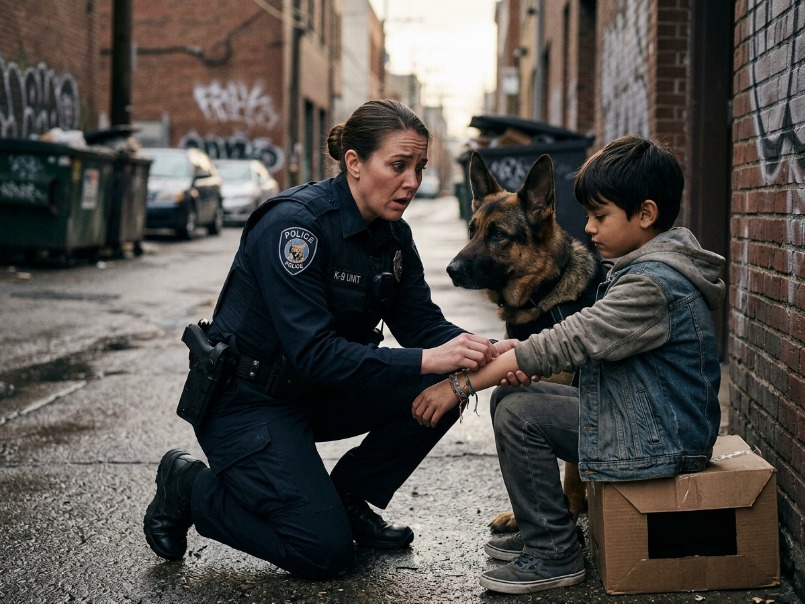
He was a ninety-pound Belgian Malinois, a missile of muscle and fur that I’d trusted with my life for four years. We’d tracked fugitives through swamps and sniffed out fentanyl in gas tanks. He was a machine. He didn’t have feelings; he had drive.
Or so I thought.
It was supposed to be a PR fluff piece. “Community Outreach.” That’s what the Chief called it. I called it a waste of a Tuesday. We were at St. Jude’s Academy, a place where the tuition cost more than my annual salary and the parents drove cars that looked like spaceships.
“Just keep him on a short lead, Mark,” my sergeant had said. “Don’t scare the donors.”
I stood on the manicured grass of the courtyard, sweating in my tactical vest. Twenty fourth-graders sat cross-legged in a semi-circle, watching us with that mixture of awe and boredom only rich kids possess.
“This is Gunner,” I said, my voice projecting the practiced authority of a ten-year veteran. “Gunner is trained to apprehend bad guys, but he’s also trained to listen. Discipline is the most important part of his job.”
I signaled the agitator—a rookie named Davis wearing the bite suit—to step out from behind the oak tree.
“Watch him,” I commanded. “Gunner! Watch!”
Gunner’s ears snapped forward. His body went rigid. He was locked in. This was the routine. We’d done it a thousand times. Davis would run, I’d give the command, Gunner would bite the sleeve, I’d call him off. Simple.
Davis took off running.
“Get him!” I shouted.
Gunner launched. The dirt kicked up behind him. He was a blur of tan and black speed. The kids gasped.
Then, halfway to the target, Gunner skidded.
He didn’t just stop; he pivoted mid-stride, his claws tearing up the expensive turf. He ignored Davis completely. He ignored my voice. He broke the cardinal rule of K-9 work: Never disengage until the threat is neutralized.
“Gunner! No! Here!” I yelled, confused.
The dog wasn’t looking at the bad guy. He was sprinting toward the children.
My heart hammered against my ribs. If he bit a kid, my career was over. If he bit a kid, the department was sued into oblivion.
“Gunner! PLATZ!” I roared the German command for ‘down.’
He didn’t down. He didn’t slow. He barreled straight into the group of sitting children. The kids screamed and scrambled back, a wave of blue blazers and plaid skirts tumbling over each other.
All except one.
A boy. Maybe eight or nine years old. Small for his age, with hair combed so neatly it looked painted on. He didn’t scream. He didn’t run. He just sat there, staring at the ground, his hands folded tightly in his lap.
Gunner slammed to a halt right in front of him.
I was sprinting now, my hand hovering near the release on my holster—not for a gun, but for the shock collar remote. But I didn’t press it.
Gunner didn’t bite.
He circled the boy once, whining—a high-pitched, desperate sound I’d never heard from him. Then, he sat. He sat directly on the boy’s sneakers, pressing his heavy ribcage against the kid’s shins. He faced outward, toward me, his hackles raised.
He wasn’t attacking. He was guarding.
The playground went silent. The other kids were huddled by the teacher, Mrs. Gable, who looked like she was about to faint.
“Officer Reynolds!” she shrieked. “Control your animal!”
“I’ve got him,” I said, though my voice lacked its usual confidence. I approached slowly. “Gunner. Heel.”
Gunner bared his teeth.
I stopped dead. My own dog. My partner. He was growling at me. It wasn’t the play-growl he did with his tug toy. This was a guttural, deep-chest warning. Do not come closer.
“Hey, buddy,” I said softly, crouching down to lower my threat profile. I looked at the boy. “You okay, son? He won’t hurt you. He likes you.”
The boy didn’t look up. He was trembling. Not the shaking of a kid scared of a dog—it was a vibration, constant and fine. He was staring at his own wrists.
“What’s your name?” I asked, inching forward.
“Leo,” he whispered. His voice was brittle, like dry leaves.
“Okay, Leo. I need to get my dog. He’s being a little silly today, huh?”
I reached for Gunner’s collar.
Gunner snapped. His jaws clicked shut inches from my hand.
“Hey!” I barked, losing my patience. “NO!”
The snap made Leo flinch. It wasn’t a normal flinch. It was a full-body convulsion. He threw his hands up to cover his face, curling into a tight ball, hyperventilating.
“Don’t tell,” Leo whimpered. “I didn’t do it. I was good. I was good.”
The words hit me like a splash of ice water. I was good. That wasn’t what a kid says when they’re scared of a dog. That’s what a kid says when they’re expecting pain.
I looked at Gunner. The dog wasn’t looking at me anymore. He was nudging Leo’s elbow with his wet nose, licking the fabric of the boy’s blazer, whining incessantly. He was obsessing over the boy’s left arm.
My police instincts overrides my embarrassment. Something was wrong. The air around the kid felt heavy, sour.
“Leo,” I said, my voice dropping to that serious tone I used for victims. “Did the dog hurt you?”
He shook his head violently, still hiding his face.
“Did someone hurt you?”
“Officer!” Mrs. Gable was marching over now, recovering her indignation. “This is unacceptable! That beast is terrorizing a student! I am calling the headmaster, and I am calling Leo’s father. Do you know who his father is?”
“Back off,” I said, not looking at her.
“Excuse me?”
“I said back off!” I snapped.
I reached out, ignoring Gunner’s low growl, and placed my hand gently on Leo’s forearm. Through the thick wool of the blazer, I felt it. Heat. Radiating heat. And something else. The texture underneath the fabric wasn’t smooth skin. It was lumpy. Uneven.
“Leo,” I whispered. “I need to see your arm.”
“No,” he gasped, pulling away. “He’ll be mad.”
“Who will be mad?”
“Dad.”
Gunner let out a sharp bark, looking toward the parking lot, then back to the boy. The dog knew. The dog knew and I was just catching up.
I moved my hand to the cuff of his blazer. “Leo, look at me. I’m a police officer. Nobody is going to hurt you while I’m here. Not Gunner. Not your dad. Nobody.”
The boy looked up. His eyes were old. Not the eyes of a child. They were hollow, exhausted, terrified eyes set in a pale face. He slowly lowered his guard.
I gripped the sleeve of his white dress shirt and the navy blazer.
“It’s okay,” I lied.
I rolled the fabric up.
The world stopped. The sounds of the playground—the wind in the trees, the distant traffic, the teacher’s gasping breath—all of it vanished.
My stomach turned over. I felt the blood drain from my face, leaving me cold and dizzy.
Leo’s arm, from his wrist to his elbow, was a landscape of horror.
It wasn’t just bruised. It was destroyed. There were circular burns, perfectly round, healing in different stages of scabbing. There were deep, purple indentations that looked like they came from a heavy grip.
But that wasn’t what paralyzed me.
Right in the crook of his elbow, on the tender skin where the veins are blue and visible, there was a cluster of puncture marks.
Track marks.
Fresh ones. Old ones. Collapsed veins.
I stared at them, my brain refusing to process the data. This was an eight-year-old boy at a private school. This wasn’t a junkie under a bridge.
“Oh god,” I breathed.
I looked at his other arm. I didn’t even have to roll it up. I could see the stain seeping through the white cuff. Fresh blood.
Gunner rested his head on Leo’s knee and let out a long, heavy sigh.
“Officer Reynolds?” Mrs. Gable’s voice was small now. She had seen it too.
I didn’t answer her. I couldn’t look away from the needle marks.
“Leo,” I choked out. “What is this? What are they giving you?”
He looked at me, tears finally spilling over those hollow ridges under his eyes. He leaned in close, so only I could hear.
“Ideally,” he whispered, using a word way too big for a second grader. “He says it makes me… perfectly still.”
The rage that hit me then wasn’t hot. It was absolute zero.
I stood up. I unclipped Gunner’s leash from my belt and clipped it to the boy’s belt loop.
“Gunner,” I said, my voice sounding like gravel. “Guard.”
The dog sat taller. He knew the order. He wasn’t a prop anymore. He was on duty.
I turned to Mrs. Gable.
“Lock the school,” I said. “Nobody leaves. Nobody enters.”
“But… his father is almost here,” she stammered. “He’s coming for early pickup.”
I looked toward the parking lot just as a sleek, black Mercedes sedan pulled up to the curb. The license plate didn’t have numbers. It just had a gold emblem. A judicial seal.
“Good,” I said, unsnapping the retention strap on my pistol. “Let him come.”
CHAPTER 2
The black Mercedes door opened with a heavy, expensive thud.
The man who stepped out looked like he belonged on a currency note. Tall, silver hair swept back with precision, a charcoal suit that cost more than my car. Judge William Thorne. I recognized him immediately. Everyone in the precinct knew him. “The Hammer,” they called him. Tough on crime. Tough on sentencing. A pillar of the community.
He adjusted his cufflinks, smiling that politician smile as he walked toward the gate. He didn’t see me yet. He didn’t see the horror on Mrs. Gable’s face. He just saw the school.
“Officer,” Mrs. Gable whispered, her hand trembling as she touched my arm. “You… you can’t. That’s Judge Thorne. He’s on the police oversight committee.”
“I don’t care if he’s the Pope,” I said. I didn’t take my eyes off him.
I looked down at Leo. The boy had gone catatonic the moment the car door opened. He was staring at his shoes, his breathing shallow and rapid. Gunner was vibrating against him, a low rumble building in the dog’s chest that sounded like a generator starting up.
“Leo,” I said quietly. “Stay with Gunner.”
I stepped between the boy and the gate.
Thorne walked through the wrought-iron entrance, spotting the scene. His smile faltered, just for a fraction of a second, before reassembling into a look of concerned authority.
“Is there a problem here?” His voice was a rich baritone, projected perfectly. “I saw the police cruiser. Is everyone safe?”
He walked right past me, heading straight for Leo.
“Leo, son. Get your bag. We have that appointment.”
“Stop,” I said.
It wasn’t a shout. It was a flat, hard command.
Thorne stopped. He turned to me, his eyebrows raising in polite confusion. He looked at my uniform, my rank insignia, scanning me like he was reading a menu.
“Officer… Reynolds, is it?” He read my name tag. “Is there a reason you’re addressing me that way? And why is that animal near my son?”
“The animal is the only reason your son is safe right now,” I said.
The courtyard was dead silent. The other kids were watching. The teachers were frozen.
Thorne’s eyes narrowed. The warmth vanished. “Excuse me?”
“Step away from the boy, sir.”
Thorne laughed. It was a dry, humorless sound. “Officer, I don’t think you understand the situation. I am Judge William Thorne. That is my son. I am taking him home. Now, move your dog before I have you fired and the dog destroyed.”
He took a step toward Leo.
Gunner exploded.
He didn’t just bark. He roared. He lunged to the end of the short leash attached to Leo, his teeth snapping inches from Thorne’s expensive suit. Foam flew from his mouth. It was the most aggressive display I had ever seen from him.
Thorne stumbled back, his face losing its composure. Fear. Pure, white-hot fear flashed across his eyes.
“Control that beast!” he screamed, his voice cracking.
“He is controlled,” I said, stepping forward so I was chest-to-chest with the Judge. “He’s reacting to a threat. Are you a threat, Judge?”
“I am his father!”
“Then why does he have needle tracks in his arm?”
The words hung in the air like smoke.
Thorne’s face went rigid. The fear vanished, replaced by a cold, calculating mask. He looked around the courtyard, checking the witnesses. He lowered his voice to a hiss.
“He has a condition. Diabetes. He requires insulin. You are making a scene, Officer, and you are making a very grave mistake. Now, give me my son.”
“Diabetes doesn’t cause cigarette burns,” I said, my hand resting near my belt. “And it doesn’t cause defensive bruising.”
Thorne leaned in. “You’re a beat cop with a dog. You have no idea what you’re stepping into. If you don’t walk away right now, you won’t just lose your job. I will make sure you are prosecuted for endangering a minor. I will bury you, Reynolds.”
It was a good threat. Delivered with the weight of the entire justice system behind it. A smarter man would have backed down. A man with a mortgage and a pension to worry about would have apologized.
But I looked back at Leo. The kid was holding onto Gunner’s fur like it was a life raft.
“You’re under arrest,” I said.
Thorne blinked. “What?”
“You heard me. Step back. Put your hands behind your back.”
“You have no warrant. You have no probable cause other than the reaction of a vicious animal.”
“I have exigent circumstances,” I said, reciting the code. “Reasonable belief of imminent danger to a child.”
“You are insane,” Thorne spat. He turned to Mrs. Gable. “Call the Chief of Police. Now! Tell him his officer has snapped.”
He turned back to Leo. “Leo. Come here. Now.”
Leo looked up. Tears were streaming down his face. He looked at me, then at his father.
“Don’t go, Leo,” I said.
Thorne lunged. He tried to grab Leo’s arm—the bad one.
I didn’t think. I reacted.
I swept Thorne’s legs. It was a standard takedown maneuver, but I put a little extra into it. The Judge hit the grass hard. The air left his lungs in a wheeze. Before he could scramble up, I had my knee in his back.
“Stop fighting!” I yelled, loud enough for the cameras that were surely recording on the parents’ phones by now. “Stop resisting!”
I pulled his wrists together. The cuffs clicked. Metal on bone.
“You are done,” Thorne hissed into the dirt, his face pressed against the grass. “You are dead. Do you hear me? Dead.”
“You have the right to remain silent,” I recited, breathing hard. “I suggest you use it.”
I hauled him up. His suit was grass-stained. His dignity was shredded. But his eyes… his eyes promised murder.
Sirens wailed in the distance. The cavalry was coming. But as I looked at the convoy of cruisers pulling into the school drive, I realized something terrifying.
They weren’t coming to help me.
The lead car wasn’t a patrol unit. It was the Chief’s SUV. And behind it, an unmarked black van that I recognized as Internal Affairs.
Thorne saw them too. He smiled. A bloody, jagged smile.
“I told you,” he whispered. “I made a call before I walked in.”
The Chief slammed his car door and marched toward us, his face purple with rage. He wasn’t looking at Thorne. He was looking at me.
“Reynolds!” he bellowed. “Release him! Immediately!”
“Chief, look at the kid’s arm!” I yelled back, holding Thorne’s arm tight. “He’s got track marks! The guy is drugging him!”
“I said stand down!” The Chief was in my face now. “Uncuff Judge Thorne. That is a direct order!”
I looked at the Chief. I looked at Thorne, smirking. I looked at Gunner, who was still shielding Leo, refusing to let any of the other officers near him.
“No,” I said.
The Chief froze. “What did you say?”
“I said no. I’m not releasing him into custody until Child Protective Services sees that boy.”
The Chief put his hand on my chest and shoved. “You’re relieved of duty, Reynolds. Give me your badge. Give me your gun.”
Two other officers, guys I played poker with on Fridays, stepped up behind him. They looked ashamed, but they had their hands on their holsters.
“Don’t make us do it, Mark,” one of them said.
I looked at Leo. If I gave up now, he went home with Thorne. If he went home with Thorne, he died. I knew it in my gut.
“I’m not giving you the gun,” I said, backing up toward Gunner and the boy. “And I’m not giving you the boy.”
“This is kidnapping, Mark,” the Chief warned. “Don’t do this.”
“It’s not kidnapping,” I said, reaching down and picking Leo up with one arm. He was alarmingly light. “It’s a rescue.”
“Gunner! Fuss!” I commanded. Heel.
For the first time that day, the dog listened to me instantly. He fell in beside my leg, placing himself between us and the wall of police officers.
“Get out of my way,” I said.
“Mark, you can’t walk out of here,” the Chief said. “We will take you down.”
“You can try,” I said, my hand tight on Leo’s back. “But you’re gonna have to shoot the best dog in the unit to get to me.”
I took a step forward. The officers hesitated. Nobody wanted to shoot Gunner.
“Move!” I screamed.
The line broke. Just a fracture. But it was enough.
I walked through the gap, the boy in my arms, the dog at my side, and the sound of my career shattering behind me.
CHAPTER 3
The walk to my cruiser was the longest fifty yards of my life.
It felt like walking underwater. Every sound was muffled, every movement slow. I could feel the eyes of twenty officers boring into my back. These were men and women I had barbecued with. I had backed them up in alleyways and on highways. Now, their hands were hovering over their weapons, and I was the target.
I held Leo tight against my chest. He was trembling so hard his teeth were chattering, a tiny, rhythmic clicking sound against my tactical vest. Gunner walked backward, his rear end bumping my leg, his teeth bared at the line of police closing in behind us. He was snarling, a continuous, wet, vicious sound that kept them at bay.
“Mark, stop!” The Chief’s voice was desperate now. “Don’t do this. You put that kid in the car, and there is no coming back.”
I reached the K-9 unit—a heavy-duty Tahoe with a reinforced cage in the back. I fumbled for my keys, my hands shaking. Not from fear. From adrenaline.
I beeped the locks.
“Get in,” I told Leo, opening the back door. The back of a K-9 unit isn’t a seat; it’s a flat platform with a metal kennel. Half for the dog, half for a prisoner. Or in this case, a refugee.
“Gunner, kennel!”
Gunner hesitated. He didn’t want to leave my side. He looked at the wall of cops, then at me.
“Go!” I shouted.
The dog leaped in. Leo scrambled in after him. I slammed the door and locked it.
I ran to the driver’s side and jumped in, hitting the door lock button the second I was inside.
Thud.
A hand slammed against my window. It was Officer Miller. He looked sick. “Mark, come on. Open the door. Don’t make us break the glass.”
I ignored him. I jammed the key in the ignition and turned it. The engine roared to life. I didn’t put it in drive. I wasn’t running. I knew I couldn’t outrun a radio. If I left this parking lot, they would PIT maneuver me into a ditch before I hit the highway.
No. I was digging in.
I grabbed the radio microphone. My thumb hovered over the transmit button. I took a breath. I knew that once I pressed this, every scanner in the county, every news desk, every neighboring precinct would hear me.
I pressed the button.
“Dispatch, this is K-9 One. I have an emergency at St. Jude’s Academy.”
The radio crackled. “Go ahead, K-9 One.”
“I have an eight-year-old male victim secured in my vehicle,” I said, my voice steady, loud, broadcasting to the world. “Severe physical trauma. Evidence of intravenous narcotic administration. I have multiple hostile subjects on scene attempting to impede the investigation. One subject is identified as Judge William Thorne.”
There was a long pause on the radio. The dispatcher was probably looking at her screen, confused, seeing that the Chief was already on scene.
“K-9 One, copy… is the scene secure?”
“Negative,” I said. “The hostile subjects are… local law enforcement.”
I looked out the window. The Chief was purple. He was screaming at Miller to break the window. But Miller wasn’t moving. He was listening to his shoulder radio. They all were. They were hearing me accuse the department of a cover-up in real-time.
Suddenly, the passenger door handle yanked violently. Locked.
I looked over. Judge Thorne was there. His suit was ruined, grass stains on the knees, tie askew. But his face was pressed against the glass, and it was a mask of pure, unadulterated evil.
He wasn’t shouting. He was mouthing words.
You. Are. Dead.
I picked up the mic again. “Dispatch, request immediate assistance from State Police and EMS. I am not opening this vehicle for anyone other than State Police. I repeat, I am barricaded until State arrives.”
It was a gamble. The “Blue Wall of Silence” is real. Cops protect cops. But I was betting that the horror of what I’d seen—the needle tracks on a child—was enough to crack that wall.
I turned around to look through the grate into the back.
Leo was curled up in the corner of the kennel. Gunner was lying across him, a heavy, furry blanket. The dog was licking the tears off the boy’s face.
“Leo?” I asked. “You doing okay back there?”
He nodded, small and jerky.
“Leo, I need you to tell me something. It’s really important.”
He looked at me through the wire mesh.
“The medicine,” I said. “Where does your dad keep it?”
Leo swallowed. He looked at the window where his father was still standing, glaring like a vulture waiting for a carcass.
“In the safe,” Leo whispered. “In the floor. In his office.”
“Does anyone else know?”
“Dr. Aris,” he said.
“Who is Dr. Aris?”
“He comes to the house. He brings the… the kit. He says I have bad blood. He says the medicine cleans it.”
Bad blood. The phrase made my skin crawl.
“Mark!”
The shouting outside had changed tone. I looked forward. The Chief was gone from my window. In his place was Captain Henderson, the shift commander. A good man. A man who had three kids of his own.
He held his hands up, palms open.
“Mark, roll the window down an inch. Just an inch. Please.”
I hesitated. Then, I cracked it. Just enough to hear, not enough for him to reach in.
“Cap, if you try to open this door—”
“I’m not,” Henderson said. His voice was low, urgent. “Mark, you just broadcasted a felony accusation against a sitting Judge and the Chief on an open channel. The media is already launching helicopters. You realized what you did?”
“I saved the kid, Cap.”
“Did you?” Henderson looked toward the school entrance. “Because Thorne is on the phone with the District Attorney right now. They are getting a warrant to extract the boy. They’re going to say you’re unstable. That you had a PTSD episode. They’ll take the kid, Mark. And once they have him, you know what happens.”
“They won’t get him,” I said. “Look at his arm, Cap! Just look at it!”
“I can’t see it from here,” Henderson said sadly. “But I believe you. The problem is, the law doesn’t work on belief. It works on procedure. And you just broke every procedure in the book.”
“Then get me a paramedic,” I said. “Get me a neutral medic to document the injuries right here. If a medic sees it, it goes on the medical record. Thorne can’t erase a hospital chart.”
Henderson stared at me for a long moment. Then he nodded.
“I’ve got an ambulance two minutes out. I’ll make sure they get to you. But Mark… once that door opens, I can’t stop the Chief. He’s going to arrest you.”
“I don’t care about me,” I said.
Henderson walked away. I watched him argue with the Chief. The Chief pointed at my truck, screaming. Henderson stood his ground, pointing at his watch.
Two minutes.
I turned back to Leo. “Hey, buddy. A nice lady or man is going to come look at your arm, okay? Just to put a bandage on it.”
“Will they make me go with him?” Leo asked. He didn’t say ‘Dad.’ He just said him.
“No,” I promised. A promise I wasn’t sure I could keep. “Leo, listen to me. When the doctor comes, I need you to show them everything. Even if it hurts. Can you do that?”
“Yes.”
A siren wailed, louder and louder, until a red and white ambulance screeched into the lot. It bypassed the school entrance and came straight to my bumper.
The back doors flew open. A woman hopped out. Sarah. I knew her. We’d worked a multi-car pileup together last Christmas. She was tough. No nonsense.
She walked toward my door, carrying a trauma kit. The Chief tried to step in front of her.
I saw Sarah stop. She looked the Chief of Police in the eye—a man who could ruin her career with a phone call—and said something sharp. She pointed at my truck. She pushed past him.
She came to my window.
“Roll it down, Reynolds,” she said.
I lowered the window. “Sarah, I can’t unlock the doors. They’ll rush me.”
“I don’t need the doors,” she said. “Open the back hatch window. I can reach in.”
I popped the rear glass. It lifted up. Gunner let out a low growl, but I hushed him.
“Gunner, it’s okay. Friend.”
Sarah reached through the window, leaning over the back seat. “Hi there, sweetie. My name is Sarah. I’m just going to look at that arm, okay?”
I watched in the rearview mirror. Sarah’s face was professional, calm. She gently took Leo’s arm. She pulled back the blazer.
I saw her composure shatter.
Her eyes went wide. She gasped, a sharp intake of air that was loud in the small cabin. She looked at the track marks. She looked at the burns. Then she looked deeper, checking his pupils, checking his pulse.
She pulled her head out of the car and looked at me. Her face was pale, her lips pressed into a thin white line.
“Mark,” she said, her voice shaking with rage. “This kid is in withdrawal. And… Jesus, Mark. These burns are patterned. It looks like a cigar lighter.”
“Document it,” I said. “Write it down. Call it in.”
“I’m taking him,” she said. “Right now. This is a Code 3 transport. Critical pediatric trauma.”
She turned to the crowd of officers.
“I need a gurney!” she screamed. “NOW!”
The authority in her voice broke the spell. The “Blue Wall” crumbled. You can ignore a rogue cop, but you cannot ignore a paramedic screaming for a child.
Three rookies ran to the ambulance to grab the stretcher.
“Open the door, Mark,” Sarah said. “I’ve got him. I swear to you, I’ve got him.”
I looked at Thorne. He was standing by the Chief, his face draining of color. He knew. He knew that once Leo was in that ambulance, the chain of custody was broken. He couldn’t control the doctors.
I unlocked the doors.
Sarah pulled Leo out. Gunner tried to follow, whining, scrambling over the seat.
“Gunner, stay!” I choked out.
Leo looked back at me as they loaded him onto the stretcher. “Mark?”
It was the first time he used my name.
“I’m right here, Leo.”
“Don’t let the dog go,” he cried. “Please.”
“I won’t.”
As they rolled him toward the ambulance, the Chief marched up to my open door. He didn’t look angry anymore. He looked tired. And cold.
“Step out of the vehicle, Officer Reynolds,” he said.
I stepped out.
“Turn around.”
I turned. I felt my own handcuffs being pulled from my belt. The cold steel snapped onto my wrists.
“You are under arrest for kidnapping, assault on a superior officer, and endangerment of a minor,” the Chief recited.
I looked over my shoulder. Thorne was walking toward us. He stopped inches from my face. He leaned in, smelling of expensive cologne and sweat.
“You think you won?” he whispered, so only I could hear. “You just handed my son to the state. I am the state, Officer. I’ll have him back by dinner. And you? You’ll never see daylight again.”
They shoved me toward a patrol car.
But as they pushed my head down to put me in the backseat, I saw something.
Sarah hadn’t loaded Leo into the ambulance yet. She was standing at the back doors, blocking the way. She was on her radio. And she wasn’t talking to dispatch.
She was holding up her phone, recording. And she had turned the screen toward the parents gathered at the gate.
“He’s got track marks!” she yelled to the crowd of wealthy parents. “The boy has heroin track marks!”
Chaos erupted.
Thorne spun around, his jaw dropping.
I smiled as the door slammed shut, trapping me in the dark. I was going to jail. But I had just lit a match in a room full of gasoline.
CHAPTER 4
The sound of a jail cell door sliding shut is specific. It’s a heavy, metallic finality that vibrates in your teeth.
I had heard it a thousand times. I had been the one pushing the button. I had been the one walking away, listening to the suspects scream or cry or beg.
Now, I was the one on the inside.
They had processed me in silence. No jokes. No “rough ride.” Just a terrifying, sterile efficiency. They took my belt. They took my shoelaces. They took my badge, which sat on the intake counter like a piece of cheap plastic.
But the worst part was what they didn’t take. They didn’t take the memory of Gunner’s eyes watching me through the window of the cruiser.
“Officer Reynolds,” the booking sergeant had said, refusing to look me in the eye. “Cell 4. Segregation.”
“Where is my dog?” I asked. “Where is Gunner?”
“Property,” he mumbled. “Animal Control took custody pending the investigation into the attack.”
“He didn’t attack anyone!” I slammed my hand on the counter. “He protected a child!”
“Cell 4, Reynolds. Don’t make me add ‘Resisting’ to the sheet.”
Now, three hours later, I was sitting on a steel cot bolted to the floor. The air smelled of industrial disinfectant and old sweat. My mind was racing, replaying the image of Leo’s arm. The purple bruises. The needle tracks.
Ideally. That’s the word Leo had used. Ideally.
It wasn’t a word an eight-year-old learns in spelling class. It was a brand name. Or a medical term.
The door buzzed.
I stood up, expecting the Chief. Expecting Thorne.
Instead, a woman walked in. She was young, maybe late twenties, wearing a suit that looked like it had been bought at a discount outlet and worn for three days straight. She carried a leather briefcase that was fraying at the seams.
She didn’t look like a shark. She looked like bait.
“Mark Reynolds?” she asked, dropping the briefcase on the small metal table. “I’m Elena Rodriguez. Public Defender’s office. I drew the short straw.”
“I don’t need a PD,” I said, pacing the small cell. “I need my union rep.”
Elena laughed. It was a dark, cynical sound. “Your union rep? Mr. Reynolds, the Police Benevolent Association issued a statement twenty minutes ago. They are ‘distancing themselves’ from your actions. They called your behavior ‘erratic’ and ‘unbecoming.’ You’re on your own.”
I stopped pacing. The union was gone. The department was gone. The “Blue Wall” wasn’t just crumbled; it had been rebuilt around me to keep me in.
“So it’s just you?” I asked.
“Just me,” she said, sitting down and pulling out a yellow legal pad. “And frankly, I have forty other cases. So let’s make this quick. The DA is throwing the book. Kidnapping. Assault on a superior. Child endangerment. Judge Thorne is pushing for no bail. He wants you buried.”
“Judge Thorne is a monster,” I said. “Did you see the video? The paramedic?”
“I saw it,” Elena said, her voice softening slightly. “Everyone saw it. It has five million views on Twitter.”
“Then why am I in here?”
“Because,” she sighed, clicking her pen. “The official statement from St. Jude’s Hospital—released by the Chief of Medicine—is that the boy, Leo Thorne, suffers from a rare autoimmune disorder. The bruising is from low platelets. The ‘track marks’ are from necessary intravenous immunoglobulin therapy.”
My blood ran cold.
“That’s a lie,” I said. “The kid told me. He said his dad makes him take medicine to be ‘perfectly still.’ He said he has ‘bad blood.’ And he mentioned a doctor. Dr. Aris.”
Elena stopped writing. She looked up, her dark eyes sharp.
“Aris?” she repeated. “You sure that was the name?”
“Yes. Dr. Aris. Leo said he comes to the house.”
Elena tapped her pen against her lip. “There is no Dr. Aris at St. Jude’s. I know the staff list. I used to date an ER nurse there.”
“Then check the private registry,” I insisted. “Check the hush-hush guys. The ones the rich people use when they don’t want things on the record.”
Elena pulled out her phone. “I’m not supposed to do this in here.”
“Please,” I begged. “For the kid.”
She hesitated, then began typing furiously. She scrolled. She frowned. She typed again.
“Okay,” she whispered. “This is weird. I’m getting a hit on an Aristedes Vane. He’s not an MD. He’s a PhD. A behavioral psychologist. He lost his license in California five years ago for ‘unethical experimental practices’ involving sedation therapy for juvenile delinquents.”
“Sedation therapy,” I said, the pieces clicking together. “That’s it. Leo isn’t sick. He’s being sedated. Thorne is drugging him to keep him quiet.”
“Quiet about what?” Elena asked.
“I don’t know. But Thorne is terrified. When Gunner lunged at him, Thorne didn’t look like a dad worried about a dog bite. He looked like a man whose house of cards was falling down.”
Elena put the phone down. She looked at me differently now. The exhaustion was gone, replaced by a glimmer of curiosity. Maybe even belief.
“If you’re right,” she said slowly, “then Thorne isn’t just an abusive father. He’s criminal. And if he’s using a disgraced doctor to administer illegal sedatives…”
“Elena, where is the boy now?” I interrupted. “Sarah took him to the hospital. Is he still there?”
Elena’s face fell. She looked down at her legal pad.
“That’s the other thing,” she said quietly. “Thorne showed up at the hospital with a court order signed by… well, by himself. Emergency custody. He claimed the hospital was compromised by the ‘public hysteria’ you caused.”
I felt like I’d been punched in the gut.
“He took him?”
“He took him an hour ago. Leo is back at the Thorne estate.”
I slammed my fist into the concrete wall. The pain was sharp and grounding. “He’s going to kill him, Elena. Or he’s going to drug him so deep the kid never wakes up. I have to get out of here.”
“You can’t,” she said. “Bail hearing is tomorrow morning. And even if you get bail, Thorne has private security ringing that estate. It’s a fortress.”
The heavy door buzzed again.
This time, it wasn’t the guard. It was the Chief.
He walked in, looking like he’d aged ten years in ten hours. He held a piece of paper in his hand. He didn’t look at Elena. He looked straight at me.
“Counselor, leave us,” the Chief said.
“I’m staying,” Elena said, her voice surprisingly firm. “My client has a right to counsel.”
“Suit yourself,” the Chief grunted. He tossed the paper onto the table.
It was a typed resignation letter.
“Sign it,” the Chief said. “Sign it, admit you had a mental health breakdown due to stress, and we drop the kidnapping charges. You plead to a misdemeanor disorderly conduct. No jail time. You lose your pension, but you keep your freedom.”
I looked at the paper. It was my life ending. Everything I had worked for.
“And if I don’t?” I asked.
“If you don’t,” the Chief said, leaning in, “We proceed with the felony charges. And… there is the matter of the dog.”
My heart stopped. “What about Gunner?”
The Chief’s eyes were cold. “The review board has already met. Since there is no body-cam footage of the incident yet, they are relying on witness testimony. Judge Thorne testified that the dog was ‘rabid and uncontrollable.’ He claimed the dog bit his child.”
“That’s a lie!” I screamed. “There isn’t a mark on that kid from the dog!”
“Thorne says there is,” the Chief said calmly. “And since Thorne has the kid, we can’t verify it. The board has deemed Gunner a ‘dangerous animal.’ He is scheduled for euthanasia tomorrow at 0800 hours.”
The room spun.
“You can’t do that,” I whispered. “He’s a decorated officer. He’s my partner.”
“He’s property, Mark. And he’s a liability.” The Chief tapped the paper. “Sign the resignation. Admit you lost control of the dog. If you do, I can pull strings. I can get Gunner retired to a sanctuary instead of the needle. You’ll never see him again, but he’ll live.”
It was the perfect trap.
Admit I was wrong. Admit I was crazy. Destroy my credibility. If I did that, Leo would be left alone with Thorne forever. Who would believe a “mentally unstable” ex-cop?
But if I didn’t sign, Gunner died.
I looked at the Chief. I saw the fear in his eyes. He was scared of Thorne too. Thorne had everyone in his pocket.
I looked at Elena. She was watching me, her breath held.
I picked up the pen.
My hand hovered over the paper. Gunner. My boy. The only living thing that loved me unconditionally. I could save him. All I had to do was surrender. All I had to do was abandon Leo.
I closed my eyes. I saw Gunner sitting on Leo’s feet. I saw the dog refusing to leave the boy. He broke protocol to do the right thing.
If I signed this, I wasn’t just betraying Leo. I was betraying Gunner. Gunner didn’t care about safety. He cared about the mission.
I opened my eyes.
“No,” I said.
The Chief blinked. “What?”
“I said no.”
I picked up the resignation letter and tore it in half. Then I tore it again.
“You kill my dog,” I said, my voice low and trembling with a rage I didn’t know I possessed, “and I will burn this entire department to the ground. I will talk to every reporter, every blogger, every camera crew. I will scream the truth until Thorne is ruined.”
The Chief’s face went purple. “You’re making a mistake, Reynolds.”
“Get out,” I said.
The Chief turned and stormed out, slamming the door.
I sank onto the cot, putting my head in my hands. I was shaking. I had just signed Gunner’s death warrant.
“Mark,” Elena said softly.
I looked up. She was packing her bag. Her hands were moving fast.
“You didn’t sign,” she said.
“No.”
“Good,” she said. She zipped the bag. “Because that means I can fight. Listen to me. I can’t get you out tonight. But I can get a message out.”
She walked to the door and knocked for the guard. Before she left, she turned back to me.
“My cousin works at the animal shelter where they’re holding Gunner,” she whispered. “The night shift.”
Hope, fragile and sharp, pierced my chest.
“Elena?”
“I’m not promising anything,” she said, her eyes flashing. “But I’m a public defender, Mark. We don’t win by following the rules. We win by causing trouble.”
She left.
I was alone again. But I wasn’t helpless. I knew the enemy now. Not just Thorne. But Dr. Aris. The man who erased children.
And I knew one other thing.
Thorne had made a mistake. He thought taking Leo back to the mansion made him safe. But he had forgotten the first rule of policing: You never bring the evidence home if the evidence is a bomb waiting to go off.
I lay back on the cot and stared at the ceiling.
Hold on, Leo, I thought. Hold on, Gunner.
Tomorrow, I was going to war.
CHAPTER 5
Time dissolves in a cell. It’s just a loop of buzzing lights and dripping water.
I was sitting on the edge of the cot, my head in my hands, waiting for morning. Waiting for the sound of boots coming to take Gunner to the needle.
At 3:14 AM, the lock clicked.
I didn’t look up. “I’m not signing, Chief. You can tell Thorne to go to hell.”
“I’m not the Chief.”
I looked up. It was Miller. The rookie who had banged on my window. The guy I played poker with. He wasn’t wearing his hat. He looked pale, sweating under the fluorescent hum.
He held up a key ring.
“Miller?” I stood up. “What are you doing?”
“The cameras in this hallway are on a loop,” Miller whispered, his voice trembling. “They reboot every night at 3:15 for system updates. We have three minutes.”
He swung the heavy steel door open.
“Get out, Mark.”
I stared at him. “Miller, if you do this, you’re done. You lose your badge.”
Miller looked me in the eye. “I went home tonight, Mark. I hugged my little girl. And then I watched that video the paramedic posted. I saw the comments. The whole city knows, Mark. If we let them kill that dog… if we let that Judge keep that boy… we aren’t cops anymore. We’re just security guards for the rich.”
He tossed me my belt and my shoes.
“Go out the back loading dock,” he said. “The night watch commander is ‘in the bathroom.’ He won’t see you.”
“Where do I go?”
“Just run.”
I grabbed my shoes and sprinted. I didn’t tie the laces. I hit the hallway, turning the corner, my socks sliding on the waxed linoleum. I burst through the heavy double doors of the loading dock and inhaled the cold night air. It tasted like freedom. It tasted like gasoline.
A car was idling in the alleyway. A beat-up Honda Civic with a rusted hood. The passenger door flew open.
“Get in!” Elena screamed.
I dove into the passenger seat. Before I could even close the door, Elena floored it. Tires screeched, and we peeled out of the alley, fishtailing onto the empty main road.
“You’re crazy!” I yelled, adrenaline flooding my system. “You’re a lawyer!”
“I told you I’d cause trouble!” she shouted over the revving engine. “Check the back seat.”
I turned around.
A shadow shifted in the darkness. Two amber eyes caught the streetlights.
“Gunner!”
The dog lunged forward, shoving his head between the headrests, licking my ear, my neck, my face. He was whining, that same high-pitched cry he gave for Leo. He was shaking.
“My cousin left the cage unlocked,” Elena said, gripping the steering wheel so hard her knuckles were white. “She said he almost tore the door off the hinges when he smelled your shirt.”
I buried my face in Gunner’s fur. He smelled like shelter disinfectant and fear, but he was alive.
“Where are we going?” I asked, sitting up.
“St. Jude’s Hospital released the discharge papers,” Elena said, running a red light. “I hacked the file. Thorne didn’t take Leo to his primary residence. He took him to the ‘guest estate.’ It’s an old hunting lodge on the edge of town. Secluded. High walls.”
“Why there?”
“Because Dr. Aris is already there,” Elena said grimly. “I tracked Aris’s car GPS. He arrived an hour ago.”
My stomach dropped. “He’s going to scrub the kid.”
“Scrub him?”
“Erase the memory,” I said, checking my empty holster out of habit. “If Aris is a sedation specialist, they’re going to dope Leo so hard he won’t remember his own name, let alone the abuse. By the time CPS gets a warrant in a week, Leo will just be a drooling zombie, and Thorne will say it’s the ‘autoimmune disease’ progressing.”
“We can’t let that happen,” Elena said.
“Pull over,” I said.
“What? No! We’re almost there!”
“Elena, pull over! I need to drive. You don’t know how to breach a perimeter.”
She slammed on the brakes. We switched seats in five seconds flat. I took the wheel. The Honda wasn’t a police interceptor, but I drove it like one. I knew the hunting lodge. It was surrounded by forest.
“There’s a service road,” I said, killing the headlights. “We go in dark.”
We rolled through the trees, the gravel crunching softly under the tires. I stopped the car a quarter-mile from the gate.
“Stay here,” I told Elena.
“No way. I’m coming.”
“Elena, this isn’t a courtroom. If Thorne has private security, they will be armed. Stay with the car. Keep the engine running. If I’m not back in ten minutes, you drive to the main gate and you lean on the horn until the cops come.”
I opened the back door. “Gunner. Fuss.”
Gunner jumped out. He didn’t bark. He fell instantly into work mode. Tail low, ears back, moving in sync with my left leg. We moved through the woods, shadows among shadows.
We reached the perimeter wall. It was eight feet of brick. Too high for me to pull myself up quietly.
“Gunner,” I whispered, pointing to a stack of firewood against the wall. “Up.”
The dog scrambled up the woodpile, balanced on the wall, and looked down. He didn’t jump. He froze. A low growl rumbled in his throat.
I climbed up behind him and peered over.
The courtyard of the lodge was lit by floodlights. Two men in private security uniforms were standing by the back door, smoking. They had sidearms.
But that wasn’t what Gunner was looking at.
To the left of the main house, there was a detached garage. The windows were boarded up from the inside. But light was bleeding through the cracks.
And I heard it.
A scream.
Not a loud scream. A muffled, choked sound. The sound of someone trying to scream through a gag.
Gunner’s muscles coiled. He was going to launch.
“Wait,” I whispered, grabbing his collar.
I needed a distraction. I looked around. Near the main gate, there was a fancy electrical box—the control for the lights and the gate motor.
I picked up a heavy rock. I had played quarterback in high school. I prayed I still had the arm.
I hurled the rock. It sailed through the air and smashed into the metal box with a deafening CLANG.
“What was that?” one guard yelled.
“Over by the gate! Check it out!”
Both guards drew their weapons and ran toward the front of the property.
“Go,” I hissed.
We dropped into the courtyard. We sprinted across the grass, staying low. We reached the garage. The door was locked. Reinforced steel.
I looked at the window. Boarded up.
I put my ear to the door.
“Please,” a small voice whimpered inside. “Ideally. Ideally. I’ll be still. I promise.”
“Ideally,” a man’s voice—smooth, clinical, terrifying—replied. “That is the goal, Leo. Perfection requires stillness.”
I backed up. I looked at Gunner. I pointed at the door handle.
“Gunner,” I whispered. “Fass.” Bite.
Gunner didn’t hesitate. He attacked the door handle, his jaws clamping onto the lever. He twisted his body, ripping at the metal. It was locked, but the distraction was enough.
I kicked the door. Once. Twice. The wood splintered near the deadbolt.
I slammed my shoulder into it, and the door flew open.
I burst into the room, Gunner a streak of black lightning beside me.
The scene inside froze my blood.
It wasn’t a garage. It was a sterile white room. Medical equipment lined the walls. In the center, there was a dentist’s chair.
Leo was strapped to it. Leather restraints on his wrists, his ankles, his head. His eyes were taped open.
A man in a white lab coat—Dr. Aris—was standing over him, holding a syringe filled with a milky liquid.
Judge Thorne was standing in the corner, arms crossed, watching.
“Police!” I roared, though I had no badge, no gun, and no authority. “Step away from the boy!”
Thorne’s eyes went wide. “Reynolds? How did you—”
“Get him!” Thorne screamed at the doctor. “Inject him! Now!”
Aris moved the needle toward Leo’s neck.
“Gunner!” I pointed at the doctor. “Packen!” Seize him!
Gunner launched across the room. He hit Dr. Aris mid-air. The doctor screamed as ninety pounds of Malinois slammed him into the cabinets. The syringe flew across the room and shattered on the floor. Gunner pinned Aris to the ground, his jaws clamped around the doctor’s forearm, not biting through, but holding with crushing pressure.
Thorne lunged for a drawer in the desk. I knew what was in there.
I tackled him.
We hit the floor hard. Thorne was big, and he was fueled by the desperate rage of a man losing everything. He punched me in the jaw, a ring-clad fist that made my vision blur.
“You ruined it!” Thorne screamed, clawing at my eyes. “He was almost fixed! He was almost perfect!”
I blocked his strike and drove my knee into his ribs. “He’s a child! Not a sculpture!”
Thorne scrambled back, reaching into the open drawer. He pulled out a snub-nosed revolver.
He leveled it at me.
“Goodbye, Officer.”
CLICK.
The hammer fell. But there was no boom.
We both stared at the gun.
Thorne pulled the trigger again. CLICK.
“I emptied it,” a small voice whispered.
We both froze. We looked at the chair.
Leo had managed to work one hand free—the restraints were loose, likely from his struggling. He was looking at his father with eyes that weren’t scared anymore. They were dead cold.
“I stole the bullets,” Leo said, his voice trembling but clear. “Ideally… guns shouldn’t have bullets.”
Thorne stared at his son in horror. The distraction was all I needed.
I lunged forward and delivered a right cross to Thorne’s jaw. He crumbled.
I stood up, breathing hard, wiping blood from my lip. Gunner was still holding the doctor, growling low.
I rushed to the chair and began undoing the straps.
“Leo,” I choked out. “I got you. I promised.”
Leo didn’t hug me. He looked past me, at the corner of the room.
“Look,” he whispered.
I turned.
On the wall, where I hadn’t looked before, was a row of cages. Dog crates. But they weren’t for dogs.
They were lined with small mattresses. School books. Toys.
“That’s where I sleep,” Leo said. “When I’m not good.”
I felt the bile rise in my throat. This wasn’t just abuse. This was torture.
“Mark!” Elena’s voice screamed from outside.
Sirens. Not one. Dozens. The night exploded with blue and red lights flashing through the open door.
“Police! Drop your weapons!”
I raised my hands. Gunner stayed on the doctor.
Officers poured into the room. But they weren’t aiming at me. They were aiming at Thorne.
And leading the charge wasn’t the Chief.
It was Sarah, the paramedic. And behind her, a woman in a trench coat holding a microphone. A news crew.
Sarah pointed at the cages. She pointed at the restraints.
“Get it all on camera!” she screamed. “Show the world what a ‘pillar of the community’ looks like!”
Thorne tried to stand up, wiping blood from his mouth. He looked at the cameras, then at me.
“You’re dead, Reynolds,” he muttered. “I own this town.”
I looked at Leo, who was finally free of the chair. He walked over to Gunner. He buried his face in the dog’s neck.
“You don’t own anything anymore,” I said.
I walked over to the camera lens, grabbed it, and pointed it directly at the cages.
“Filming,” I said.
The red light on the camera was steady. The world was watching.
But as the police moved in to cuff Thorne, he smiled. A terrible, knowing smile.
“You think this is over?” Thorne whispered as they dragged him past me. “Check the safe, Officer. Check the adoption papers. I’m not his father.”
I froze.
“What?”
“I’m not his father,” Thorne laughed, a manic, broken sound. “I was his customer.”
CHAPTER 6
The silence that followed Thorne’s confession was heavier than the scream of the sirens outside.
I was his customer.
The words seemed to suck the oxygen out of the room. I looked at the man I had pinned to the floor—a judge, a leader, a man whose signature had sent hundreds of people to prison. He wasn’t looking at me with defiance anymore. He was looking at me with the spiteful satisfaction of a suicide bomber who had just detonated his vest.
“Get him out of here,” I said, my voice barely a whisper.
The officers, finally moving with the urgency the situation demanded, hauled Thorne to his feet. As they dragged him out, passing the news cameras that were devouring every second of his downfall, Thorne didn’t hide his face. He stared right into the lens.
I turned back to the room. To the dentist’s chair. To the cages.
Sarah, the paramedic, was kneeling next to Leo. She was checking his vitals, but her hands were shaking. Leo wasn’t looking at her. He was looking at the safe built into the wall behind the desk.
“The book,” Leo whispered.
I walked over to him. I crouched down, ignoring the pain in my ribs where Thorne had kicked me.
“What book, Leo?”
“The black book,” he said, his eyes unfocused. “In the safe. He writes in it. When I’m… when I’m sold.”
I stood up and walked to the wall safe. It was digital.
“Thorne!” I yelled out the door. “Get him back here! I need the code!”
“1-2-1-5,” Leo said softly. “It’s the Magna Carta. He says… he says he is the law.”
I punched in the numbers. The lock beeped. The heavy steel door swung open.
Inside, there was no money. There were no drugs. There was just a single, leather-bound ledger and a stack of passports.
I pulled the ledger out. My hands, still covered in the grime of the forest and the sweat of the fight, stained the pristine leather. I opened it.
I expected to see accounting. I expected numbers.
What I saw made my knees buckle.
It was a catalog.
Photos. dozens of them. Children. Boys and girls, none older than ten. Next to each photo were notes in neat, cursive handwriting.
Subject: Leo. Age: 7. Temperament: High energy. Conditioning status: Incomplete. Buyer: T.
Subject: Maya. Age: 9. Temperament: Compliant. Conditioning status: Complete. Buyer: Senator [Redacted].
I flipped the pages, faster and faster. It wasn’t just Leo. It was a pipeline. “Dr. Aris” and Judge Thorne weren’t just abusing a child; they were running a boutique conditioning center for the elite. They were taking vulnerable kids—fosters, runaways, undocumented immigrants—breaking their spirits with drugs and torture until they were “perfectly still,” and then selling them to monsters who wanted living dolls.
I felt a hand on my shoulder. It was the Chief.
He looked at the book in my hands. He saw the photos. He saw the names of the buyers listed in the columns—names he undoubtedly recognized. Powerful names.
The Chief’s face went gray. He took off his hat and held it against his chest.
“Mark,” he rasped. “My God.”
“You wanted me to sign a resignation,” I said, not looking up from the book. “You wanted to bury this.”
“I didn’t know,” the Chief whispered. “I swear to you, Mark. I thought it was just… a domestic dispute. I didn’t know.”
“You didn’t want to know,” I said. I slammed the book shut and shoved it into his chest. “Here’s your evidence. If one page of this goes missing, Chief… if one name gets redacted… I will finish what I started.”
I walked away from him. I walked back to Leo.
Gunner was sitting next to the boy, his head resting on Leo’s lap. Leo was burying his fingers in the dog’s fur, twisting it, grounding himself.
“Leo,” I said gently. “We have to go now. Sarah needs to take you to the hospital properly this time.”
Leo looked up. Panic flared in his eyes. “With you? Can I go with you?”
I looked at the social workers who had just arrived. They were standing by the door, clipboards in hand. The system. The same system that had failed him. The same system Thorne had manipulated.
“I can’t take you, Leo,” I said, my heart breaking. “Not yet. But I promise—”
“No!” Leo screamed. It was a raw, feral sound. He grabbed Gunner’s collar. “Ideally, I stay! Ideally, I stay with the dog!”
“Ideally,” I said, reaching out and taking his small, scarred hand in mine, “we change the definition of that word.”
THREE MONTHS LATER
The trial was the biggest thing to hit the state in fifty years.
They called it the “Thorne Ring.” The ledger I found had toppled dominoes all the way to the state capital. Three city councilmen, a prominent surgeon, and Judge Thorne were all behind bars. Dr. Aris had taken a plea deal to avoid the death penalty, singing like a canary about every single “client.”
I didn’t watch the verdict on TV. I was busy.
I was sitting in a small, cramped office in the Department of Child and Family Services, wearing a suit that smelled like mothballs. Elena was next to me. She wasn’t just my lawyer anymore; she was my lifeline.
Across the desk sat Mrs. Higgins, a stern-faced caseworker with glasses on a chain. She had a file in front of her. A thick file.
“Mr. Reynolds,” Mrs. Higgins said, looking over her spectacles. “Your application is… unconventional.”
“I know,” I said.
“You are currently unemployed. You have a pending lawsuit against the police department for wrongful termination—which, I grant you, looks like a win—but currently, you have no steady income. You are a single male. And you live in a two-bedroom apartment.”
“I have a pension coming,” I said. “And the settlement will be substantial.”
“Money isn’t the issue,” she sighed. “The issue is the boy’s needs. Leo has severe PTSD. Night terrors. Behavioral regression. He needs a clinical environment. A therapeutic foster home.”
“He was in a clinical environment,” I said, my voice rising. “That’s where they tortured him. He doesn’t need a clinic. He needs a home.”
“We have a facility in Vermont,” she said, tapping the file. “Specialists. Doctors.”
“He’s scared of doctors,” I said. “Mrs. Higgins, look at the report from the group home he’s in right now. How is he doing?”
She hesitated. She opened the file. “He… refuses to speak. He hoards food. He sleeps under the bed.”
“Exactly,” I said. “He sleeps under the bed because that’s where he feels safe. You know the only time he slept in a bed? The night I broke him out. He slept in the back of my car with my dog.”
“The dog,” Mrs. Higgins rubbed her temples. “The dog that the police board marked as dangerous.”
“The dog that saved his life,” Elena interjected, sliding a piece of paper across the desk. “This is a certification from the State Behavioral Unit. Gunner has been recertified as a psychiatric service animal. He isn’t a police dog anymore. He’s a therapy dog.”
Mrs. Higgins picked up the paper. She looked at it. Then she looked at me.
“Mr. Reynolds, why? Why do you want this? You’re free. You’re a hero in the press. You could write a book, go on talk shows, move to Florida. Why take on a broken child?”
I looked down at my hands. I thought about the moment I rolled up Leo’s sleeve. I thought about the weight of the silence in that schoolyard.
“Because I’m broken too,” I said softly. “I wore a badge for ten years thinking I was one of the good guys. And I let monsters walk past me every day because they wore nice suits. I need to fix this. Not for the world. Just for him.”
Mrs. Higgins stared at me for a long time. The clock on the wall ticked.
Finally, she closed the file.
“He has a hearing tomorrow,” she said. “The judge a new judge will decide placement. If you can convince her, I won’t stand in your way.”
The courtroom was packed. Not with reporters Elena had filed a motion to seal the proceedings to protect Leo’s identity but with tension.
I sat at the plaintiff’s table. Leo sat with a court-appointed guardian ad litem at the other table.
He looked small. So small. He was wearing a suit that was too big for him. His hands were folded on the table, perfectly still. Ideally still.
It broke my heart.
The new judge, Judge Kaplan, read through the files. She looked stern, exhausted by the horror of the case details.
“Mr. Reynolds,” she said. “I have read your petition. I have also read the state’s recommendation for a residential treatment facility. The state argues that you are ill-equipped to handle Leo’s trauma.”
She turned to Leo.
“Leo,” she said gently. “Do you understand what we are doing here?”
Leo nodded. He didn’t look up.
“Do you have a preference?” she asked. “I know this is scary, but I need to know what you want.”
Leo stayed silent. The silence stretched. The guardian ad litem leaned in to whisper to him, but Leo flinched away.
I felt panic rising in my chest. If he didn’t speak, the state won. The state always won.
“Your Honor,” I stood up. “May I?”
Judge Kaplan hesitated, then nodded. “Briefly.”
I walked out from behind the table. I didn’t go to the podium. I went to the back of the courtroom, where Elena was standing by the doors.
“Open it,” I said.
Elena pushed the double doors open.
Gunner walked in.
He wasn’t wearing his tactical vest. He was wearing a simple red vest that said SERVICE DOG.
The bailiff took a step forward, hand on his gun. “Your Honor, no animals allowed in the—”
“Sit down, Deputy,” Judge Kaplan ordered, her eyes fixed on the dog.
I whistled. A low, two-note whistle.
Gunner trotted down the center aisle. His claws clicked on the wood floor. He didn’t look at me. He didn’t look at the judge.
He walked straight to the plaintiff’s table. He nudged past the guardian ad litem. He shoved his big, blocky head under Leo’s arm.
Leo gasped.
The stillness broke.
Leo turned. He buried his face in Gunner’s neck. He started to cry. loud, messy, gasping sobs that echoed off the high ceiling. It wasn’t the polite crying of a victim. It was the release of a survivor.
Gunner just stood there, leaning his weight into the boy, absorbing the grief.
I walked over and knelt beside them. I didn’t touch Leo. I just waited.
Leo looked up at the judge, his face wet with tears, his nose running. He looked like a mess. He looked perfect.
“He remembers,” Leo choked out.
“Who remembers, Leo?” the Judge asked softly.
“The dog,” Leo said. “He remembers when I was scared. And he didn’t leave. Ideally… ideally, fathers don’t leave either.”
Judge Kaplan took off her glasses. She wiped her eyes. She looked at the state attorney, who was closing his briefcase, knowing the fight was over.
“Petition granted,” she said. “Immediate custody awarded to Mr. Reynolds.”
THE PRESENT
The sun is setting over the backyard. It’s not a big yard—just a patch of grass behind the fixer-upper I bought with the settlement money—but it’s fenced.
I’m sitting on the porch, a cup of coffee in my hand. The air is cool, smelling of autumn leaves and charcoal from the neighbor’s grill.
“Mark! Look!”
I look up.
Leo is running. He’s not wearing a blazer. He’s wearing jeans with grass stains on the knees and a t-shirt that’s covered in mud. He’s sprinting across the yard, holding a frisbee.
“Go long!” he screams.
He throws it. It’s a terrible throw. It wobbles and veers left.
Gunner doesn’t care. The old Malinois, a little gray in the muzzle now, launches himself into the air. He catches the frisbee with a snap and lands, rolling in the grass.
Leo laughs. It’s a belly laugh. Deep and real.
He runs over to the dog and wrestles the frisbee away. Gunner play-growls, his tail thumping a rhythm against the earth.
I watch them, and I feel the old wound in my chest—the loss of my career, the betrayal of my department—finally begin to close.
I didn’t change the world. The Thorne Ring was broken, but there are other rings, other monsters. I know that now. The world is a dark place, full of people who will hurt you and tell you it’s for your own good.
But as I watch the boy and the dog rolling in the dirt, covered in mud and absolutely alive, I realize something.
You don’t have to save the world to make a difference. You just have to save one small part of it.
Leo looks over at me, breathless, his hair a mess.
“Mark! Did you see that catch?”
“I saw it, kid,” I call back. “Ideally, you work on your aim though!”
Leo grins. He throws the frisbee again, wild and high.
“Who cares about ideally?” he shouts, chasing after the dog. “Ideally is boring!”
I take a sip of coffee.
“Yeah,” I whisper to myself. “It is.”
The sun dips below the horizon, casting long shadows across the grass. The monsters are still out there, lurking in the mansions and the high offices. But in this yard, behind this fence, we are safe.
And for the first time in a long time, the silence isn’t heavy. It’s just peace.