
A heartbreaking secret. — Everyone thought the quiet boy had drugs when my K-9 alerted. The truth inside his bag brought me to my knees…
Chapter 1: The Wrong Signal
“Trust the dog, Mike. The dog is never wrong.”
That was the first thing they taught us at the academy. It was the golden rule. Machines fail, people lie, evidence gets tampered with—but a dog’s nose? That’s biological truth.
I looked down at Rex, my four-year-old Belgian Malinois. He was sitting at perfect attention, his muscles coiled like steel cables under his fur, eyes locked on the target.
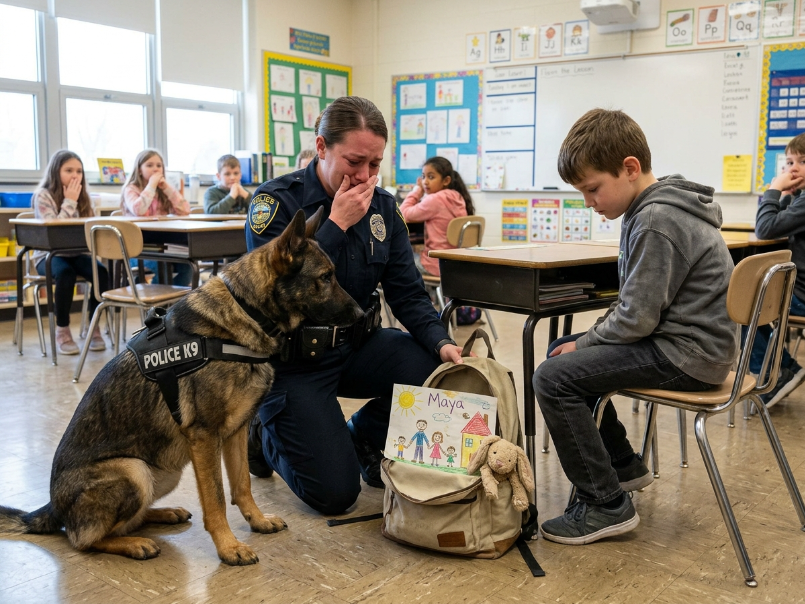
The problem was, he was looking at the wrong thing.
We were in the gymnasium of Oak Creek Middle School. It was supposed to be a routine “Red Ribbon Week” demonstration. A PR stunt. I plant a fake bag of narcotics (scent only, obviously) in a locker, Rex finds it, the kids cheer, and I give a speech about making good choices.
Simple.
But Rex had ignored the locker.
Instead, he had marched past the planted bait, dragged me across the polished hardwood floor, and sat down directly in front of a kid sitting on the bottom row of the bleachers.
The gym, which had been buzzing with the whispers of three hundred teenagers, went dead silent.
“Well,” Principal Vance boomed, his voice echoing off the high ceiling. He adjusted his tie, a smug look spreading across his face. “It seems we have a volunteer.”
I felt a knot tighten in my stomach. “Rex, heel,” I commanded, giving the leash a sharp, corrective tug.
Rex didn’t budge. He let out a low, high-pitched whine—a sound I’d never heard him make in the field. He wasn’t signaling aggression. He wasn’t signaling drugs. He was signaling… distress.
“Officer Harlin,” Vance said, stepping closer, his shoes squeaking loudly. “Your dog seems to have found something. I think we need to see what’s in that young man’s bag.”
I looked at the kid.
He couldn’t have been more than twelve. He was small for his age, drowning in a faded gray hoodie that had seen better days. His sneakers were held together with duct tape. He was pressing his backpack against his chest like a shield, his knuckles white.
His eyes were wide, terrified. And familiar. Not the boy himself, but the look. It was the look of someone who expects the world to hurt them.
“Stand up, son,” Vance ordered.
“Sir,” I interjected, stepping between the principal and the dog. “Rex might be confused. The acoustics in here, the smells of the lunchroom—”
“The dog isn’t confused, Officer,” Vance snapped, dropping his voice so only I could hear. “That’s Leo Miller. We’ve had reports of him dealing. His father is a junkie. The apple doesn’t fall far, does it?”
Vance turned back to the crowd, playing to the audience. “In this school, we have zero tolerance. Stand up, Leo. Empty the bag. Now.”
Leo stood up, his legs shaking so hard I thought he’d collapse.
“I… I didn’t do anything,” Leo whispered. His voice was brittle, like dry leaves.
“Then you have nothing to hide,” Vance said, reaching out to snatch the bag.
“Don’t!” I barked.
Vance froze.
“I’ll handle this,” I said, my voice low and dangerous. I crouched down, bringing myself to Leo’s eye level. I ignored the three hundred pairs of eyes drilling into my back. I ignored the principal’s huff of indignation.
I looked at Rex. The dog nudged Leo’s knee with his wet nose, then looked back at me, letting out that same heartbreaking whine.
“Leo,” I said softly. “My name is Mike. Rex here… he thinks you have something interesting. Do you have anything you shouldn’t have in there?”
Leo shook his head violently, tears finally spilling over his lashes. “Just my lunch. And… and my friend.”
“Your friend?”
“He means a toy,” Vance scoffed from above me. “He brings a filthy stuffed animal to school. The kid is disturbed.”
I ignored Vance. “Leo, I need to open the bag. Just to show them Rex made a mistake. Is that okay?”
Leo hesitated, then slowly, painfully, handed me the backpack.
It felt light. Too light for a school bag.
I unzipped the main compartment. It was mostly empty. A crushed juice box. A singular, spiraled notebook. And at the bottom, wrapped in a dirty t-shirt, was a lump of fabric.
I reached in.
The moment my fingers brushed the fabric, a scent hit me.
It wasn’t marijuana. It wasn’t cocaine. It wasn’t gunpowder.
It was a smell that stopped my heart cold in my chest.
Vanilla. And rain.
It was a specific, custom-blended laundry detergent my late wife used to buy from a boutique in town. She was obsessed with it. She washed everything in it. Especially her things.
My breath hitched. My vision tunneled.
I pulled the object out.
It was a stuffed rabbit. One ear was torn off. The pink fur was matted and gray with dirt. But around its neck, tied in a double knot, was a blue ribbon with tiny white stars.
The gym disappeared. The principal disappeared.
I was back in a hospital room five years ago, handing this exact rabbit to a seven-year-old girl with curly blonde hair.
“Daddy, look! I named him Jumper!”
My hands started to shake. Uncontrollably.
I turned the rabbit over. There, on the tag, faded almost to nothing but still legible if you knew what to look for, were three initials written in Sharpie.
S.H.
Sarah Harlin.
My daughter.
My daughter who had vanished from our front yard five years ago without a trace. The police had closed the case. My wife had died of a broken heart two years later. I was the only one left looking.
And here was her rabbit. In the backpack of a boy named Leo.
I looked up at Leo. The fear in his eyes had changed. He wasn’t looking at me like a cop anymore. He was looking at the rabbit.
“Where…” My voice cracked, a guttural sound that didn’t sound human. “Leo, where did you get this?”
Principal Vance stepped forward, impatient. “Well? Is it drugs? Officer Harlin!”
I stood up slowly, clutching the rabbit to my chest so hard I could feel the stuffing compress. I turned to Vance, and the look on my face must have been terrifying, because he took a step back.
“It’s not drugs,” I whispered.
I turned back to the boy. I grabbed his shoulders, maybe a little too hard. “Leo. Listen to me. This rabbit. Where did you get it?”
Leo trembled. He looked at the principal, then at the exit doors, then back at me. He leaned in, his voice barely a breath.
“She gave it to me,” he whispered.
My heart stopped. “Who? Who gave it to you?”
“The girl in the basement,” he said. “She said… she said her daddy would come if I showed this to the dog.”
Chapter 2: The Girl Who Forgot The Sun
The world didn’t stop just because mine had shattered. That was the cruelest part about being a cop. The gym was still loud with the murmurs of confused teenagers. Principal Vance was still standing over me, his polished shoes tapping impatiently on the hardwood, waiting for a drug bust that wasn’t happening.
“Officer Harlin,” Vance hissed, leaning down, his breath smelling of stale coffee and mints. “I asked you a question. Is it narcotics? Because if it is, I need to call the Superintendent before the press gets wind of this. And I need to call Mr. Miller to come collect his delinquent son.”
The mention of the father—Mr. Miller—sent a jolt of electricity through my spine that was so sharp it almost knocked the wind out of me.
The girl in the basement.
Leo’s words were bouncing around my skull like a pinball. She said her daddy would come.
If I let Vance call Leo’s father, if I let that man know we were onto him, Sarah was dead. If she wasn’t already.
I stood up, forcing my knees to lock. I had to bury the father—the grieving, broken man who wanted to scream—and become the officer. Cold. Calculated. Authority figure.
“It’s not drugs,” I said, my voice sounding distant, like I was speaking from underwater. I slipped the rabbit into my tactical vest, right against my heart. It burned there, a phantom limb I thought I’d lost forever. “It’s… paraphernalia. Evidence of a potential felony theft ring.”
Vance blinked. “Theft? A stuffed animal?”
“A marker,” I lied smoothly. The lie tasted like ash, but I needed to get Leo out of there. “Gangs use innocent items to mark territory or signal drops. I need to take the boy into custody for questioning. Immediately.”
“Custody?” Vance bristled, straightening his tie. “Now see here, Mike. You can’t just haul a student out without parental notification. I’ll call his father.”
“No!” The word came out too loud, a gunshot in the quiet gym.
Rex barked, sensing my spike in adrenaline. The students in the bleachers jumped.
I lowered my voice, stepping into Vance’s personal space. I used the physical intimidation I usually reserved for bar fights. “Principal Vance, this is an active investigation involving a multi-jurisdictional crime ring. If you make that call, you could be compromising a federal case. Do you want to be the reason a predator goes free? Do you want that on the six o’clock news?”
Vance paled. He was a bureaucrat. He feared bad PR more than he feared God.
“Fine,” he muttered, waving a dismissive hand at Leo. “Take him. He’s been nothing but trouble since he transferred here anyway. Just get him out the back so you don’t disrupt the assembly.”
I turned to Leo. The boy was shaking so hard his teeth were actually chattering, a tiny, rhythmic clicking sound that broke my heart. He looked at me with eyes that were too old for his face—eyes that had seen things no twelve-year-old should ever see.
“Let’s go, Leo,” I said softly.
I didn’t cuff him. I put a hand gently on his shoulder. He flinched at the touch, his whole body going rigid, expecting a blow.
“It’s okay,” I whispered, steering him toward the double doors of the fire exit. “I’ve got you. Nobody is going to hurt you.”
We walked out into the blinding afternoon sun. The air was crisp, typical for an October in Oregon, but I was sweating cold bullets.
I opened the back door of my K-9 unit. Usually, the cage is for perps. “Do you want to sit up front with me?” I asked.
Leo looked at the back seat, then at the front, then at Rex who had hopped into his kennel in the back.
“Can I… can I sit near the dog?” Leo asked, his voice barely audible over the hum of the distant traffic.
“Sure. You can sit in the back. Rex likes you.”
I watched him climb in. He didn’t slouch like a tough kid. He curled into himself, making himself as small as possible, hugging his backpack like a life raft.
I got into the driver’s seat and locked the doors. The silence in the car was heavy, suffocating. I gripped the steering wheel, my leather gloves creaking. I needed to drive. I needed to go. But I didn’t know where.
I pulled the rabbit out of my vest.
In the sunlight, it looked even worse. The fabric was worn thin from being rubbed. The “Jumper” I remembered was vibrant pink. This thing was gray, stained with grime, maybe even mold.
I brought it to my nose again. The scent was fading, overwhelmed by the smell of the boy’s backpack—old food, sweat, and damp earth. But the trace of vanilla was there. It was the scent of the last hug Sarah gave me before she ran out to play in the sprinklers.
“Daddy, watch me jump!”
I squeezed my eyes shut, fighting back the wave of nausea.
“Leo,” I said, looking at him through the rearview mirror.
He jumped, his eyes snapping to mine in the reflection.
“You said… the girl in the basement gave this to you.”
Leo nodded slowly.
“Is she…” I couldn’t finish the sentence. I swallowed a lump of razor blades. “Is she still there? Right now?”
“Yes,” Leo whispered.
“Where is ‘there’, Leo? Where do you live?”
“1402 Oakwood. The house with the blue tarps on the roof.”
Oakwood. That was the decaying edge of town. Old mill houses that had been rotting since the factory closed in the nineties. Meth country.
I started the car, peeling out of the school lot faster than I should have. I didn’t turn on the sirens. I couldn’t spook them.
“Leo,” I said, trying to keep my voice steady, trying not to sound like a desperate father. “Tell me about her. The girl.”
Leo looked down at his duct-taped sneakers. He picked at a loose thread on his jeans.
“She doesn’t talk much anymore,” he said.
My heart hammered against my ribs. “Anymore?”
“She used to,” Leo said, his voice taking on a strange, rhythmic quality, like he was reciting a story he’d told himself a thousand times in the dark. “When my dad first… when we first moved in. She used to cry a lot. She used to scream names. ‘Daddy’. ‘Mommy’. But the Bad Man…”
He stopped.
“Your dad?” I asked.
“No,” Leo said quickly. “Not my dad. My dad just… he just sleeps on the couch. He takes the medicine and sleeps. The Bad Man comes in the truck. He brings the food. He brings the… the stuff for my dad.”
“A dealer,” I murmured. “Who is the Bad Man, Leo? Do you know his name?”
“Uncle Ray,” Leo said. “But he’s not my uncle. He makes me call him that. He says if I tell anyone about the girl, he’ll put me in the hole with her. And he’ll never let me out.”
I merged onto the highway, my knuckles white. “You’re brave, Leo. You’re so brave for telling me.”
“I’m not brave,” Leo sniffled, wiping his nose on his sleeve. “She… she made me be brave. She got sick.”
I almost swerved into the other lane. “Sick? How sick?”
“She got hot. Really hot. And she wouldn’t wake up to eat. She just kept holding Jumper. She told me… two days ago, she woke up for a second. She pushed Jumper through the gap under the door. She said…”
Leo paused, choking back a sob.
“What did she say, son?”
“She said, ‘Jumper needs to find the policeman. Jumper remembers the way home. I don’t remember anymore.’”
I let out a sound that was half-sob, half-growl. She doesn’t remember. Five years. She was seven when she was taken. She’d be twelve now. A pre-teen. She’s grown up in a hole.
“She said if I saw a police dog, I had to give it to the dog,” Leo continued. “Because dogs are smarter than people. That’s what she said.”
Dogs are smarter than people. I used to tell her that. When I was training Rex as a puppy, Sarah would sit in the backyard and watch. I’d tell her, “Baby, people lie. People pretend. But a dog always tells you the truth.”
She remembered. Through the trauma, through the darkness, through five years of hell, she remembered my voice.
“We’re going to get her, Leo,” I vowed. “I promise you. On my life.”
I grabbed the radio. I needed backup. If this ‘Uncle Ray’ was there, or if the house was fortified, I couldn’t do this alone. But then I hesitated.
The department had given up on Sarah three years ago. The Captain had told me, gently but firmly, “Mike, you have to let go. The statistics… after 48 hours…”
If I called this in as a “possible sighting of Sarah Harlin,” they’d treat me like a hysteric. They’d send a patrol car to do a “welfare check.” They’d knock on the door. The Bad Man would smile, say everything is fine, and flush the evidence. Or worse.
I couldn’t risk the bureaucracy. I couldn’t risk a warrant taking four hours to sign.
Leo said she was sick. She wouldn’t wake up.
I clicked the radio off.
“Leo,” I asked, watching the scenery change from suburban lawns to overgrown yards and rusted chain-link fences. “Is your dad home now?”
“He’s always home. But he won’t wake up until night. Uncle Ray… he comes on Fridays.”
Today was Friday.
I checked my watch. 2:15 PM.
“What time does Ray come?”
“Before dinner. He brings pizza.”
We had time. Maybe.
“The basement,” I pressed. “How do you get in?”
“You can’t,” Leo said, looking at me with wide, hopeless eyes. “That’s why I’m scared. The door is metal. Ray has the key. My dad doesn’t even have it. There’s just a little slot at the bottom for the food trays.”
A metal door in a residential basement. A prison cell.
“Is there a window?”
“There’s one. But it’s bricked up. There’s just a tiny vent. That’s where we talk. In the backyard, behind the old shed. I lay on the ground and whisper into the pipe.”
“Okay,” I said, formulating a plan. “Okay.”
We turned onto Oakwood. The street lived up to its reputation. Abandoned cars on cinderblocks, stray dogs trotting across the cracked asphalt, houses that looked like they were exhaling their last breath.
House 1402 was at the end of a cul-de-sac. It was a small, ranch-style house painted a peeling yellow. The blue tarps Leo mentioned covered half the roof, flapping lazily in the wind. The windows were covered with tin foil.
It looked dead. But I knew, deep in my gut, that it was alive with secrets.
I parked the cruiser two houses down, behind a massive, overgrown hedge.
“Stay here,” I told Leo. “Lock the doors. Do not open them for anyone but me. If things go bad… if I don’t come back in ten minutes…”
I pulled my personal cell phone out and punched in a number. It wasn’t 911. It was Detective miller—no relation to Leo—my partner from the Major Crimes unit before I transferred to K-9. The only guy who never told me to “move on.”
“Voicemail,” I cursed.
“Mike,” I said to the recording. “I’m at 1402 Oakwood. I have a credible lead on Sarah. I’m going in. If I don’t check in by 14:45, bring the cavalry. And bring a bus [ambulance].”
I hung up and tossed the phone to Leo. “If that phone rings, you answer it. You tell Detective Miller exactly what you told me.”
Leo nodded, clutching the phone like a holy relic.
“Rex,” I commanded. “With me.”
I opened the back door. Rex bounded out, silent and focused. He knew. Dogs always know when the energy shifts from ‘training’ to ‘hunting’.
I checked my service weapon. Round in the chamber. Safety off.
I moved low, using the overgrown bushes as cover, approaching the house. The silence of the neighborhood was eerie. No birds. No lawnmowers. Just the wind and the blood rushing in my ears.
I bypassed the front door. Leo said the dad was on the couch, likely passed out, but I couldn’t risk a creaky floorboard alerting him. I needed to assess the basement first.
I circled around to the back. The yard was a landfill of trash bags, rusted bike parts, and knee-high weeds. And there, just like Leo said, was a rotting wooden shed.
Behind it, half-hidden by a thorny bush, was a PVC pipe sticking out of the ground. The vent.
I signaled Rex to stay guard. I dropped to my stomach in the mud, crawling through the thorns until my face was inches from the pipe.
It smelled of mildew and stale air.
“Sarah?” I whispered.
The name tasted foreign on my tongue. I hadn’t said it out loud, not directly to her, in five years.
Nothing. Just the sound of air moving.
“Sarah, baby. It’s Daddy.”
I pressed my ear to the cold plastic.
Silence.
Then, a sound so faint I thought I imagined it.
A cough. Wet, weak, and rattling.
“Sarah! Can you hear me?”
“Daddy?”
The voice was a ghost. It wasn’t the voice of the seven-year-old I lost. It was deeper, raspy, broken. But the cadence… the way the word lifted at the end…
Tears blinded me instantly. I bit my lip so hard I tasted copper.
“I’m here, baby. I’m right here. I’m going to get you out.”
“Daddy…” She sounded delirious. “I sent Jumper. Did Jumper make it?”
“He made it. He found me. He’s a good boy.”
“I’m tired, Daddy. The water is rising.”
My blood ran cold. The water is rising?
“What water, Sarah?”
“The pipe… it broke. It’s cold.”
I looked at the house foundation. There was an old hose bib right above where the basement layout would be. It was dripping. No, it wasn’t dripping. It was hissing.
“Sarah, listen to me. Stay awake. I’m coming in.”
I scrambled up. I didn’t care about stealth anymore. She was down there, sick, and apparently, the basement was flooding or leaking.
I ran to the back door of the house. Locked.
I kicked it. Once. Twice. The cheap wood splintered near the lock.
I burst into the kitchen. The smell hit me instantly—ammonia, rotting food, and unwashed bodies. The meth house perfume.
“Hey!” a voice croaked from the living room.
I swung my weapon up. A man was stumbling off the sofa, tangled in a dirty blanket. He was gaunt, eyes wild, skin covered in sores. Leo’s dad.
“Police! Get on the ground! Now!” I roared.
He blinked, swaying. “You can’t come in here. Ray said no cops.”
“Where is the key?” I advanced on him. “The key to the basement!”
“I don’t… I don’t have it,” he stammered, putting his hands up. “Ray has it. Ray is coming.”
“I don’t have time for Ray!”
I holstered my gun and grabbed the man by his greasy t-shirt, slamming him against the wall. “Is there another way down? Tell me!”
“No! It’s… it’s a reinforced door. Ray built it. Like a bunker.”
“Where is it?”
“Behind the fridge.”
I shoved him down. “Stay there. Rex, watch him!”
Rex planted himself in front of the man, baring teeth that could snap bone. The man froze, terrified.
I ran to the refrigerator. It was an old, heavy beast. I dug my fingers into the side and heaved. It groaned, scraping across the linoleum, revealing a heavy steel door set into the wall where a pantry should have been.
It had no handle. Just a deadbolt and a keypad.
Electronic.
“Code!” I screamed at the dad. “What’s the code?”
“I don’t know!” the man wailed. “I swear! He never tells me!”
I looked around the kitchen. My eyes landed on a heavy cast-iron skillet on the stove, and then a toolbox in the corner. A crowbar? No, not for a steel door.
I put my ear to the steel. I could hear the faint sound of running water now.
“Sarah!” I yelled, banging on the metal.
“Daddy…” Her voice was muffled, distant.
I needed to breach this door. But I didn’t have explosives. I didn’t have a battering ram.
Then I heard it. The sound of a heavy diesel engine pulling into the driveway. Tires crunching on gravel.
“Ray’s here,” the dad whispered, his face draining of what little color it had. “You’re dead. We’re both dead.”
I drew my weapon again. I looked at the steel door, then at the back door where Ray would likely enter.
I had a choice. Hold the position and wait for backup that might be twenty minutes out? Or ambush the monster coming through the door and pray he had the key on him?
I looked at the keypad. It was a four-digit code.
Think, Mike. Think like a predator.
Ray kept a girl for five years. He made Leo call him ‘Uncle’. He was possessive. Controlling.
Narcissists use dates.
“When is his birthday?” I asked the dad.
“I don’t know… July? August?”
Useless.
The truck door slammed outside. Heavy boots hit the porch steps.
“Leo!” A deep, gravelly voice boomed from outside. “Come help me with the groceries, boy!”
He didn’t know I was here. He didn’t know Leo was safe in my car.
I moved to the side of the kitchen entrance, pressing my back against the wall. I signaled Rex to stay silent. The dog lowered his body, ready to spring.
The back door handle turned.
“Leo? Why is the door unlocked?”
The door swung open.
A giant of a man stepped in. He was holding two pizza boxes. He had to duck to clear the doorframe. He looked like a bear that walked on two legs.
He saw the dad on the floor. He saw the moved fridge.
He dropped the pizzas. His hand went to his belt. A gun.
“Drop it!” I screamed, stepping out, my weapon leveled at his chest.
Ray didn’t freeze. He didn’t panic. He smiled. A cold, dead smile that chilled my marrow.
“Well,” Ray said, his hand hovering over his pistol. “Looks like Jumper finally made a friend.”
He knew. He knew about the rabbit.
“Hands where I can see them!” I yelled. “On your knees!”
“Or what?” Ray chuckled. “You shoot me? You kill me, Officer? You do that, and you’ll never get the code. And that little girl… she’s got maybe an hour before the water hits the electrical box down there. Fried or drowned. Her choice.”
My finger tightened on the trigger. He was baiting me.
“Give me the code,” I said, my voice shaking with rage.
“No,” Ray said.
And then he moved. Not for his gun, but for a small remote on his keychain.
He pressed a button.
A loud CLANK echoed from the steel door. Not the sound of it opening.
The sound of additional deadbolts engaging.
“Hard lockdown,” Ray grinned. “Timer set. 60 minutes. Or until I put in the override.”
He raised his hands slowly, mockingly.
“So, Officer. You want to negotiate? Or do you want to watch the clock run out?”
I stared at him. I had the gun. I had the badge. But he held the only life that mattered in the palm of his hand.
And outside, the sun began to set, casting long, bloody shadows across the kitchen floor.
Chapter 3: The Monster in the Kitchen
The air in the kitchen was thick enough to choke on. It smelled of pepperoni pizza, old sweat, and the metallic tang of imminent violence.
“Sixty minutes,” Ray repeated, his voice a low rumble that vibrated through the floorboards. He tossed the remote onto the linoleum, then crushed it under his heavy boot. Plastic crunched. The circuit board shattered. “Oops. Guess we’re doing this the hard way.”
I didn’t blink. I kept my Glock trained on the center of his chest. “Get on your knees, Ray. I won’t ask again.”
Ray didn’t kneel. He took a step forward. He was massive—at least six-four, built like a linebacker who had gone to seed but kept all the power. His eyes were devoid of light. They were flat, black shark eyes.
“You’re not going to shoot me,” Ray said, wiping a smear of grease from his chin. “You’re a cop. You play by rules. You need me alive to open that door. And you know it.”
He was right. And he was banking everything on it.
From behind the heavy steel door, the sound of water had changed. It wasn’t just a hiss anymore. It was a splash. A gurgle.
“Daddy!” Sarah’s voice came through, muffled but rising in panic. “Daddy, it’s cold! It’s up to my knees!”
The sound of her terror tore through my discipline like a bullet. My hand wavered.
“Tick tock,” Ray grinned.
“Rex,” I whispered. “Guard.”
Rex growled, a low, menacing sound from deep in his throat. He was crouched low, eyes locked on Ray’s jugular.
“Cute dog,” Ray sneered. “I had a dog once. Too noisy.”
Then, Ray moved.
For a big man, he was terrifyingly fast. He didn’t lunge at me. He kicked the kitchen table, sending it skidding across the room, slamming into my legs.
I stumbled back, my shot going wide, blowing a hole in the ceiling plaster.
“No!” I roared.
Ray was on me before I could recover. He didn’t go for the gun. He went for my head. His fist, the size of a sledgehammer, connected with my jaw.
Lights exploded behind my eyes. I tasted blood instantly. The gun flew from my hand, skittering across the floor and sliding under the stove.
“Rex! Attack!” I screamed, spitting blood.
Rex launched himself into the air, a sixty-pound missile of fur and teeth. He latched onto Ray’s forearm, jaws clamping down with bone-crushing force.
Ray howled, but he didn’t go down. He was on something—PCP, meth, adrenaline—he didn’t feel pain like a normal human. He swung his arm, lifting Rex entirely off the ground, and slammed the dog into the refrigerator.
THUD.
Rex yelped—a sharp, high sound that cut me to the bone—and slumped to the floor, dazed.
“Stupid mutt,” Ray grunted, shaking his bleeding arm. He turned back to me.
I was already moving. I tackled him around the waist, driving him back into the counter. It was like hitting a brick wall. We crashed to the floor, a tangle of limbs and rage.
This wasn’t a police arrest. This was a father fighting for his child. I gouged at his eyes, I struck his throat. I wanted to kill him. I wanted to tear him apart.
But Ray was stronger. He flipped me over, pinning me with his massive weight. His hands, thick and calloused, wrapped around my throat.
“You should have stayed at the school,” Ray wheezed, his face inches from mine. His breath reeked of rot. “You could have lived a nice, sad life. Now? You get to listen to her drown while I squeeze the life out of you.”
My vision started to spot with black dots. I clawed at his hands, but his grip was iron. I couldn’t breathe. I couldn’t speak.
I looked to the side. Rex was trying to stand, his back legs wobbling.
I looked at the steel door. The water was louder now.
I failed her. The thought drifted through my hypoxia-starved brain. I found her, and I failed her again.
Suddenly, the back door—the one Ray had left open—slammed against the wall.
“Hey!” a voice screamed. A child’s voice. High and terrified, but fierce.
Ray’s head snapped up. I used the split second of distraction to jam my thumb into the pressure point under his jaw.
Ray roared and loosened his grip. I bucked my hips, throwing him off.
I scrambled back, gasping for air, coughing violently.
Standing in the doorway was Leo.
He held my partner’s heavy Maglite flashlight in both hands like a baseball bat. He was trembling, tears streaming down his face, but he wasn’t running.
“Leo, run!” I rasped.
“No!” Leo yelled. He looked at Ray, then at the steel door. “Let her out!”
Ray laughed, a wet, bubbling sound. He stood up slowly, wiping blood from his neck. He looked at Leo like a wolf looks at a rabbit that forgot to run.
“Well, well,” Ray sneered, stepping over Leo’s dad, who was still cowering in the corner. “The little mute speaks. You want to join her, Leo? There’s room in the hole.”
Ray took a step toward the boy.
“Leo, get back!” I yelled, trying to find my footing. My head was spinning.
Leo didn’t back up. He reached into his pocket.
He pulled out the cell phone I had given him.
“I called him,” Leo said, his voice shaking. “I called Detective Miller. He’s listening. Right now.”
Ray froze.
“He heard everything,” Leo said, holding the phone out. “The sirens are coming, Uncle Ray. Can’t you hear them?”
Ray cocked his head. In the distance, faint but growing louder, was the wail of approaching sirens.
Ray’s face twisted in pure, animalistic fury. The game was over. Now, he just wanted to destroy the board.
He lunged for Leo.
“Rex!” I screamed with the last of my air.
My dog, my battered, brave partner, didn’t hesitate. Despite the concussion, despite the pain, Rex sprang. He didn’t go for the arm this time. He went for the leg. He bit into Ray’s calf and twisted.
Ray screamed as his tendon tore. He buckled, falling to one knee.
I didn’t waste the opening.
I grabbed the cast-iron skillet from the stove—the one I had spotted earlier. I swung it with every ounce of strength I had left.
CLANG.
Iron met skull.
Ray collapsed face-first onto the linoleum and didn’t move.
I dropped the skillet, my chest heaving. I fell to my knees next to Ray, patting him down frantically. Pockets. Belt. Boots.
Nothing. No key. No backup remote.
“The code,” I panicked. I grabbed Ray’s unconscious head and shook him. “Wake up! What’s the code!”
He was out cold.
I looked at the keypad on the wall. Four digits. Ten thousand combinations.
“Daddy!” Sarah’s voice was a gurgle now. “The water… it’s at the light!”
“Sarah!” I screamed, crawling to the door. I pounded on the steel. “Hold on! Climb on something! Climb on the shelves!”
“There are no shelves,” she sobbed.
I looked around the kitchen, desperate. The crowbar? No time. The gun? Shooting the lock wouldn’t work on a mechanism like this; it might jam it permanently.
“Leo!” I turned to the boy. “Think! You lived here. You watched him. Did you ever see him type it in?”
Leo shook his head, sobbing. “He always made me turn around. He said… he said it was a secret for the special ones.”
“Think!” I grabbed Leo’s shoulders. “Does he have a favorite number? A birthday? The address?”
“I don’t know!” Leo cried. “He hates birthdays!”
I looked at the keypad. The red light blinked mockingly.
Wait.
“He’s a narcissist,” I muttered to myself. “He keeps trophies.”
I looked at Ray’s wrist. No watch. I looked at the walls. No calendar.
Then, I looked at Leo.
“Leo,” I said, my voice eerily calm. “Why did he let you live upstairs? Why weren’t you in the hole?”
“Because… because I’m quiet,” Leo stammered. “And because… I look like his brother.”
“His brother?”
“He has a picture. In his wallet. A little boy.”
I ripped Ray’s wallet out of his back pocket. I tore it open. There, behind a cracked plastic sleeve, was a black-and-white photo of two young boys standing in front of a car. On the back, written in faded ink: Ray and Benny, 1982.
“Benny died,” Leo whispered. “He told me Benny drowned.”
Drowned.
The water in the basement. The method of torture. It wasn’t random. He was recreating his trauma.
“When did Benny die?” I asked, scanning the wallet. No other dates.
“I don’t know,” Leo wailed. “Please, the water!”
I slammed my fist against the wall. I was going to lose her. I was two feet away, and I was going to lose her.
“Wait,” Leo said, his eyes widening. He pointed at the fridge.
Held up by a dirty magnet was a chore chart. It was bizarrely domestic for a house of horrors. But at the bottom, written in red marker, was a series of numbers.
7 – 5 – 1 – 2
“What is that?” I asked.
“That’s the wifi,” Leo said. “He changed it last week.”
“Why those numbers?”
Leo paused. “That’s… that’s the day you came to the school. Five years ago. With the dogs.”
I froze.
“What?”
“July 5th, 2012,” Leo said. “7-5-1-2. That was the day he saw you on TV. The day you got an award for the K-9 unit. He talked about it. He said… he said he wanted to steal something from the hero.”
My blood turned to ice. It wasn’t about Sarah. It was about me. He took her because of me.
I scrambled to the keypad. My fingers were shaking so hard I could barely aim.
7.
5.
1.
2.
BEEP.
A green light flashed.
The heavy clank of deadbolts retracting echoed like a gunshot.
I grabbed the handle and wrenched the door open.
A wave of cold, black water surged out, hitting me in the chest, knocking me backward. It smelled of sewage and death.
“Sarah!” I screamed into the darkness.
The water poured into the kitchen, swirling around the unconscious body of the monster and the shoes of the boy who saved us.
But from the black hole of the basement… there was no sound.
“Sarah!”
I didn’t wait. I took a breath and dove into the flooded dark.
Chapter 4: The Long Way Home
The darkness under the water wasn’t empty. It was crowded with the debris of a stolen childhood.
My hands thrashed through the freezing, murky liquid, brushing against things that shouldn’t have been there. A floating plastic chair. A soggy mattress. A bucket. Every object felt like a body, and every second felt like a decade.
The water was rising fast, churning against the ceiling of the small, concrete bunker. The air pocket was gone.
“Sarah!” I screamed underwater, expelling precious oxygen. The sound was a dull roar in my own ears.
My flashlight beam cut through the silt, a frantic saber of light in the gloom. It caught a glimpse of something pale near the corner, wedged behind a floating wooden crate.
Hair. Long, tangled hair floating like seaweed.
I kicked hard, my boots heavy as lead anchors, propelling myself toward her. I grabbed her arm. It was limp. It was cold. Too cold.
I pulled her toward me, wrapping my arm around her waist. She was so small. My god, she was so light. Five years of malnutrition had left her fragile as a bird.
I turned and kicked toward the faint rectangle of light that was the door. The current of the incoming water fought me, pushing us back, but I didn’t care. I kicked with the strength of a man possessed. I would have drained this basement with my own lungs if I had to.
We broke the surface in the kitchen, gasping—or rather, I gasped.
Sarah didn’t make a sound.
I dragged her onto the linoleum, slipping in the mud and water that now covered the floor. I laid her down next to where Ray was still unconscious, face down in a pool of black sludge.
“No, no, no,” I begged, ripping the wet hair from her face.
Her skin was blue. Her lips were gray. Her eyes were closed.
“Rex! Back!” I shouted as the dog tried to lick her face, whining high and sharp.
I tilted her head back. I pinched her nose. I covered her mouth with mine and breathed.
One breath. Two breaths.
Her chest rose and fell with my air, but there was no resistance. No life.
I interlaced my fingers and placed the heel of my hand on her sternum.
One, two, three, four.
“Come on, Sarah,” I grunted, pumping hard. “Don’t you do this to me. Not now. Not when I finally found you.”
Five, six, seven, eight.
I heard a rib crack. I flinched, but I didn’t stop. You can heal a broken rib. You can’t heal death.
“Breathe!” I screamed at her, tears dripping off my nose onto her wet shirt. “Sarah, breathe!”
I breathed into her again. I tasted the basement water on her lips—the taste of mold and despair.
I went back to compressions. My arms burned. My vision blurred.
“Officer!” A voice shouted from the living room.
Detectives were swarming in. Blue uniforms. Guns drawn.
“Get a medic!” I roared without looking up, not breaking my rhythm. “Medic! Now!”
“Mike, let us…” Someone tried to pull me away. It was Miller.
“Don’t touch me!” I snarled, shoving him back with my shoulder. “I’ve got her. I’ve got her.”
One, two, three, four.
I was losing her. I could feel it. The tether that connected her soul to this earth was snapping, thread by thread.
“Please,” I whispered, my voice breaking into a sob. “Please, God. Take me. Take me instead. Just give her back.”
And then, a spasm.
Her body jolted under my hands.
A retch.
I rolled her onto her side just as water erupted from her lungs. She coughed—a terrible, hacking, violent sound—but it was the most beautiful music I had ever heard.
She gasped, sucking in air with a desperate, hungry wheeze. She started to cry, a weak, high-pitched keening noise.
I scooped her up. I didn’t care about protocol. I didn’t care about spinal precautions. I pulled her wet, shivering body against my chest and buried my face in her neck. I rocked her back and forth on the kitchen floor, sobbing uncontrollably.
“I’ve got you,” I cried. “Daddy’s here. I’ve got you.”
Miller was shouting orders. “Secure the suspect! Get the EMTs in here! Someone get a blanket for the boy!”
The boy.
I looked up through my tears. Leo was standing by the refrigerator, soaked to the bone from the splash, clutching the Maglite. He was watching us, his eyes wide and unblinking. He looked terrified, but he also looked… relieved.
“Leo,” I choked out.
Leo dropped the flashlight. He walked over, his sneakers squishing in the mud. He reached out a trembling hand and touched Sarah’s shoulder.
Sarah flinched, burying her face deeper into my vest.
“It’s okay,” Leo whispered to her. “The dog came. The dog came like you said.”
Rex, sensing the shift in energy, crawled forward on his belly. He didn’t bark. He simply laid his head on Sarah’s leg and let out a long, heavy sigh.
Sarah froze. Then, slowly, her hand uncurled from my shirt. Her fingers, pale and wrinkled from the water, reached down and buried themselves in Rex’s fur.
“Jumper…” she rasped, her voice barely a whisper.
“Yeah, baby,” I wept, kissing the top of her head. “Jumper brought us home.”
The hospital waiting room was a different kind of purgatory. It was bright, sterile, and smelled of floor wax and old coffee.
It had been six hours.
They had taken Sarah to the ICU. Hypothermia. Pneumonia. Malnutrition. Severe dehydration. The list of medical terms the doctor had thrown at me felt like a sentencing hearing. But the one word that mattered was stable.
I sat in the plastic chair, still wearing my wet uniform, smelling like swamp water. I refused to leave. The nurses had tried to make me shower, but I wouldn’t go further than the restroom to wash the mud off my hands.
I couldn’t be more than fifty feet away from her. Not again.
Rex was in the K-9 unit car outside, under the care of a patrol officer. I had promised him a steak the size of a hubcap.
“Mike.”
I looked up. Detective Miller was standing there, holding two cups of coffee. He looked exhausted.
“How is she?” he asked, sitting down next to me.
“Sleeping,” I said, taking the coffee. My hands were still shaking. “They have her sedated. She… she has a lot of healing to do, Miller. Physically. Mentally.”
“She’s alive,” Miller said firmly. “That’s the win. Don’t lose sight of that.”
I nodded, staring into the black coffee. “Ray?”
“In custody. He’s at the county hospital under heavy guard. Concussion, broken leg, ruptured tendon. He’ll live long enough to die in prison. We found the room, Mike. It’s… it’s bad. Pictures. Trophies. He’s been doing this a long time. Sarah wasn’t the first.”
I closed my eyes, fighting the urge to vomit. “And Leo?”
Miller sighed, rubbing the back of his neck. “That’s the complicated part. CPS is involved. His dad… well, Mr. Miller is currently in detox, but he’s facing charges for child endangerment and aiding a felon. He knew, Mike. He knew Ray had a girl down there. Ray was paying him in product.”
“So where is Leo?” I asked, sitting up straighter.
“Emergency foster placement. He’s downstairs in the social worker’s office right now. They’re looking for a bed, but the system is overloaded. He’ll probably end up in a group home tonight.”
“No,” I said.
Miller looked at me. “Mike…”
“No group home,” I said, standing up. “He saved my daughter’s life. He stood in front of a monster with a flashlight. He’s the reason I found the code.”
“You can’t just take him, Mike. There are protocols. You’re a single male, heavily traumatized, currently involved in a major investigation—”
“I don’t care,” I interrupted. “Pull strings. Call the judge. You know Judge Halloway owes me a favor for that arson case last year. Emergency kinship placement. I’m ‘kin’ enough.”
“Mike, are you sure? You’re going to be dealing with Sarah’s recovery. Can you handle a twelve-year-old boy who just came out of a meth house?”
I thought about Leo. I thought about him sitting in the back of my cruiser, asking if he could sit near the dog. I thought about the way he looked at Sarah—not with curiosity, but with a shared, silent language of survival.
“Sarah is going to need someone who understands,” I said. “I can be her dad. I can protect her. But I can’t understand what it was like in that house. Leo does. They need each other.”
Miller stared at me for a long moment, then cracked a small smile. “I’ll call the judge.”
Three Months Later.
The rain in Oregon never really stops, it just takes breaks. Today was one of those breaks. The sun was filtering through the Douglas firs in my backyard, casting long, golden beams across the wet grass.
I sat on the porch steps, a mug of tea in my hand.
The house was different now. It used to be a mausoleum—a quiet, dusty shrine to a life I lost. Now, it was loud. It was messy. There were shoes by the door that didn’t belong to me.
In the yard, Rex was chasing a tennis ball. He was moving a little slower these days—the injury from the fridge had left him with a slight limp—but he was happy.
And he wasn’t alone.
Sarah was sitting on the grass, wrapped in a thick wool blanket. Her hair had been cut short to remove the mats, framing her face in a pixie cut that made her eyes look enormous. She still didn’t talk much to adults. She flinched at loud noises. She had nightmares that woke the whole house up at 3 AM.
But right now, she was smiling.
Leo was standing a few feet away, holding the slimy tennis ball. He had filled out in three months. The dark circles under his eyes were fading. He was wearing jeans that actually fit and a hoodie that didn’t smell like smoke.
“Throw it, Leo!” Sarah called out. Her voice was scratchy, but strong.
Leo wound up and threw the ball. It was a terrible throw, wobbling through the air, but Rex treated it like a major league pitch. He bounded after it, snatching it from the air.
Leo laughed. It was a rusty sound, like an engine that hadn’t been turned over in years, but it was getting smoother every day.
Rex trotted back, but he didn’t give the ball to Leo. He walked over to Sarah and dropped the slobbery ball in her lap.
“Ew, Rex!” she giggled, wiping her hands on the blanket.
I watched them, a lump forming in my throat.
They were broken, all of them. Sarah, with her stolen years. Leo, with his shattered trust. Rex, with his battle scars. And me, with my guilt that would probably never fully go away.
But we were a pack.
I heard the sliding glass door open behind me.
“Hey,” Leo said. He was standing there, looking a bit sheepish. “Are we still doing pizza tonight?”
I smiled. “Yeah, Leo. But no anchovies this time.”
“Sarah likes them,” he defended, grinning.
“Sarah has questionable taste,” I teased. “Hey, Leo?”
“Yeah?”
“Come here a sec.”
He walked over and sat on the step next to me. He still had that habit of making himself small, of not taking up too much space.
I reached into my pocket and pulled out a small, velvet box.
“I found something,” I said. “When they were cleaning out… the evidence. They gave this back to me.”
I opened the box. inside was a silver charm bracelet. It was tarnished, and missing a few links, but the charms were there. A ballet slipper. A heart. And a tiny silver dog.
“This was hers,” I said. “Before.”
I looked out at Sarah, who was currently trying to teach Rex to shake hands.
“I think you should give it to her,” I said, handing the box to Leo.
Leo looked at the box, then at me. “Why me? You’re her dad.”
“Because,” I said, putting a hand on his shoulder. “You’re the one who heard her when no one else did. You’re the one who brought her back.”
Leo took the box. He ran his thumb over the velvet.
“Mike?” he asked quietly.
“Yeah?”
“Do you think… do you think the bad dreams ever go away?”
I looked at my daughter. I looked at the boy who saved her. I looked at the dog who sniffed out the truth when the whole world was blind.
“I don’t know, kid,” I said honestly. “Maybe not completely. But I think they get quieter. Especially when you don’t have to sleep in the dark anymore.”
Leo nodded. He stood up and walked into the yard.
“Sarah!” he called out. “I got something for you.”
I watched as he sat down next to her. I watched as she opened the box. I saw the way her face lit up, not with the manic joy of a child, but with the deep, quiet peace of someone who has found a lost piece of themselves.
She put the bracelet on. She hugged Leo. Then, she leaned over and wrapped her arms around Rex’s neck, burying her face in his fur.
I took a sip of my tea. It had gone cold, but I didn’t mind.
People always told me to trust the dog. They said the dog is never wrong.
They were right.
Rex hadn’t signaled drugs that day. He hadn’t signaled danger.
He had signaled family.
And for the first time in five years, as the sun dipped below the tree line and the porch lights flickered on, I finally felt like I was home.